Few musical moments are more evocative in opera than the opening of Aida‘s Third Act. The delicate music paints the swaying of the Nile, its gentle waves adorned in sparkles of moonlight. The Nile Scene showcases “O patria mia”, the musical heart of Aida-the-character longing for her home country by the lilting waves, then later, in undulous phrases, seducing Radames to reveal the biggest state secret. The Nile is essential to this opera. It is there on those seductive banks, in the mystery of night where the infatuated Radamès’s choice to betray his country seals both his and Aida’s fates. An Aida without the Nile feels unnerving, to say the least, and every production I’ve seen in my life had at least some semblance of a body of water in that scene. Instead, in his new production, Michael Mayer chooses to keep us in the realms of catacombs and temple flames, depriving the audience of the Nile’s “presence” that in the former, 36-year-old production by Sonja Frisell always proved visually enchanting.
I understand that this was supposed to be an updated Aida. But if you’re going to take the Nile out, at least make some radical updates to the whole opera. What we get is a relatively traditional ancient-Egypt-evoking set by Christine Jones and glittery costumes by Susan Hilferty, and a relatively static delivery by the singers, downstage—which has its own advantages in that little distracts from the singing and music. The elements that do distract are precisely the so-called updates consisting of archaeologists appearing at various points in the opera to demonstrate that they are somehow imagining this story, in their coveting Western minds. In fact, the opera begins with an archaeologist coming down a rope, and eventually triggering the plot to come to life.
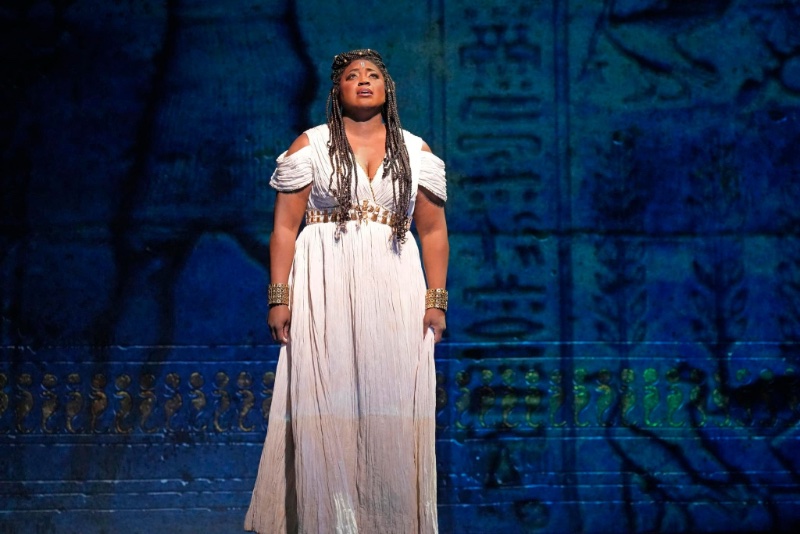
Angel Blue as Aida (Photo: Ken Howard / Met Opera)
Fortunately, there weren’t too many instances of these “intruders” appearing throughout the performance. The absolute worst was during the Triumphal March when they were the ones carrying out the loot that the Egyptian soldiers were supposed to have brought back from Ethiopia. Combined with the awful, clunky dance sequence by male dancers choreographed by Oleg Glushkov, the Triumphal March scene proved the most jarring of them all. No wonder that, in an otherwise sensitive, generous, and well-paced approach to the music, Maestro Nézet-Séguin conducted this particular scene faster than I’d ever heard it conducted, as though he were running for his life from what he was seeing onstage, and just wished it were over. Another instance of an equally terrible—and somewhat creepy—choreographed sequence took place at the end of Act 1 when priests were lifting up children dressed as little priests to consecrate Radamès to the service of Ptah. Why was this necessary?
However, take away the updates and the choreography, and you’ve got a standard staging of Aida—minus, of course, the Nile—plus a wonderful opportunity to revel in the voices of its cast. Having missed an opening night fraught with vocal difficulties for the tenor, I had the good fortune of hearing his replacement, SeokJong Baek, a total musical treat. In a creamy, sunshine-filled voice inflected with emotion and ardor, Baek offered the audience a beautifully sung, youthful, impassioned, and moving Radamès, more on the sweet than the heroic side. His “Celeste Aida” flowed with elegance and control, creating a dreamy musical mood with each ascending phrase. There was just a touch of sliding on his final note, but he recovered in an infinitesimal fragment of a second and closed it brilliantly. After he surpassed the test of the beginning aria, his voice bloomed with more and more abandon and zest. In the Nile Scene duet with Aida, and the subsequent “Io son disonorato” trio with Amonasro, Baek conveyed tenderness and anguish in a sound that retained a bel canto polish. He navigated well through “Sovra una terra estrania teco fuggir dovrei!” that might sometimes come out strained. The final duet “La fatal pietra… O terra, addio” was truly exquisite, a singing lesson in legato and dynamics, infused with profound emotion. When he sang “Tu… in questa tomba,” he had that pure “lagrima nella voce” quality—and this wasn’t the only instance of it in his performance.
Baek’s outstanding singing seemed to also inspire Angel Blue. She was at her best in the duets with the tenor. Blue possesses a distinctive voice and can create moments of beauty and feeling… when she allows herself to do so. Often, it seemed that she was too preoccupied by the tempi to let us revel in her sounds. Some of her phrasing did not unfold as generously as one would expect of a great Aida. To give just one example, when she sang “In estasi beate la terra scorderem” she didn’t allow the potential thrilling wave of that phrase to flourish as it could have. To a listener who has heard some magnificent Aidas, this was a tease of what could be delivered and was not. And there were other such instances in which one would have needed just a bit extra bounteousness of phrasing from her. “O patria mia” started out promising, rich in nuances, yet the final pianissimo disappointed in that it was cut too abruptly. Blue gave more in the duet with Amonasro; her delivery of “O patria quanto mi costi” shimmered, heartfelt and stirring, her most moving moment of the night. But she lacks a certain heft in the middle and lower parts of her voice, a thicker vocal substance that an Aida singer needs and can use to great advantage in this role. Overall, hers was an on-and-off performance. At times, her singing sounded really “on” and committed, and one could relish those sounds. Then the delivery would turn bland and prove simply inadequate for this type of role.
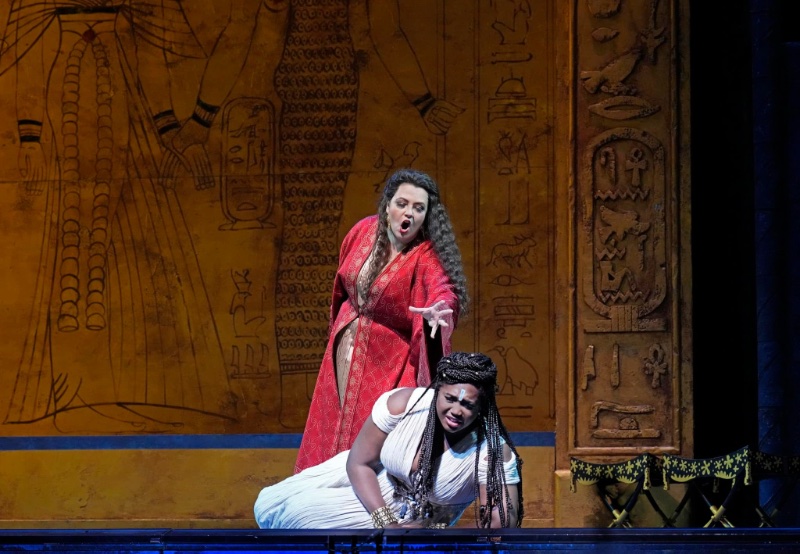
Judit Kutasi as Amneris and Angel Blue as Aida (Photo: Ken Howard / Met Opera)
A similar on-and-off, interrupting sensation came from Judit Kutasi who sang Amneris. Her singing was puzzling. The voice is undoubtedly there, a big, gorgeous instrument that can convey top quality and presence in moments. But then it is as though she interferes and interrupts the flow or the blossoming of her phrases with hooded, muffled effects that snap one out of the enjoyment promised at the start of those phrases. Because of those effects her diction became muddled, so the singing often sounded like gargling or wavered about in wobbles. Kutasi sang her best in the duet with Aida where she seemed to control the chaotic tendencies of her singing and focus her voice in delivering commanding, mesmerizing phrases as she menaced Aida. Due to this tendency to swallow her sound and interrupt the flowering of her phrases, she was often overpowered by the orchestra in her big confrontation scene with the priests. The most frustrating aspect of Kutasi’s performance is that it isn’t for lack of a voice that she didn’t create a memorable Amneris; it is rather her approach and some inexplicable vocal habits that undermine what she might really deliver.
Quinn Kelsey made for a determined, sometimes harsh Amonasro, also fully capable of vocal tenderness and warm Verdian phrases in his duet with Aida. Morris Robinson, who took over for Dmitry Belosselskiy as Ramfis, resounded steady and imposing. As the King, initially sung by Robinson, Harold Wilson displayed a gleaming voice and liquid phrasing. The offstage Priestess, Amanda Batista, offered one of the most captivating moments of the night in limpid, graceful tones and sweet articulation.
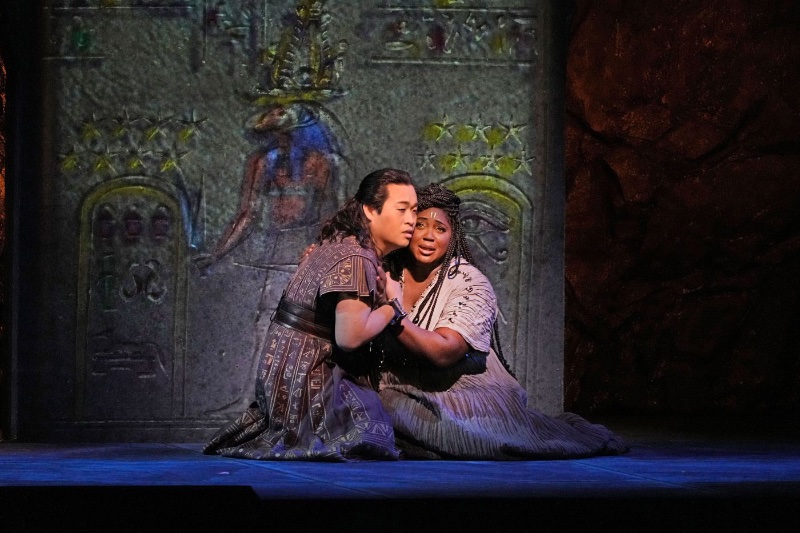
SeokJong Baek as Radamès and Angel Blue as Aida (Photo: Ken Howard / Met Opera)
As always, the chorus, still under the direction of Donald Palumbo, proved their mastery of vocal textures, unity, and dynamics. And the orchestra’s brilliant players followed Nézet-Séguin’s thoughtful direction and, for the most part, supported the singers.
SeokJong Baek sang the role of Radamès in only two performances: on January 4 and 7, a delightful surprise gift to the public. It is assumed that Piotr Beczala will resume the role on January 10.
As for this production, I truly believe that the director was in denial when he removed the Nile… and yes, that is a lame play on words. But if the gods of directing hear me, in the future let someone give us an Aida on Mars or anywhere where it implies a radical change of perspective, sets, and costumes, and then I won’t complain about the Nile’s absence. But if you’re going to give us a more-or-less standard Aida, please never ever deny us the Nile.
Verdi’s Aida at the Metropolitan Opera runs through January 25, and resumes March 14-29, and April 27-May 9 with several new cast members.
Top photo: Triumphal March Scene in Aida – Photo: Ken Howard / Met Opera