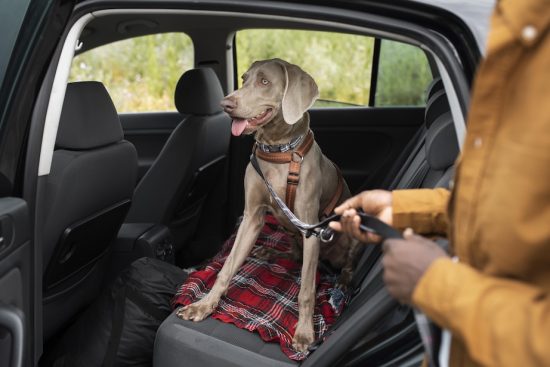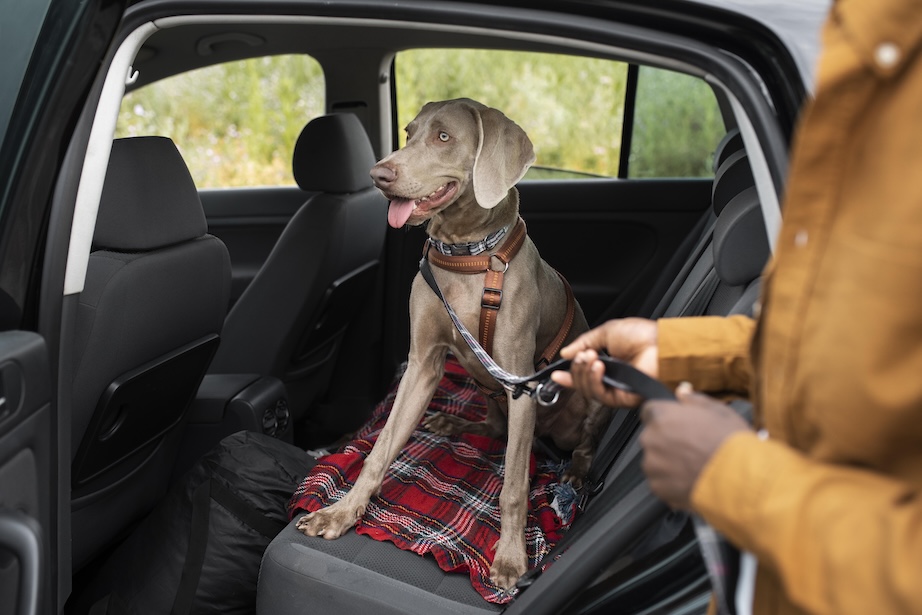
A dog seat belt is a short, adjustable tether. One end clicks into the buckle receiver already built into your back seat, and the other end clips to your dog’s harness, so your passenger can sit and lie down comfortably but can’t roam the cabin or climb into your lap.
That’s the whole idea, and it takes about ten seconds to use once it’s set up. What trips people up is everything around it: which kind to buy, how short to set it, and how to convince the dog this is fine. So let’s walk through it.
How Does It Actually Work?
Think of it as a bridge between two anchor points. The car-side end has a metal tongue shaped like the one on your own belt, so it clicks straight into the receiver in the back seat. No installation, no adapters in most cars.
The dog-side end has a clip like the one on a leash, and between the two runs an adjustable strap. You set the length once: enough slack to sit, turn around, and lie down, not enough to reach the front seats or hang out the window.
The dog gets a defined spot. You get a drive without a nose appearing over your shoulder at highway speed.
Why Bother, Especially for Short Trips?
Restraining a dog in the car sounds like an “on long road trips” thing until you think about how everyday driving actually goes.
An unrestrained dog can wander between seats, block your mirror, or land in your lap because a squirrel exists somewhere. In a sudden stop, they keep moving at whatever speed the car was doing, and in the chaos after any incident, an open door means a scared dog loose in traffic.
A tether solves all three quietly. It also settles most dogs faster than a wide-open bench does, because a defined spot, ideally with a familiar blanket or bed on it, reads as “your place” rather than “the waiting area.” Several countries and a number of US states already treat restraint as a legal requirement or a distracted-driving issue, but honestly, the daily calm is reason enough.
What Should You Look For When Buying?
The checklist is short. A good one gets these five things right:
| What to check | Why it matters |
|---|---|
| Standard buckle-receiver tongue | Fits most cars, SUVs and crossovers without adapters |
| Clips to a harness, never a collar | Any force spreads across the chest, not the neck |
| Durable, non-fraying webbing | Survives being clipped and unclipped every day |
| Rust-resistant, smooth hardware | Clicks in one-handed and stays put |
| A fabric and color you actually like | The gear you like is the gear you use |
That last row sounds cosmetic, but it decides everything. A stiff, scratchy strap in a color you hate migrates to the trunk within a month. If you want to see what checking every box looks like, browse a dog seat belt from Le Noof, which makes them in the same fabrics as its harnesses and leashes so the set matches rather than clashes. Use it as a comparison point even if you buy elsewhere.
How Short Should the Strap Be?
Shorter than instinct tells you. Your dog should manage a comfortable sit and a full lie-down, and very little else.
Extra slack feels generous, but it undoes the whole arrangement: the dog can reach the front, tangle in the strap, or build up momentum in a hard stop. Set it snug, watch one drive, and lengthen only if the dog genuinely can’t settle.
For small dogs and puppies, pair the tether with a bolstered car bed. They stay contained, they can see out the window, and seeing out cuts down on motion sickness for a lot of dogs.
Collar or Harness?
Harness, every time, and this is the one rule with no exceptions. Clipped to a collar, a sudden stop puts your dog’s full body weight on their neck. Clipped to a well-fitted harness, the same force spreads across the chest and shoulders.
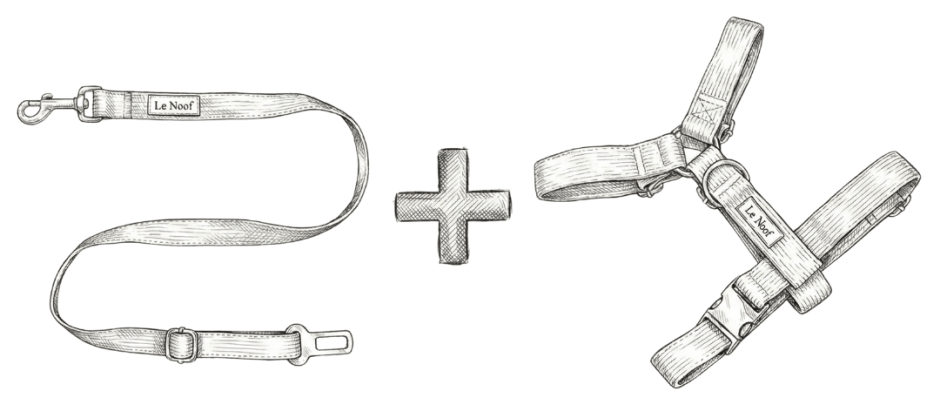
It’s the most common mistake owners make and the cheapest to fix. If your dog only wears a collar in the car, that’s the first thing to change, before the tether, before anything.
How Do You Get a Dog Used to It?
Few dogs love it on day one, and a week of easy reps fixes that:
- Clip in while parked. Engine off, treat, unclip, done. Repeat a few times.
- Make the first drives short and fun. Five minutes to somewhere good, not just the vet.
- Add a familiar surface. A blanket that smells like home turns the spot into theirs.
- Use it every single drive. Consistency is what makes it as unremarkable as the leash.
Most dogs stop noticing it within a week. The ones who fuss longest are usually the ones whose humans only use it sometimes.
Quick Answers
Will it fit my car? Almost certainly. The standard tongue fits the receivers in the vast majority of cars, SUVs and crossovers. A few vehicles with unusual rear buckles are worth checking before you order.
Can it go in the front seat? No. Front airbags are built for adult humans and can injure a dog even in a minor collision. Back seat, always.
What if my dog chews the strap? Redirect with a chew toy on the first drives and keep trips short. Chewing is almost always a settling-in behavior that fades once the routine is boring.
Get the fit right, keep it on the harness, and pick one you like looking at. That’s the entire recipe for turning car restraint from a thing you keep meaning to do into something that happens automatically every time the door opens.
Contributed posts are advertisements written by third parties who have paid Woman Around Town for publication.