Directed by Louisa Proske in a remarkable company debut, the evening achieved a rare completeness, succeeding across virtually every artistic dimension. Proske’s staging offers an intelligent, detailed, atmospheric reading that treats the entire tragedy as though it were boiling inside a witches’ cauldron.
The production’s masterstroke is the agency given to the supernatural, transforming the Weird Sisters into the true directors of the evening. The witches remain watchful presences especially whenever the Macbeths occupy the stage. Operating like malicious puppet masters tugging at invisible strings, they loom over the action, actively facilitating the very catastrophes they prophesy. This concept turns the stage into a fishbowl of continuous surveillance, physically anchored by Jon Bausor’s rotating set. At its center is a jagged, violent break in a massive wall, serving as the gateway via which much of the dramatic action unfolds. Noticeably, this rugged aperture frequently resembles an enormous, gaping eye, reinforcing the sense that the characters are permanently trapped under the unblinking gaze of the coven.
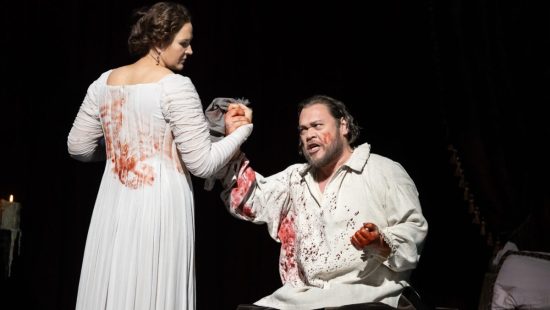
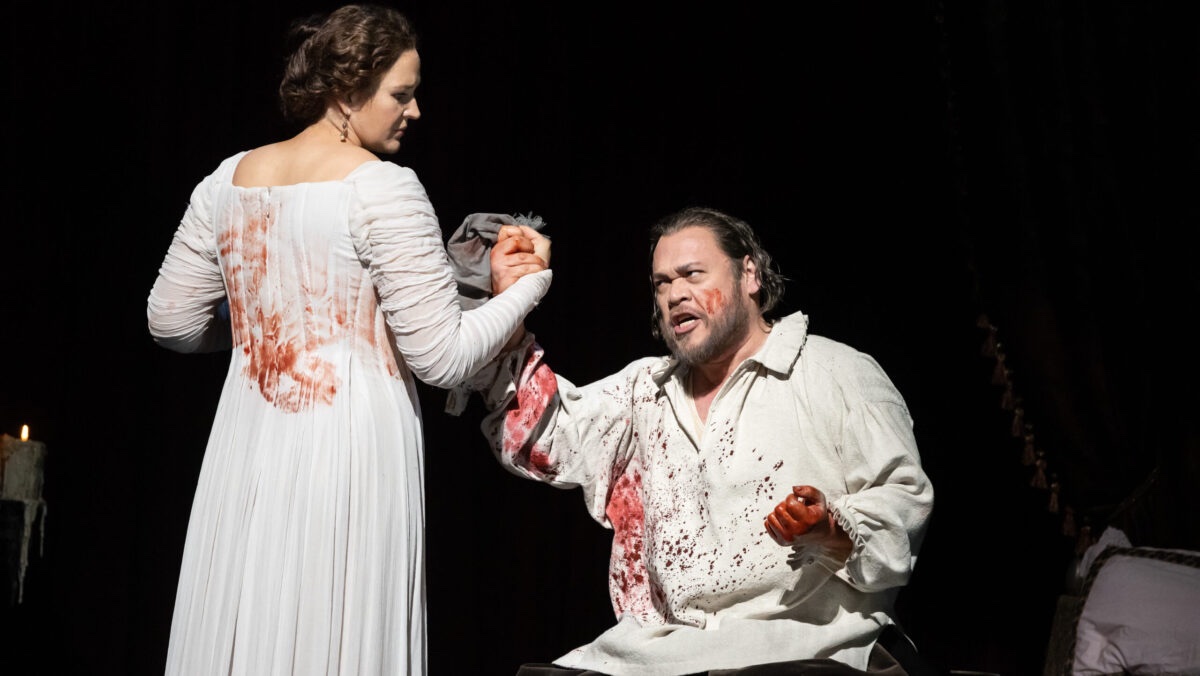
Lise Davidsen as Lady Macbeth and Quinn Kelsey as Macbeth in Verdi’s Macbeth – Photo: Marty Sohl / Met Opera
This architectural eye seamlessly morphs to reveal both the intimate and public spaces of the tragedy, housing everything from the confines of the Macbeths’ grand bedroom to the banquet table. It is during the banquet scene that the production delivers one of its most spine-chilling visual coups: a massive, horrifying roast pig is placed on the table, only to transform grotesquely into Banquo’s bloody corpse, giving physical form to the havoc consuming Macbeth’s psyche. This nightmarish landscape revolves with fluid urgency under Adam Silverman’s shadow-heavy, fog-ringed lighting, while Montana Levi Blanco’s richly conceived costumes evoke a world in which grandeur and brutality coexist.
Musically, opening night reached dizzying heights. The Met Orchestra and Chorus performed at the peak of their powers. A moment of sheer sonic tumult arrived at the end of Act I: when King Duncan’s murder was discovered, the chorus voices burst out like a tidal wave of collective shock, creating an unforgettably exciting torrent of sound. Later, the chorus’ emotional zenith of the evening came in Act IV with the mournful “Patria oppressa”, whose deep weight of grief and poignant vocal lyricism struck directly at the heart.
Maestro Yannick Nézet-Séguin conducted with aplomb, structural nuance, and vividly delineated textures. He unleashed thunderous dramatic force to mirror the violence onstage yet remained sensitive enough to draw the orchestra down to a delicate, shimmering whisper, giving the principal singers room to breathe in their quietest moments.
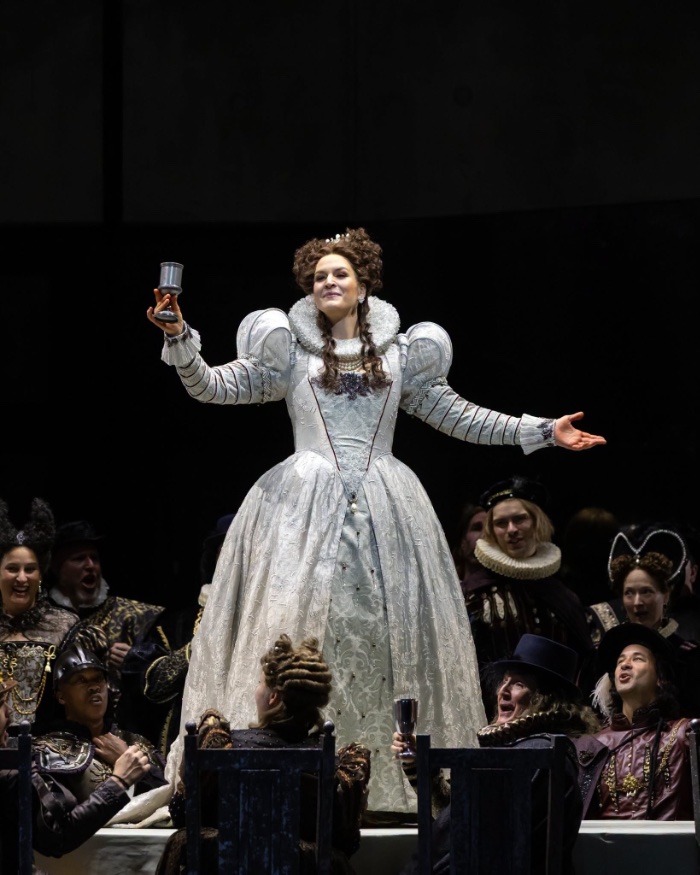
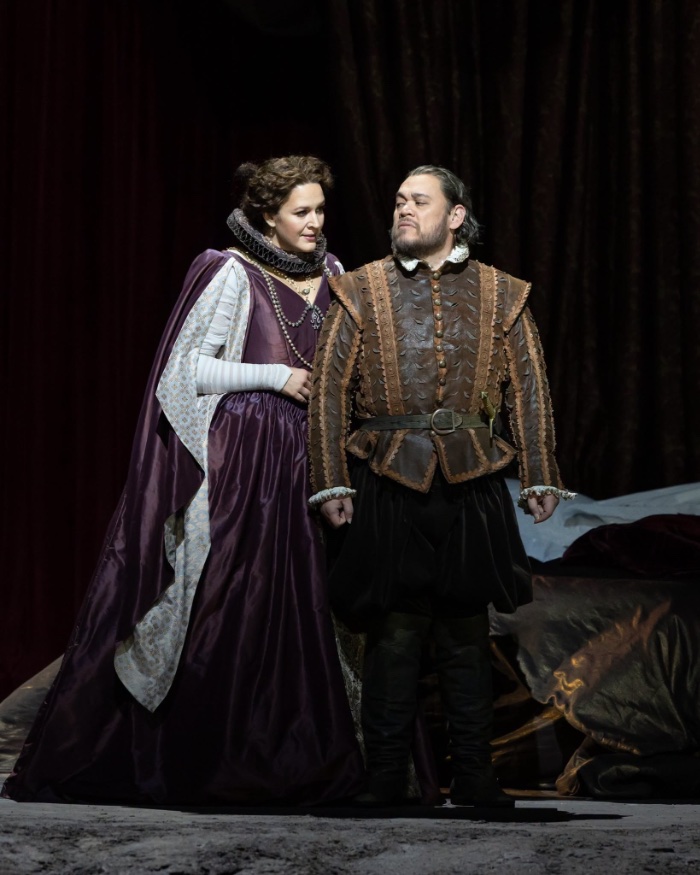
Lise Davidsen as Lady Macbeth in Verdi’s Macbeth – Photo: Marty Sohl / Met Opera
The cast met the score’s challenging demands, with the two protagonists tracing compelling individual musical and psychological journeys.
In a highly anticipated role debut as Lady Macbeth, Lise Davidsen offered a remarkably restrained portrait of the antiheroine. Rather than leaning into overtly manic villainy, she presented a cool, collected mastermind, concealing a calculating psyche beneath an unshakable, frosty exterior that complemented her regal, majestic stage presence. Her soprano remains a phenomenon, luscious and gleaming, with immense, room-filling power, yet capable of astonishing delicacy in her softer, more introspective moments.
Her evolution was mapped vividly across her arias. In “Vieni! t’affretta!” she introduced Lady Macbeth’s calculating steel housed in abundant cascades of sound. In “La luce langue,” her voice shone with chilling authority, moving from the shadowy flicker of doubt in “nuovo delitto” to the towering determination of “è necessario.”During the banquet scene, her handling of the brindisi, “Si colmi il calice,” captured the forced gaiety of a queen trying to save face and hold the court together while her husband visibly unraveled in public. Finally, in “Una macchia,” the Sleepwalking Scene, Davidsen distilled her massive instrument into a ghostly, deeply colored thread of sound that laid bare Lady Macbeth’s own psychological undoing.
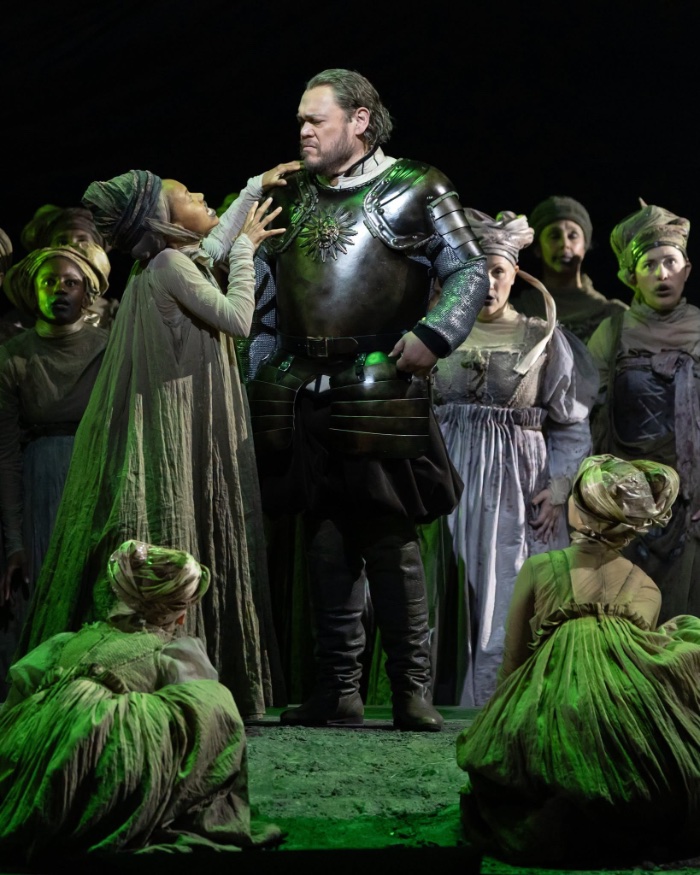
Quinn Kelsey as Macbeth, with the witches in Verdi’s Macbeth – Photo: Marty Sohl / Met Opera
Quinn Kelsey brought a visceral, explosive theatricality to the title role, anchoring the tragedy in human vulnerability. His baritone possessed a compelling versatility, at times grainy and harsh, mirroring the king’s ambition and disintegrating psyche, and at others beautifully radiant and saturated with emotion. His performance unfolded with mounting dramatic intensity. In Act I, his hushed contemplation of the witches’ initial prophecies captured a man suspended between motivation and terror. Later, his extraordinary rendition of “Pietà, rispetto, amore” movingly delivered the ache of tragic inevitability and fatalism. The restoration of “Mal per me che m’affidai,” Macbeth’s death scene from Verdi’s original 1847 version of the opera, proved devastating. Mortally wounded and finally confronting the ruin wrought by his faith in the prophecies, Kelsey sang with harrowing, fragile transparency, capturing the stark isolation of a dying tyrant who knows he has lost everything.
As Macduff, Freddie De Tommaso made a sensational impact, singing with a brilliant, heroically ringing tenor. His Act IV lament, “Ah, la paterna mano,” carried urgent, passionate heft and provided one of the night’s most exciting vocal highlights. As Banquo, Ryan Speedo Green cut a noble figure. His Act II aria, “Come dal ciel precipita,” unfolded in smooth vocal lines, his resonant bass-baritone bringing heartbreaking gravity to Banquo’s foreboding. Making his Met debut as Malcolm, Jonathan Burton supplied a burst of vocal substance and charisma, lending momentum to the liberating forces of the final act.
By marrying a chillingly focused theatrical concept with formidable musical forces,this season-opening Macbeth emerged as an absolute triumph. It provided an outstanding beginning to the Metropolitan Opera’s 141st season, which also marks 60 years since the company moved into its Lincoln Center home. If this Macbeth is any indication of what lies ahead, audiences are in store for a thrilling season of opera.
Verdi’s Macbeth runs at the Metropolitan Opera through October 20.
Top: Lise Davidsen as Lady Macbeth and Quinn Kelsey as Macbeth in Verdi’s Macbeth – Photo: Marty Sohl / Met Opera