“It’s important to have that sort of graciousness in wanting to see others succeed.” Jamie deRoy The Pittsburgh Jewish Chronicle
Part I
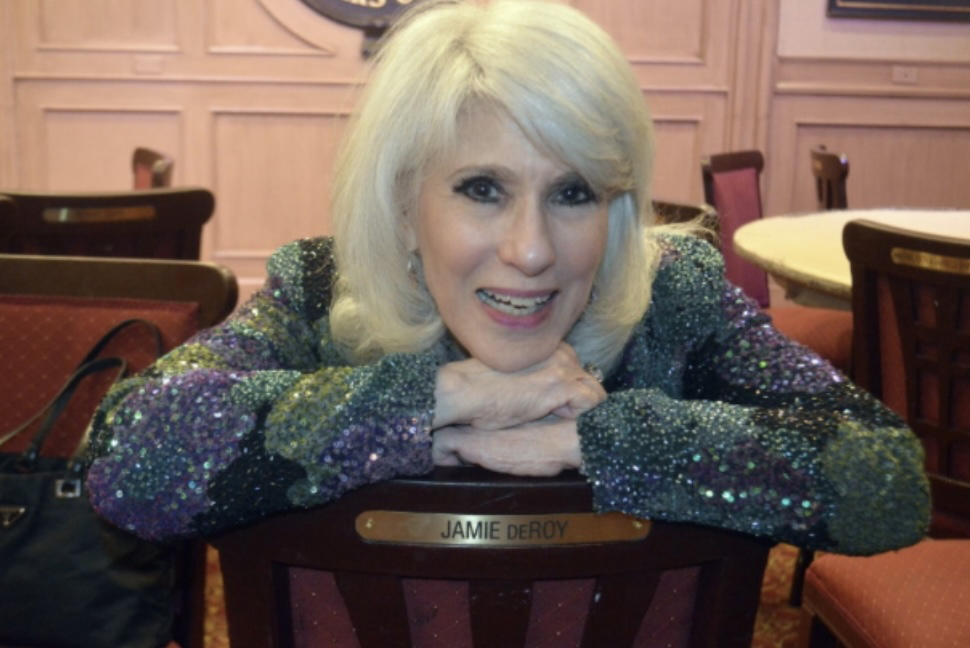
Jamie deRoy is an actress, host, vocalist, producer (78 Broadway shows -10 Tony Awards and counting- also Off Broadway and film), collector of art and artists, and a humanitarian. She juggles all this with energy – though not in the morning, honed acumen – 50-plus years in entertainment, unbridled, unjaded enthusiasm (sparks still fly), humor, and her gut.

Righthand photo – Stephen Sorokoff
Zelig-like, Jamie seems to have met, recognized the qualities of, and/or worked with a multitude of people before they became successful and often influential. She drolly bemoans not having made a better friend of eventually well connected television producer Steven Bochco while they were both at Carnegie Tech. “He was such a nice guy and took care of – got work for – everyone at school.” In 1968, her friend Sid Davidoff arranged for his assistant “Squirt,” aka Jeffrey Katzenberg, to squire Jamie around John Lindsay’s City Hall selling her handmade neckties. He became a movie mogul.
Bonding with fellow AMDA student Tyne Daly, however, lead to the ladies dueting “Marry the Man Today,” at a recent benefit. The number had been performed as students. Her rolodex is the stuff of dreams. Jamie frequently seems to be in the right place at the right time (with the right attitude). Ask her to tell you the Polo Lounge story where she ends up at the home of Sammy Davis, Jr. Or the one where her cat almost made it to a Broadway stage.

With Tyne Daly at Primary Stages Gala – Photo, Stephen Sorokoff
Her energy is legendary. Longtime friend Stephen Sorokoff notes she sometimes attends several events in an evening. Invited up to his Berkshire home “the first thing she asked after unpacking was is there a movie playing in town that we could go to now before the show tonight? “
Jamie has a grounded sense of self and judgment that applies almost everywhere except choice of (two) husbands. Despite a reputation for compromise (and collaboration), she loves guacamole, but won’t touch an avocado and eats raisins from a box but picks them out of anything cooked. Unable to leave the house before making her bed, scheduled on in two calendars, she nonetheless forgets to put things on her phone.
Skills as a super conductor, a “shadchanit” (matchmaker) are widely acknowledged, though often remain unknown to those for whom she secures auditions or jobs. Then there are those who do know. Former lighting designer Richard Winkler credits her with “creating” him in 2009 by giving the novice producer his first above the title credit earning his first Tony Award. (Alan Ayckbourn’sThe Norman Conquests.) A warm, successful professional relationship began.

Richard Maltby and Jamie, 2014
Lyricist Richard Maltby, Jr. says the business, half love, half cut-throat, is made bearable by people like Jamie who “reminds artists that working hard and being good is worth it. We all need to be reminded. She’s a force, a true supporter, a lover of talent.”
————————————-
Jamie was raised in the Squirrel Hill neighborhood of Pittsburgh by fine artist mother Aaronel deRoy Gruber, whose art and art collection lives with her daughter in New York, and father Irving Gruber who owned American Forge and Manufacturing Company. (Listen to her song “Daddy’s Girl.”) She has two siblings, Jon Gruber is an investment manager, Terry Gruber a photographer . There were piano lessons (she barely plays), voice lessons (a teacher wanted her to study opera, but she’d fall asleep when attending one and is admittedly bad with languages), and ballet lessons. “I toyed with the idea of becoming a professional until I learned how dedicated you had to be.”

Jamie and Her Parents
Mr. Gruber often woke the family with a Broadway recording as if reveille. When a friend who’d been Hal Prince’s college roommate asked for a $1000 stake, “huge those days,” in The Pajama Game, Gruber invested and got it back many times over, a rarity these days on which she comments. The show and its backstage environs were ten year-old Jamie’s first Broadway exposure. “From that time on I was hooked.” She never considered producing. “He was an investor.” The little girl started to act in community theater.

Used by permission – All rights reserved Playbill Inc.
Her father’s speculation with Damn Yankees followed. Jamie asked him why he decided to invest and was told the name George Abbott fostered confidence. Gruber’s third investment, a serious play, closed in three days. Years later, Stephen Sondheim’s Merrily We Roll Along didn’t do much better. “Who knew it would have that kind of afterlife?!” she quips. That was the end of that.
I ask about stage fright. Jamie says unlike today, it wasn’t pronounced when she was younger. “Every time I do a show now I want to quit performing. Then when it’s over, I think that was fun! And go through it all over again.” Longtime friend and collaborator Barry Kleinbort says, “It costs her dearly to get up on stage now. People from the industry come. The stakes are higher.”

Junior year summer the teenager played Polly Peachum in The Three Penny Opera opposite Rene Auberjonois with The Peninsula Players in Fish Creek, Wisconsin. After graduation, she became an apprentice at Westport Country Playhouse (Linda Hunt directed her in No Exit) and was loaned out to Goodspeed without notice, in need of a jacket “it was cold!” and toothbrush. Then came Carnegie Tech. Impatient to begin as a professional, through school, she stayed only one year. Carnegie had no musical theater program at the time, and, in fact, frowned upon the genre. Jamie would sneak into practice rooms to sing early in the morning.

Left:Westport Country Playhouse (Creative Commons Attribution-Share Alike 3.0); Right: Goodspeed Opera House (Public Domain)
She resolved to move to New York. Hoping for discouragement, her father suggested talking to Hal Prince. His advice was to remain a big fish in a small pond awhile, but the young woman was chafing at the bit. She registered at AMDA (American Musical and Dramatic Academy). Through her mother, a one bedroom apartment was found, then a roommate from school.

Jamie then; Barry Manilow and Jamie 2022
In 1965, Jamie auditioned for the heroine in W.H.S. Smith’s 1844 play, The Drunkard – “…only because it was on my way to dinner. I was lazy and cheap.” She got the part, played Off Broadway, then toured with the campy show. Barry Manilow (yes, that Barry Manilow) was musical director and wrote special material.
Expecting to sign a tour contract for Camelot at the office of producer Laurence Feldman, she was kept waiting for hours, got “antsy,” and volunteered to help his beleaguered secretary. Eventually “Lairy” (Pittsburgh pronunciation) came out and told the young actress he couldn’t use her. “I started crying. I was a kid. I wanted to be in musical theater.”

Young Jamie
His secretary then asked whether she could hire Jamie. The job was flexible, allowing her to sleep mornings. The next civilian gig was with Michael F. Goldstein Public Relations. She met people. Jamie always met people. She still does. And oh, how she remembers names!
Ashley Famous (the agency then became International Famous, then ICM) was looking for “a nightclub singer – not an actress, not a musical theater artist. I thought, I sing, I don’t care where. I didn’t really understand. There was no such word as cabaret.” An agent asked how many charts she had. Charts?! Jamie called “Beary” (the Pittsburgh version of Barry) in a dither. “I need an act!” She grins.
They wanted a girl singer (her tone implies the raising of an eyebrow) who performed standards, an opener for male comics. She and Manilow had begun working together on isolated songs. He became her music director. Jamie played Goldman’s in New Jersey to get her feet wet; the Nevele, the Concord, eventually Atlantic City and even St. Kitt’s.

Evolution of the Hair
One evening at Reno Sweeney, her ex-husband’s lawyers heckled her (she’d passed through a first short marriage). Jamie responded with clever retorts. Comedian Alan King’s partner (in the audience) told her she was quick on her feet and funny, that she should go in that direction to distinguish herself. “I never knew I was funny, but I thought, well, I can always burst into song.”
With relish, she started specializing in humorous material like David Friedman’s “My Simple Christmas Wish”:
“I wanna be rich, famous, and powerful/Step on all my enemies and never do a thing/ I wanna be rich, famous and powerful/So all I have to do all day is sit around and sing…”
David Buskin’s “Jews Don’t Camp”: Jews don’t camp/If it hasn’t got a kitchen/And it isn’t air conditioned/Where’s the exit ramp/…Jews don’t camp…”
And, sung to the tune of “My Favorite Things,” Barry Kleinbort’s parody of the places Jamie played:
“Dannys’ and Dillons’and Freddy’s, my golly!/Mickey’s, the Living Room and Grand Finale/Then at The Monkey Bar, I stayed and stayed…/These are a few of the clubs I have played…
Arci’s, Jan Wallman’s- My God, that was teeny/Both the Panaches, McGraw’s, Reno Sweeney/Joints where they paid you and joints where YOU paid/ These are few of the rooms I have played…”

Tom Postilio, Baby Jane Dexter, MariEileen O’Brien, Karen Akers, Judy Barnett, Sam Sagenkahn, Karen Mason, Christine Pedi. Me! Cabaret month 1997- Photo by Maryann Lopinto
There are several more verses. She has a real penchant for parodies and clearly got around. Moving from clubs to cabarets was a shock, however. Suddenly take-home was a percentage of the door rather than a pay check. Ever resourceful, when she played The Triad (then called Palssons) between showings of Forbidden Broadway, Jamie blocked out signage to read “Forbidden Broad.”
Kleinbort remembers seeing her show Upstairs at Eighty-Eights.. Jamie sang Andrew Lloyd Weber/ Tim Rice’s “I Don’t Know How to Love Him” (Jesus Christ Superstar) while stripping down to “a corset, whips, and chains.” And a set that included “My Funny Valentine” sung to Taffy, the dog, a sympathetic, Bill Huber marionette.

The vocalist has collected a pocket full of missing piano stories. Arriving midday at an unfamiliar Sacramento club, she discovered the owner drunk and no sign of a piano. “I thought you were going to bring it!” he declared. “Go see the town,” “Don’t worry about a thing, I’ll take care of it.” This is a phrase that came to scare Jamie “more than any other in the English language.” She made sure to visit the sole piano store which had not, in fact, received an order and rectified the situation.
Another occasion found a rich Long Island hostess whose baby grand was in the foyer insisting (vociferously) that her hired entertainment sing in a living room down the hallway. Jamie could barely hear accompanist Dick Gallagher who remained at the only instrument. He couldn’t see her at all. They got through it. Her equanimity is fabled.


Walking home to West 72nd Street, Jamie passed a film shoot outside The Dakota (apartment building). She had just secured her SAG (Screen Actors Guild) card. Never shy, she asked who was in charge and strode into the courtyard to address casting. (Things must’ve been very loose in terms of security.) She was told to come back with a headshot/resume and, living just blocks away, very promptly returned. At 5 p.m., Jamie received a phone call asking her to be on set the next morning as an extra in Rosemary’s Baby.
The young actress would go on to be cast in Hello, Dolly! “We were told no photos of Barbra,” Annie Hall, and The Front. Producer (on the Allen films) “Charlie” Joffe, whom she’d date, told Jamie she has a “great laugh.” (She does.) At the Monkey Bar, because of said laugh, comedy duo Randall and Charles asked that she be in the audience at a live album recording of their show. Later there would be television roles and commercials for her. Spirited and attractive, Jamie frequented Studio 54 and the discotheque Xenon always breezing in. “The clubs were nice to single, young women.” She threw annual 30th birthday parties at the venues.

One of Jamie’s many 30th birthdays (Courtesy of theaterlife/Barry Gordin)
All photos not credited, by permission of the photographer or candid photos.
Opening Photo by Maryann Lopinto