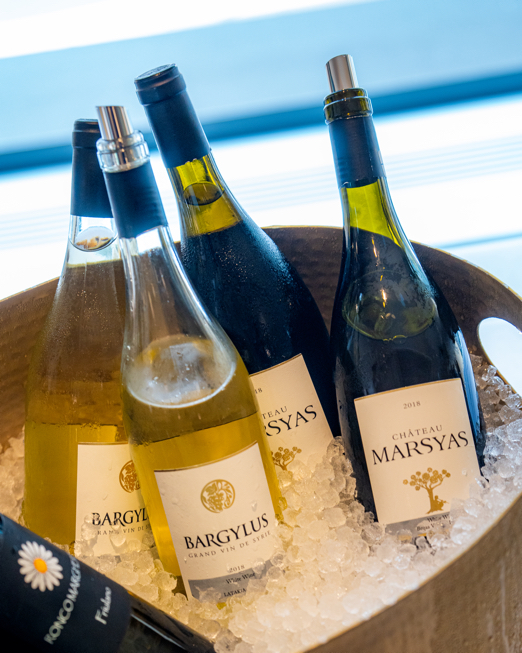
There’s a lot of buzz about the quality and diversity of wines from Syria and Lebanon. Megan Anderson, the founder of the boutique import company, Pendenza Wine, imports some of the rarest wines globally to share their story of resilience including those from Domaine de Bargylus and Château Marsyas.
In the early 2000s, the Johnny R. Saadé family, based in Lebanon, launched two vineyards in the Middle East region. Domaine de Bargylus heralded a revival of Syrian winemaking, and Château Marsyas is a pioneering venture in Lebanon’s Beqaa Valley. Today, their wines vie with the best globally and are made from fruit grown in some of the oldest vine-growing areas of the world.
It’s significant to note that Domaine de Bargylus and Château Marsyas have survived the national seizures in the 1970s, the Syrian war, and the 2020 blast at the Beirut Port, which almost killed the Saadé family. Their dedication to world-class winemaking in the face of adversity is to be admired.
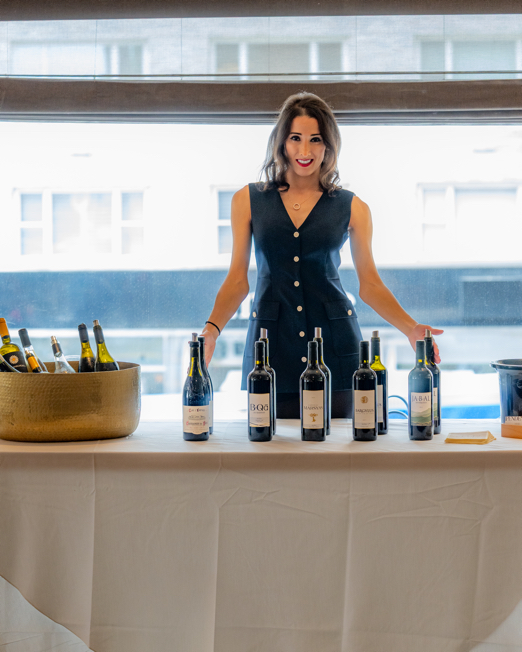
Megan Anderson (above) is a Syrian American sommelier and hospitality professional, born in Damascus, a region with a winemaking heritage dating back over 5,000 years, evidenced by one of the world’s oldest discovered wine presses. A graduate of Central Connecticut State University, she is currently pursuing the Advanced Sommelier certification through the Court of Master Sommeliers, with the ambition of becoming the first Master Sommelier representing this part of the world.
Her connection to Syrian wine began in Geneva, where she celebrated completing the Geneva Marathon with a bottle of Bargylus 2015 vintage. It was her first encounter with fine Syrian wine, a moment that sparked both admiration and determination, as she realized that sanctions had long prevented these wines from entering the United States.
In 2025, Megan traveled to Beirut, Lebanon, and Syria, where she met with Karim, owner of Château Marsyas and Bargylus, along with Ayman, the marketing director, at the Marsyas and Bargylus boutique. The meeting took place in a vibrant Beirut neighborhood known for its contemporary art, dynamic restaurants, and lively wine culture. Together, they explored the opportunity to introduce some of the Eastern Mediterranean’s most distinctive wines — including the first Syrian wines — to the U.S. market.
Navigating regulatory challenges and evolving sanctions required persistence and careful study of U.S. Food and Drug Administration requirements, ultimately helping make this vision possible.
Both wines hold deep personal significance for Megan: Château Marsyas is produced just an hour’s drive from Damascus, her hometown, while Bargylus is grown in one of the most naturally beautiful coastal regions of northwestern Syria. Together, they represent resilience, heritage, and the enduring legacy of winemaking in the Eastern Mediterranean.
Megan Anderson shared with WAT readers interesting insights about her career and the wines her company imports.
What initially attracted you to working with Domaine de Bargylus of Syria and Château Marsyas of Lebanon?
What first drew me to these wineries was their extraordinary quality and their deep connection to the land where I was born. The terroir and microclimates of the Eastern Mediterranean are truly fascinating — from clay, limestone, and flint soils to the cooling influence of sea breezes and high elevations that moderate the warm Mediterranean climate.
As a professional sommelier, and perhaps one of the very few women representing this region in the wine world, I feel a responsibility to preserve and advocate for a threatened heritage rooted in one of the oldest wine-producing regions on earth. Working with these wineries is not only about wine quality; it is also about protecting history, culture, and identity through wine.
Why do you think wines from the Middle East are often overlooked in terms of accessibility and quality?
There is no single answer to this question. The region has endured more than a century of wars, political instability, migration, and economic disruption — all of which have deeply affected agriculture and winemaking. War is never kind to farmland, vineyards, or supply chains.
Sanctions and logistical challenges have also made exporting wines from the region more difficult and significantly more expensive.
At the same time, it is important to distinguish between the situations in Syria and Lebanon. Syria has suffered one of the most devastating conflicts of the post-World War II era, along with years of economic isolation and sanctions. Lebanon, while facing its own struggles, has historically maintained a more open economy and stronger French influence within its wine culture.
Despite these obstacles, wine production has never stopped, and wines from the region continue to be exported internationally. This is where education and media become essential. Greater collaboration across the Eastern Mediterranean is needed to increase visibility and reshape perceptions of the region.
I believe the Eastern Mediterranean should position itself not simply as an emerging wine region, but as the ancient world of wine — a cradle of viticulture with thousands of years of continuous history.
What are some of the challenges of your position as the founder of Pendenza Wine?
One of the greatest challenges is encouraging buyers and consumers to explore wines beyond what I call the “classic three” — France, Italy, and the United States. Many consumers are unfamiliar with wines from the Eastern Mediterranean, so education is a major part of the work.
Tariffs and supply chain disruptions have also been significant challenges, especially over the past year. Importing wines from smaller and less-established regions often requires navigating higher costs, shipping uncertainty, and limited market familiarity.
At the same time, these challenges are also opportunities — because once people taste these wines and understand their history, they are often surprised by the quality, authenticity, and sense of place they offer.
What do you envision as the future of Syrian Wines?
This is a difficult question, but my short answer is resilience — the resilience of the Syrian people and of Syrian viticulture itself.
For thousands of years, Syria has never truly stopped producing wine. Vineyards can still be found along the coast and mountain ranges, as well as in southern Syria near Damascus and around Homs, despite the devastating war of the past decade.
Today, Syrian wines are being served in some of the top restaurants in New York City and across the United States. That alone sends a powerful message to anyone who doubts whether Syrian wine has a future.
In the 1990s, Syria had more than 100,000 hectares of vineyards. Today, that figure is roughly half, yet it still represents a significant vineyard footprint. The country has remarkable agricultural potential.
There are also cultural challenges. Wine has historically existed alongside stronger traditions surrounding arak, the anise-flavored grape spirit that many would consider the national drink. Building a broader wine culture domestically will take time.
Following recent political and economic changes, Syria is beginning to move toward a more open-market model after decades of state-controlled economic policies. There are historical parallels to Eastern European wine regions that experienced major positive transformation after economic liberalization. However, stability remains the essential factor for long-term growth.
Ultimately, I believe Syrian wine will increasingly be seen as something rare and distinctive: an ancient wine culture rediscovered. These are wines from a land once celebrated by the Romans and embraced during the Crusader era. If you ever have the opportunity to taste Syrian wine, I would encourage you not to hesitate.
Photo Credits: Courtesy of Domaine de Bargylus and Château Marsyas