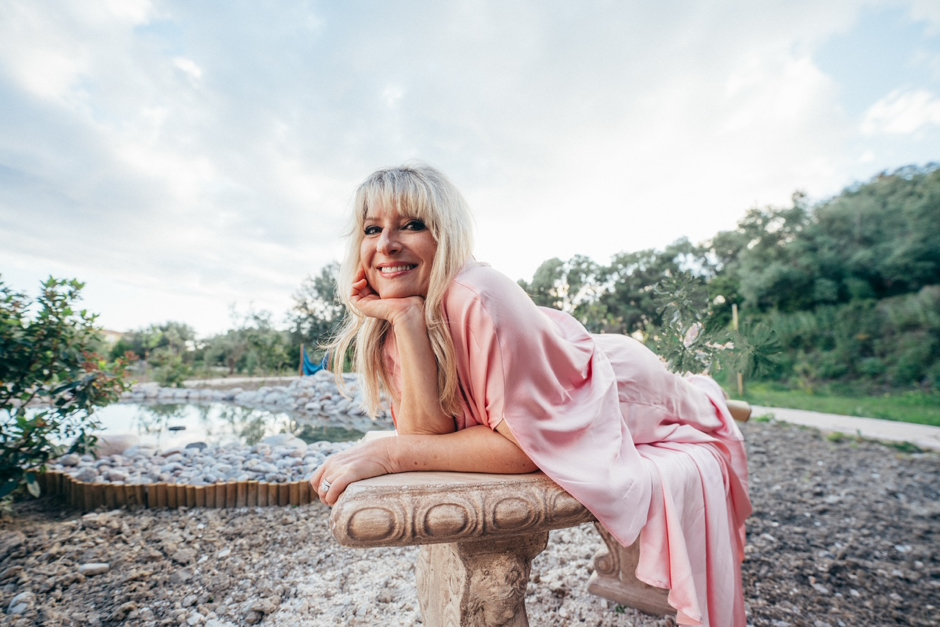
Pauline was born in the U.S., and has lived in Athens, Greece (ages five to 15), Chicago, and South Florida. She now splits her time between Pompano Beach, Florida, Athens, and the island of Kefalonia.
Her work is often inspired by coastal environments, particularly South Florida and Greece; her process is deeply informed by proximity to the sea and the shifting qualities of light and atmosphere. With a background in economics and public service, Adams brings a disciplined and intentional approach to her practice.
Can you point to one event that triggered your interest in your career?
No…I can’t point to one specific event because this has been a lifelong passion and grew into a very accelerated pursuit recently.
Drawing came naturally to me from a very early age; portraiture in particular, fascinated me. I was always drawn to people—their presence, their expression—and to the challenge of capturing a likeness. I was sketching human-looking figures as soon as I could hold a pencil. My parents were going through a difficult divorce, so drawing became my happy place. I was drawing nonstop and everywhere, often illustrating fully developed stories. I remember being as young as five years old in Greece, sitting on the beach and sketching stories on the wet sand using discarded kebab skewers, attracting small crowds amazed at what this little girl could do. By age seven, I was already surprising people with how accurately I could capture a likeliness.
At that point, my academically inclined family recognized the talent, and concerned about the path it may lead to, did their best to steer me away from it. I was forbidden from sketching outside of school assignments, and even my teachers were asked to report any “unauthorized” drawings they found. When there is will there is a way, so I adopted—I began sketching on newspapers during siesta time, drawing directly over the print. By squinting, the text became a grey background, and when I was done, I would discard the paper—no one ever thought to search discarded newspapers for sketches!
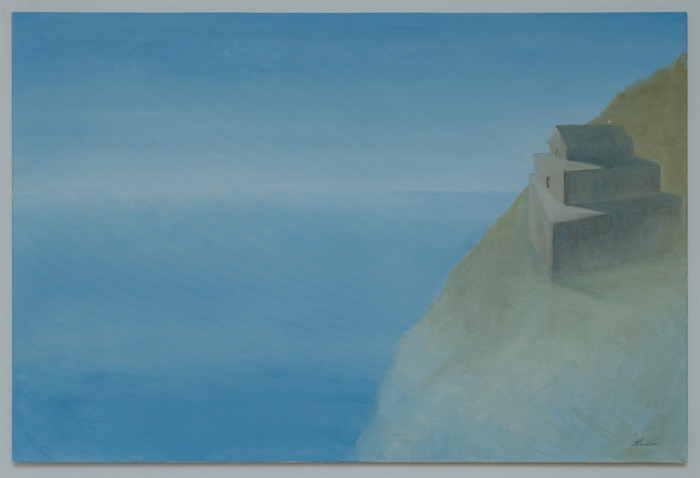
The Quiet Edge
Despite my efforts, my family ultimately ensured I did not pursue any formal training in art, guiding me instead to a more traditional path that led to a master’s degree in economics and a career with a congressional investigative agency. As an adult, I was free to return to art openly, but demanding career obligations forced it to be an after-hours practice. I gravitated toward oil painting and explored different subjects and techniques and painting styles intuitively. I supplemented my practice with online classes, and books on technique. But all these efforts were pursued in isolation—as an outsider. I think deep inside I resented not being allowed to join the art world early on, so chose to ignore it.
A few years ago, a moment stayed with me. During a Christmas service, a Greek Orthodox priest spoke intensely about identifying the one true talent God gave us and using it—”otherwise it would be like throwing it back in His face.” It struck me in a way I could not ignore. While I had many interests—classical piano, ballroom dancing, languages—art was the one that had always set me apart.
I decided I owed it to that calling—and to that little girl—to bring art to the forefront of my life. I left my job, intensified my training, and became more deliberate in my work.
The real acceleration came about a year and a half ago, when I was asked to organize and lead meetings in New York for a Chinese art company exploring U.S. expansion. Unexpectedly, I was offered a leadership role in their U.S. branch. Although the company ultimately decided not to pursue U.S. expansion, the experience immersed me in the art world in a direct way I had previously avoided. I was no longer observing from a distance—I was inside it.
That moment marked a shift—from doing art solely to meet a personal need to fully committing to painting—not as an afterhours pursuit—and offered clarity in how to structure a sustained and disciplined practice.
What about this career choice did you find most appealing?
What draws me most to this work is the ability to capture something that is inherently intangible—the feeling of being fully inside a moment. I’m interested in presence: not just in people, but in everything that surrounds them—the air, the atmosphere, the quiet energy of a place—often something as simple as a figure calmly walking alongside a huge wave before it breaks, or the moment just after a soft wave has kissed a little rock on the sand.
Much of my work is inspired by the sea and coastal environments, where that sense of immersion is especially powerful and stillness and movement coexist. I try to translate that onto the canvas—not in a literal way, but as a sensation. I spent much of my childhood in Greece, which first established my connection to the sea. Today, I live with views of the sea in Florida and in Kefalonia, and it continues to serve as a constant source of inspiration.
Of course, portraiture has always been central to me. As soon as I could hold a pencil, I was drawn to the challenge of rendering a person not just as they appear, but as they feel. In a way, I think of it as building someone out of air—capturing something fleeting and giving it form. The intimacy of this process fascinates me.
Over time, my practice has evolved into a more intentional visual language, supported by a restrained palette—particularly indanthrone blue and amethyst—which allows me to focus less on description and more on mood, atmosphere, and presence. My goal is to magnify the significance of small moments both, by simplifying the composition and by increasing the size of the canvas to as large as my studio can handle at the moment.
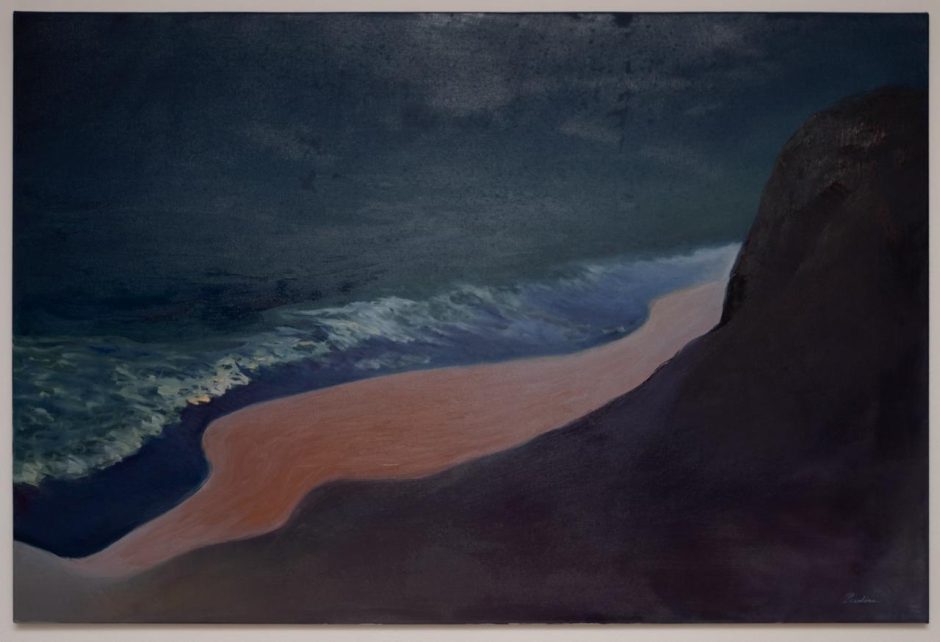
Edge of Quiet
What steps did you take to begin your education or training?
As I said earlier, I have been training over time. Finally, I felt I had to master my gifts, quit my job and pursue this full time.
My approach has been very intentional and self-directed. Once I made the decision to pursue art seriously, I knew I needed to move beyond instinct and begin shaping a clear visual language rather than working purely intuitively. I started by studying my own work—looking closely at what had been consistent over time and what felt essential. From there, I expanded outward, immersing myself in the work of contemporary painters whose sensibilities resonated with mine. That process of comparison and reflection helped me better understand where my work sits within a broader context, and where it begins to diverge.
At the same time, I became very focused on refining my materials, particularly color. What had once been a broad and exploratory palette gradually became more restrained and deliberate. I now work with a limited range centered around indanthrone blue and amethyst, which allows me to focus less on description and more on atmosphere, tone, and presence. Throughout this process, I’ve drawn on skills from my previous career—particularly research and disciplined analysis—to build a foundation that is both intuitive and structured. It has been less about formal training, and more about constructing a practice that is rigorous, focused, and continuously evolving.
Along the way, were people encouraging or discouraging?
In my early years I had to face discouragement by my family, who strongly steered me toward a more traditional career path. Throughout my adult life, however, friends and colleagues were largely supportive, providing me with an appreciating audience and several commissions.
Now I am fortunate to have a deeply supportive partner, who has been my biggest cheerleader; long engaged with my work since we met 16 years ago, encouraging me every step of the way, and supporting me—from helping me network, to running to the art store for last minute art supplies, to taking my large canvases to the frame store with assurances that the store owner has clear directions from me and he does not have to explain anything.
Did you ever doubt your decision and attempt a career change?
Becoming a professional artist was, in itself, a career change. Once I made that decision, my focus shifted entirely toward building a practice and developing the work. There has been a clear sense of direction, and I’ve approached it with consistency and commitment with absolutely zero regrets. It has been a long time coming.
When did your career reach a tipping point?
I would say I’m in the midst of that transition now. After a year of very focused work, things have begun to take shape in a tangible way. I have an upcoming exhibition scheduled in September 2026 in Kefalonia, Greece. At the same time, I am in the process of establishing a dedicated, brick and mortar gallery space there, with plans to expand my presence more broadly within the Greek islands. In parallel, I’ve been developing a cohesive body of work and working toward a coffee table book that brings together not only the paintings, but the broader aesthetic and environment in which they exist. It feels less like a single moment and more like a gradual alignment—where the work, the direction, and the opportunities are all beginning to converge.
Can you describe a challenge you had to overcome?
One of the more significant challenges was internal—reframing how I approached this transition. Entering the art world at this stage in life, without a traditional academic path or established network, required a shift in perspective. Rather than seeing those factors as limitations, I came to understand them as part of a different kind of foundation—one shaped by discipline, independence, and a deep capacity for focused work. What initially felt like a late start has, in many ways, become an advantage. It allows me to approach the work with intention, clarity, and a strong sense of direction.
What single skill has proven to be most useful?
Discipline has been the most essential. While creativity is often associated with spontaneity, that spontaneity is subject to disruptions, such as the inevitable fluctuations in mood, motivation, and confidence that affect creative work. Talent alone can only take you so far. Without discipline, it can become stagnant. I’ve found that consistency is what allows the work to deepen and evolve. My previous career instilled in me a strong sense of structure and follow-through—what we referred to as objectives, scope, and methodology—an approach I’ve carried into my art practice, providing me with a clear sense of direction and a commitment to showing up every day. That consistency creates momentum, allows ideas to develop over time, and leads to growth and tangible results.
What accomplishment are you most proud of?
What I’m most proud of at this stage is the body of work I’ve been able to bring into focus over a relatively short period of time. It represents the emergence of a clear direction—something that feels cohesive, intentional, distinctly my own, and increasingly recognizable to others. In particular, the work connected to Kefalonia has been especially meaningful, reflecting a deep connection to place, memory, and atmosphere.
More than any single milestone, I take pride in having committed fully to this path and in building a practice that is grounded, disciplined, and evolving.
Any advice for others entering your profession?
Of course, there is the familiar advice to follow your passion and do what you love. I would add that it also requires courage to begin and patience to sustain the effort over time.
Clarity and structure are equally important—having a sense of direction and returning to it consistently.
Most importantly, show up. The work reveals itself through repetition and sustained attention.
Instagram: PaulineAdamsArt
Photo Credit: Panagis (Demo) Diakrousis