What do Americans know about the holocaust? Polling organizations, including the Pew Research Center and the Claims Conference, periodically attempt to find out. The results are alarming.
A 2018 survey found that 41% of American adults did not know what Auschwitz was, with 66% of millennials and Gen Z unable to identify correctly the Nazi concentration and extermination camp. Particularly disturbing: fewer than half of Americans – 43% – know that Adolf Hitler became chancellor of Germany through a democratic process. Dictators don’t always seize power, but convince others through lies and misinformation that they should be handed the levers to control all aspects of government for the common good. That never turns out to be true.
A consistently encouraging finding is that an overwhelming percentage – 93%, in one survey – felt that the Holocaust should be taught in schools to prevent history from repeating itself. And a majority of Americans, 58%, believe that something like the Holocaust could happen again.
These surveys are eight years old, so it’s hard to discern whether these percentages might change for the better if a new poll is conducted. Unfortunately, with many schools in red states now changing curriculum to downplay events like the Holocaust or slavery, what students now learn may still present a distorted view of history. And as the above quote warns, and the majority of people believe, we risk repeating the devastating mistakes of the past. Many would say we are already far down that road.
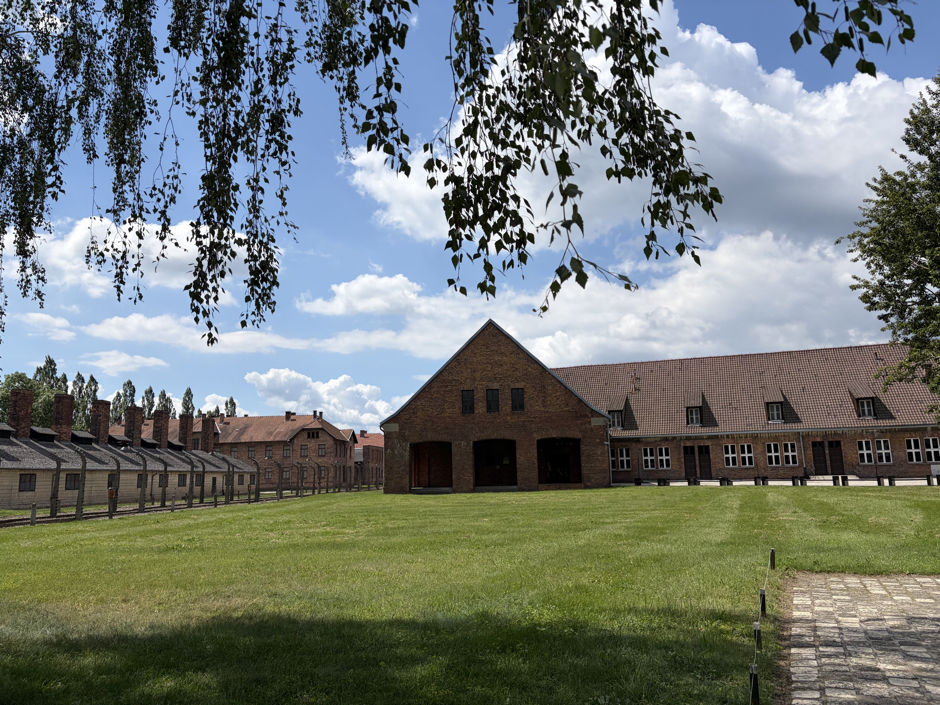
There’s never been a more critical time for educating young people and ourselves about what happened when Hitler rose to power, started a war, invaded countries, and enacted cruel and inhumane policies to eradicate those who didn’t fit his definition of a master race. There’s no better time to actually visit Auschwitz and Birkenau, two of the death camps 90 minutes outside of Kraków, in Poland.
Auschwitz
If you do visit Auschwitz, be prepared. This isn’t Disneyland. But the guides are knowledgeable and well trained. Originally the buildings were used to house transient workers, and later as a Polish army barracks. After Germany invaded Poland in 1939, Auschwitz soon was converted into a camp to hold prisoners.
The first people to be sent to Auschwitz were Polish. In 1940, German prisoners were sent to Auschwitz to help manage the prison population. Our guide described these workers as “functionary prisoners,” who, while they were technically still incarcerated, earned privileges, better housing and better food, working as guards. These functionary prisoners earned the reputation for being cruel, torturing prisoners, and establishing Auschwitz’s reputation as a sadistic prison.
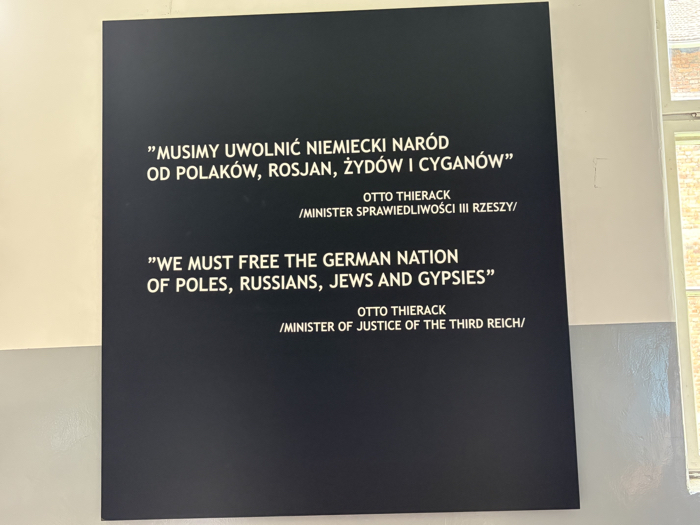
Our guide explained that while ethnicity was a factor in who would be sent to Auschwitz, more important was ideology. Those who quickly got on board with what the Nazi regime was espousing might be spared. Most Jews, of course, had no choice. They were the main target of the ethnic cleansing the Nazis promoted.
There’s some dispute about when the first Jews were sent en masse to Auschwitz, but little disagreement about how they were treated once they arrived. Most were misled to believe they were merely being relocated, and so arrived with their possessions packed in suitcases with their names and addresses printed on the outside. They were quickly relieved of these possessions. Piles of clothing, shoes, eyeglasses, prayer shawls, even prosthetic devices are piled high in exhibits.
Physicians were employed to evaluate the prisoners shortly after they arrived. Those found too frail or ill to work were sent directly to the gas chambers. Because the Nazi goal was to eradicate the future of Jews, children were also marked for death. (Some children were subjected to horrific medical experiments performed by Josef Mengele, the “Angel of Death.”) Those deemed fit for work were sent to the barracks. Ironically, upon entering Auschwitz, a sign above reads, “Arbeit macht frei,” “Work will set you free.” Few prisoners survived the abusive conditions for more than six months, our guide said.
Breaking Down the Prisoners
Heads were shaved, striped uniforms handed out, photos taken, and numbers assigned. These were the first steps in dehumanizing the detainees. The sheer numbers who were subjected to such treatment can be seen in the headshots that dominate the walls of the exhibit. What shocks is the youth of those in some of the photos. What might have these victims contributed to their families, their communities, their countries, and the world if they had lived? We will never know.
Such cruelty profited those who enabled and supported the Nazis. The women’s hair, for example, was kept and shipped to factories who used those locks to construct fabrics used in clothing and rugs. One exhibit shows piles of human hair that never made it to such factories.
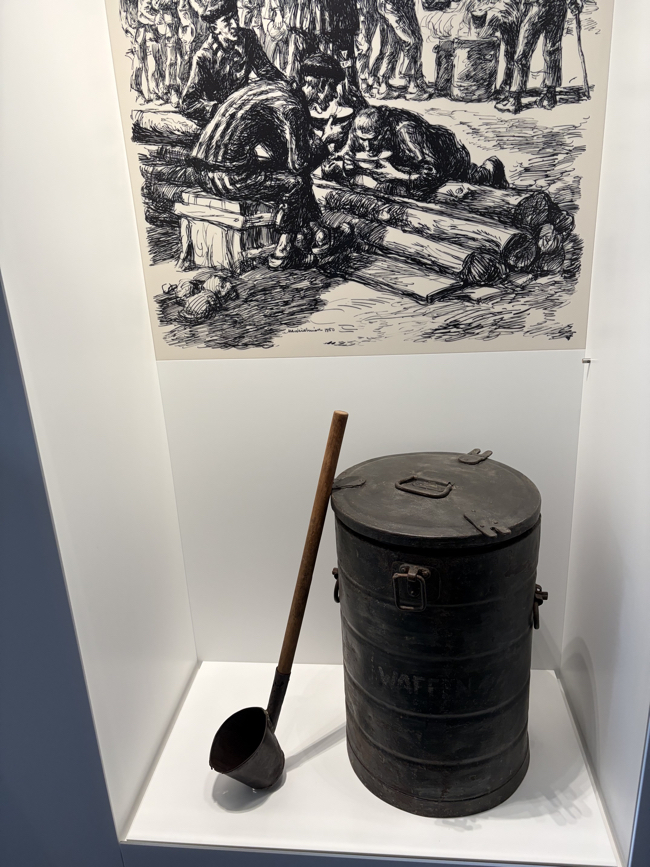
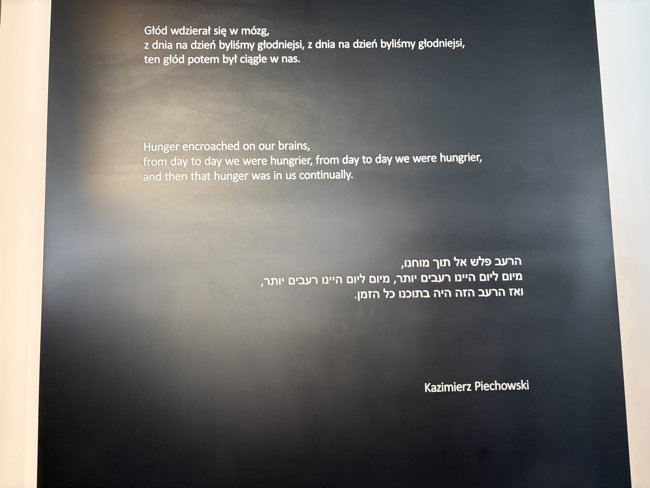
To truly weaken prisoner resistance, however, even crueler methods were employed. Food consisted of thin soups made with potatoes and cabbage, no protein, and doled out in quantities that would afford inmates around 1,000 calories a day. Hunger was rampant, and many inmates died of malnutrition.
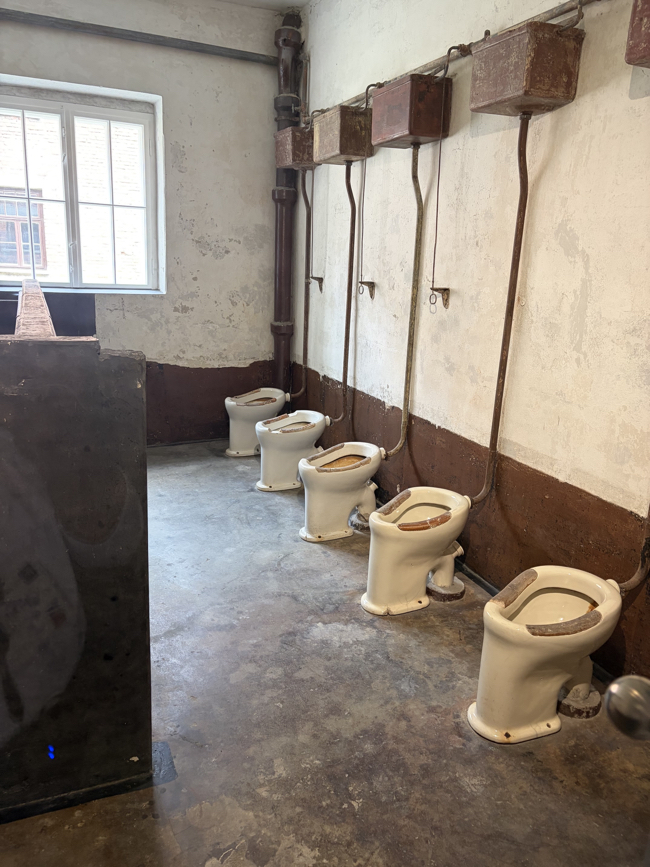
There was no privacy. Group toilets were set up in large rooms where prisoners were seated close together. Nothing was handed out for cleansing afterwards, no towels, no water. Our guide said that the guards were repulsed by the smells.
One person on our tour asked about those guards. Weren’t they being forced against their will to work at Auschwitz? Weren’t some of these Germans appalled by what they were seeing and, if given a choice, would opt out? Our guide explained that the officers at Auschwitz were at the top of the hierarchy, and if they wanted a transfer to another posting, would certainly be granted that request. In other words, they were part of the cruelty we were seeing.
Obfuscation
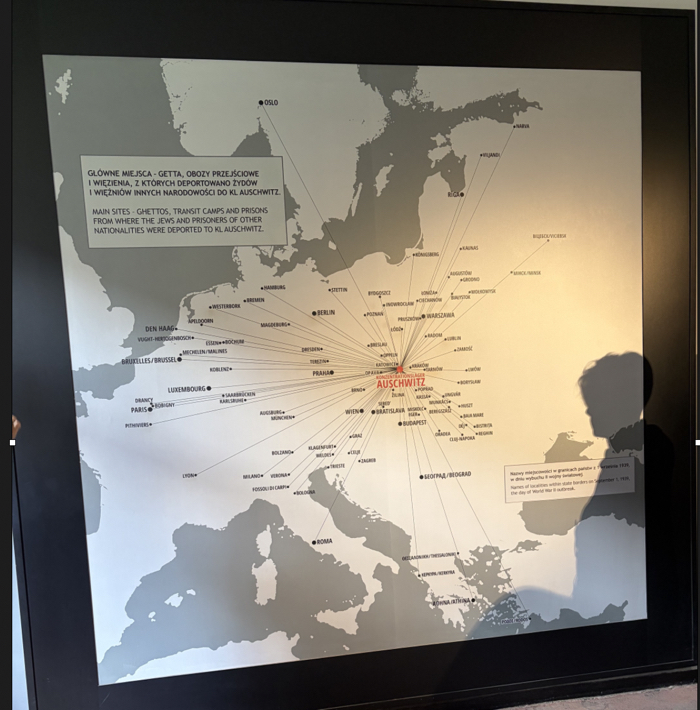
Auschwitz was the landing site for similar facilities around Europe, some as far away as Norway. In one room, a map is displayed showing the “ghettos, transit camps, and prisons, from where the Jews and prisoners, of other nationalities were deported to KL Auschwitz.” Our guide explained that this strategy helped the Nazis hide from many people what was happening at the camps. While there were rumors and reports about the inhumane conditions and deaths, many remained ill informed about what the Nazis were actually doing to carry out their plan for ethnic cleansing.
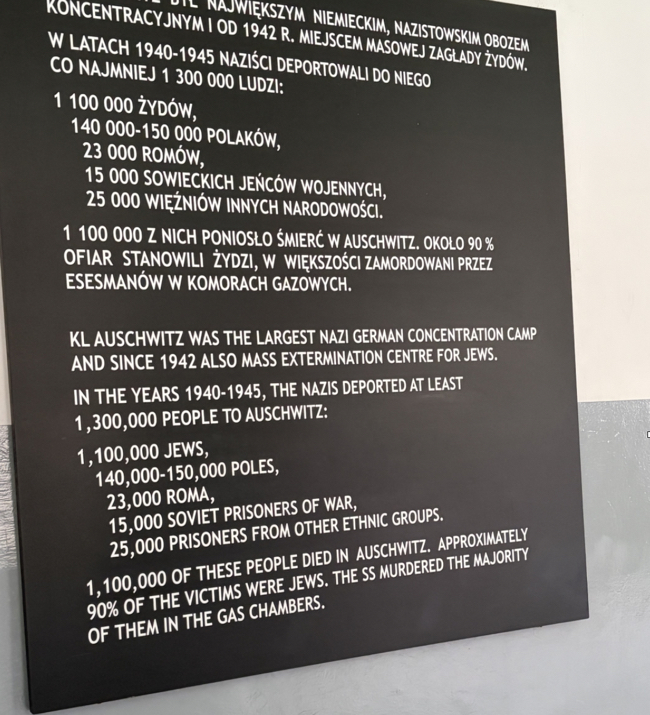
The numbers of people who died at Auschwitz – 1.3 million, in one estimate – is heartbreaking. But what’s truly astounding is how few survived. Our guide said that each year they attempt to find survivors to ask how they managed to live through the experience. One man said that he was young when he was brought to Auschwitz and had never fallen in love. He held out because he wanted that experience.
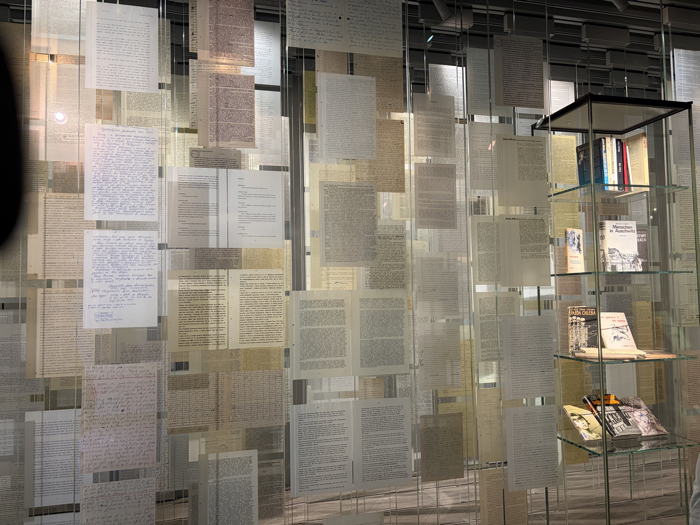
Left behind are writings from those who died and those who survived, detailing their experiences. The Nazis did themselves no favors by photographing their abuses. This evidence was later used to convict them of their crimes.
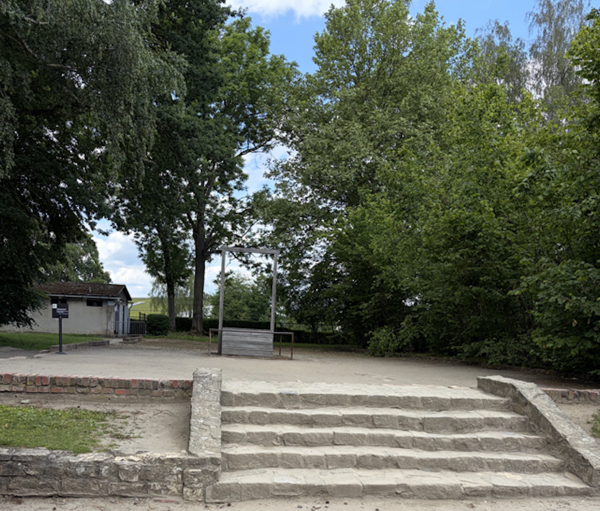
The head of the camp, Rudolf Höss, was eventually tried , sentenced to death, and the site of his hanging displayed at Auschwitz.
Birkenau
A short distance from Auschwitz is Birkenau, a camp built to hold the overflow from Auschwitz. There is less on display, but what is here is a sobering reminder of how the Nazis employed abuse and humiliation to break down prisoners.
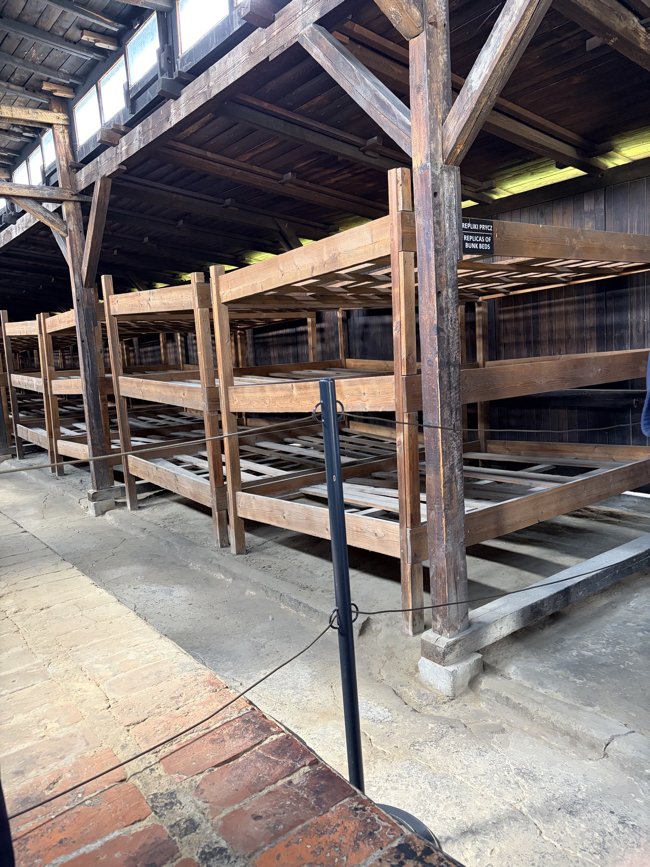
Bunk beds made of wood were meant to hold eight people on three levels. Overcrowding was inevitable.
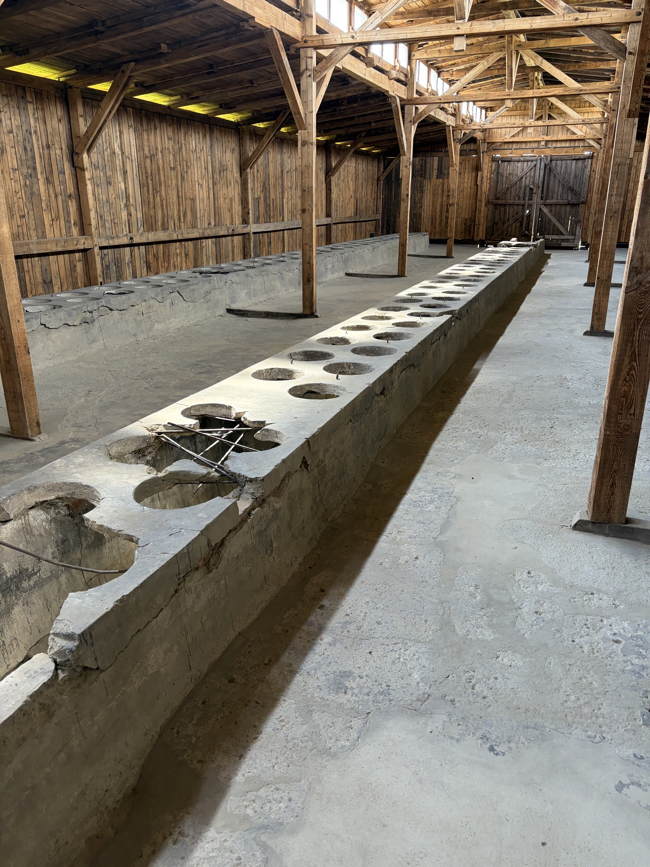
The toilet situation was even more primitive than what existed at Auschwitz. Once again, no towels or water was supplied for cleansing.
Before the Allied forces invaded, all the gas chambers at Birkenau were destroyed by the Nazis. Only one at Auschwitz survived as evidence of what had happened to those detained.
Legacy
Adolf Hitler first came to power in 1933 and Poland was invaded in 1939. For six long years, many came to understand that Hitler’s goal was to eliminate an ethnic group, a culture that he felt was inferior. But many others underestimated the strength of his support.
It’s hard not to reflect on what’s happening in our own country while walking through Auschwitz. As Santayana said, forget the past, risk repeating it. That’s a danger we still have time to avoid.
Top photo: Auschwitz
Photos by Woman Around Town