
Let me say right off, that Boston is a beautiful, diverse, and yes, clean city. The streets and parks look pristine, even though the city was hosting a regatta with thousands of sailboats as well as a No Kings March. Boston harbor, too, sparkles. After many years of being polluted, threatening fishing, one of the city’s major industries, officials got to work and cleaned up the waterway. We were told by our tour guide that the harbor has been cited for being the cleanest on the east coast. Checking online, I found that Boston has been lauded for improving its waterways, but so has New York. Neither has been named the cleanest.
It wasn’t the first exaggeration our guide told. In fairness, New York City guides do that, too. In the past I have accompanied family and friends on everything from those Hop On, Hop Off buses to the Circle Line and heard many distortions or downright lies about a building, event, or a famous New Yorker. I never correct a guide publicly. Their jobs are tough enough, presenting what is essentially a one or two hour lecture. And we truly enjoyed the presentations by our two guides, one on our bus, the other on our boat. Since we’re into fact checking these days, however, I couldn’t let some of what our guide told us pass.
We were told that 75 percent of Boston sits on man made land. Something that had people on our bus gasping. Online sources say that one-sixth to one-half of Boston sits on man-made land depending on whether that measurement includes the entire city or just its central neighborhoods. Whatever the actual percentage, a mind-blowing fact.
For those unfamiliar with the terminology, we were told that a pier was made of wood and a wharf was made of steel. Maybe, but online sources add that a wharf runs parallel to the shoreline, while a pier extends perpendicular at an angle over the water. The names were further confused since some piers have a name that includes wharf.
When we passed the area where two terrorists set off bombs during the Boston Marathon, our guide made a claim that caught the attention of several in our group. He said that because that area is near three Boston hospitals with trauma centers, more than 250 people would have died, rather than the three people who tragically were killed. More than 500 people were injured, many of them seriously, but no one has ever claimed 250 people would have died without being given prompt medical care.
Speaking of the Boston Marathon, our guide said that 40,000 people ran the 2026 one held each year on the first Monday in April. The official website says that 29,025 runners finished the Boston Marathon this year out of the 30,000 who began the race. To be off by a few hundred is fine, but by 10,000? In contrast, 59,662 runners finished the 2025 New York City Marathon, out of the 59,226 who began the race.
Harvard was mentioned and our bus guide took that opportunity to explain how Harvard became part of the Ivy League. He said that originally, there were only four colleges in that sports league, Harvard, Yale, Princeton, and Dartmouth. They were identified with the Greek numbers IV, thus “Ivy.” Later, he said, the other colleges – Columbia, University of Pennsylvania, and Brown, were added. I could find no information online to verify his tale. The Princeton website credits a writer from the New York Herald Tribune coining the name, mostly because of the greenery covering many walls in those universities.
We couldn’t help but notice two topics they emphasized – Boston sports teams, particularly the Boston Red Sox, and the Boston Tea Party. Guides like to ask people where they are from. Answer New York and be prepared to defend the Yankees. (After admitting he was from New York and pressed on whether he rooted for the Yankees or the Mets, one man wisely told the board guide, “No comment,” after being roasted by our bus guide.) In all the guided tours I’ve taken in New York, Boston teams, specifically the Red Sox, never come up. The idea that Yankees vs. Red Sox is the fiercest rivalry in sports, for many fans that no longer holds. In recent playoffs, the Yankees have more trouble with teams from Texas, Florida, and Canada. Boston fans, however, hold grudges. When one of the guides asked which sports figure incurred the wrath of bean town fans, the answer was, not Babe Ruth, but Tom Brady, who played his last years with the Tampa Bay Buccaneers, despite helping the New England Patriots win six Super Bowls!
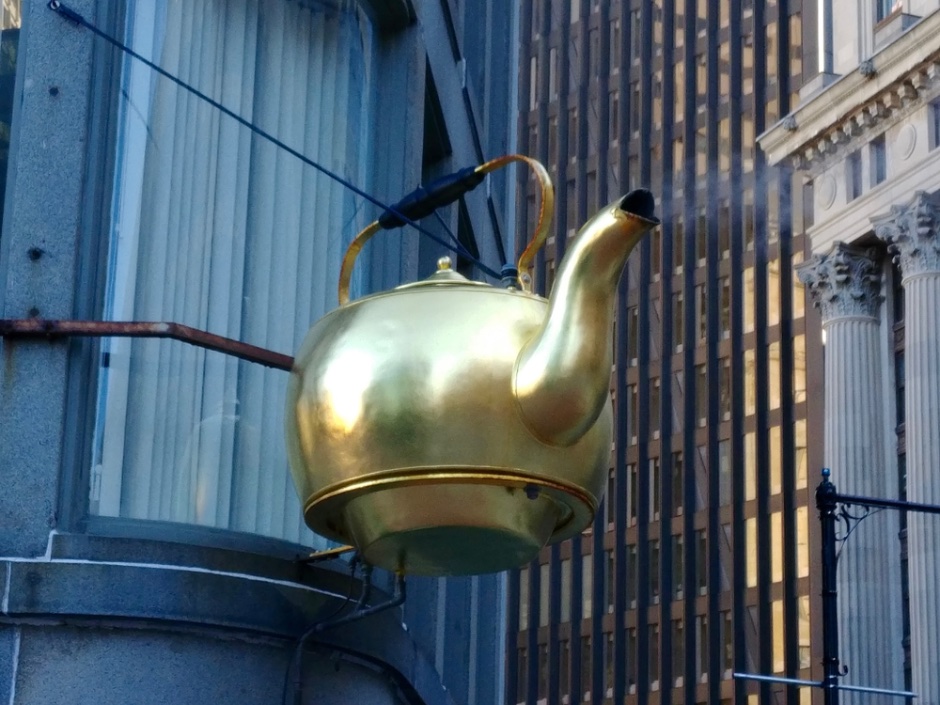
Boston played a major role in the American Revolution and one event was cited numerous times by our guides, the Boston Tea Party, when locals, dressed in Mohawk costumes to hide their real identities, dumped more than 340 cases of tea into Boston harbor. (We regret there was not enough time for us to visit the Boston Tea Party Museum.) Also commemorating the rebellious act is a large brass teapot spewing steam that hangs from the Government Center in downtown Boston (top photo).
Anyone who admitted being from England would be teased about that event which not only sent a serious message to the British troops, but became a galvanizing force throughout the colonies as Samuel Adams and Paul Revere spread the word about what the patriots had done.
But Massachusetts would find another way to celebrate liberation from British rule. On March 17, British forces were effectively evacuated from Boston, so that day became a state holiday known as Evacuation Day, while other states and cities around the country celebrate St. Patrick’s Day. Seems that in Boston, the two holidays exist quite happily together saying a lot about the adaptability and cordiality of Bostonians.
Top Shutterstock photo by quiggyt4