From February 27 through March 15, La MaMa will present the world premiere of Skysaver Production’s FOOTNOTES, created, designed, and directed by Theodora. Opening night is March 1.
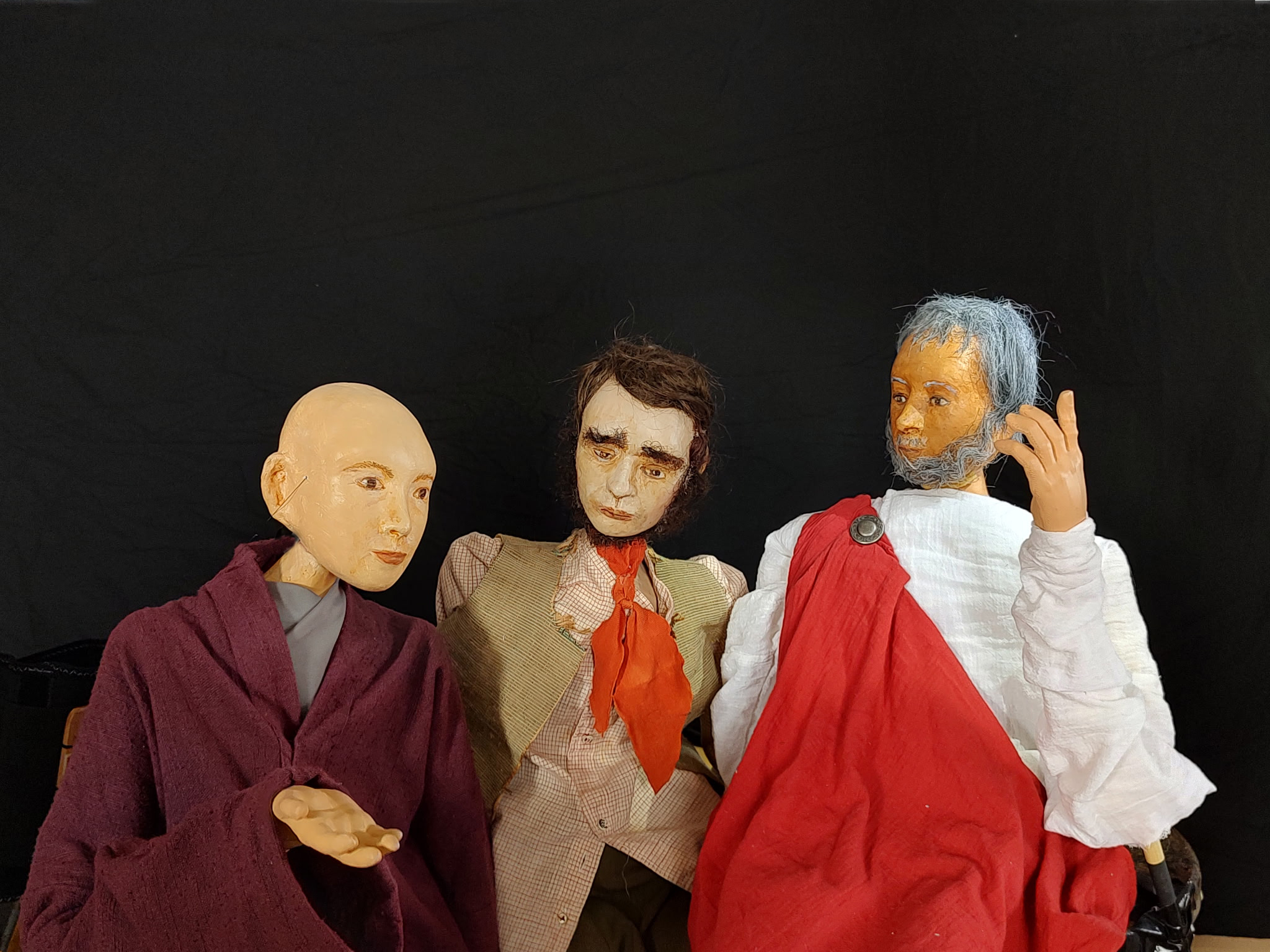
FOOTNOTES is an immersive multi-media puppetry performance. The show takes place in four distinct locations in the Ellen Street Theatre and explores the them of walking – its history, its science, its political power, its poetic and spiritual dimensions. The audience itself travels to several spaces within the theater, each member guided by a small booklet of instructions and stories. As they embark on their journey, the audience encounters a labyrinth, and several “famous” walkers throughout history: Aristotle who taught his lessons while walking, three medieval female pilgrims who walked thousands of miles, Henry Thoreau, Virginia Woolf and Mahatma Gandhi. The production features dozens of puppet figures, video, animated film, and live music composed and performed by Sxip Shirey.
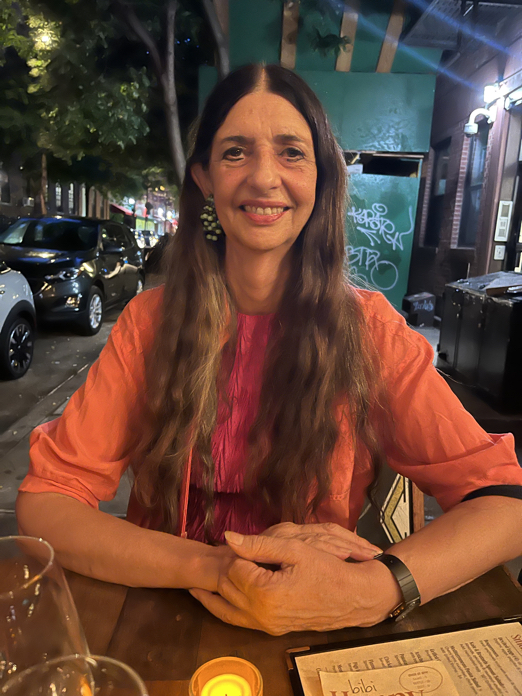
Theodora Skipitares
“I believe puppets are innocent beings, capable of telling the truth in a powerful way,” says Theodora. “That’s why I have always created puppets to tell important stories ab out American history, genetics, medicine, incarceration, food and famine, and racism. As I was researching for FOOTNOTES, I was thrilled by Rebecca Solnits’ book on the history of walking, WANDERLUST. She writes, `Walking came from Africa, from evolution and from necessity, and it went everywhere, usually looking for something. The pilgrimage is one of the basic modes of walking, walking in search of something intangible.'”
Can you point to one event that triggered your interest in your career?
My mother and her four sisters were expert seamstresses. At a young age, I started sewing costumes for myself. In high school, in San Francisco, I began doing outdoor performances with those costumes, painting my face and body. My sister had a driver’s license, so she would drive me to Golden Gate Park and wait in the car, keeping the engine running, in case my performance of the day was a flop and I had to disappear.
What about this career choice did you find most appealing?
It was thrilling to do these Sunday afternoon performances. Our strict parents thought we were going to the library. This deception added to the excitement.
What steps did you take to begin your education or training?
I studied sculpture and theater as an undergrad at U.C. Berkeley. After that, I came to New York and studied costume and set design at N.Y.U.
Along the way, were people encouraging or discouraging?
In grad school, I began to understand that my work didn’t fit neatly into conventional ideas of costume or set design for the theater. There were a few instructors who appreciated my ideas, but many did not. It was the early 1970’s and just a few blocks away, in downtown Manhattan, was a neighborhood called SoHo, that was exploding with exciting new art forms. I began to spend a lot of time in SoHo, and I believe that my frequent exposure to the multi-media performances was my real education/training.

Three Pilgrims Walking (Photo by Jan Leslie Harding)
Did you ever doubt your decision and attempt a career change?
There were many times when I couldn’t pay my rent. That was really difficult, but I think I’m very persistent, and I didn’t envision what else I could do besides make my art.
When did your career reach a tipping point?
My career reached a tipping point several times. I think most artists like me have ups and downs. I first received recognition from several European theaters and galleries as a “performance artist” in the 1970’s. At that time, I knew very little about puppetry. My work was part of a feminist wave of autobiographical performance, using my body to tell stories about my life. A few years later, I stumbled onto puppetry and its rich traditions as a unique storytelling art form. I slowly exited from the stage as a performer and added several small self-portraits onto the stage, and my identity as a puppeteer was born.
Can you describe a challenge you had to overcome?
When I first began using puppet figures in my work, I knew very little about the rich potential of puppet performance. Initially, I received a lot of resistance from part of the puppetry community who felt that the subjects of my work were too dark for puppet theater. However, as American puppeteers began to experience the work of master European and Asian puppeteers (largely due to the support of the Jim Henson Foundation), the range of “acceptable” subjects for puppet theater broadened, and support for my work grew. At this time (1980’s), more women were starting to be visible as creators of their own performance works.
What single skill has proven to be most useful?
I am a maker of things, from a variety of materials and techniques. In that way, I am like many contemporary puppeteers.
What accomplishment are you most proud of?
I have been a resident artist at La MaMa Theater for several years. This relationship has been a crucial support in my development as an artist.
Any advice for others entering your profession?
Be willing to present your ideas publicly as often as possible. Find a community of like-minded artists and support each other.
Top photo: Philosophers against black (Photo by Victoria Forbes)