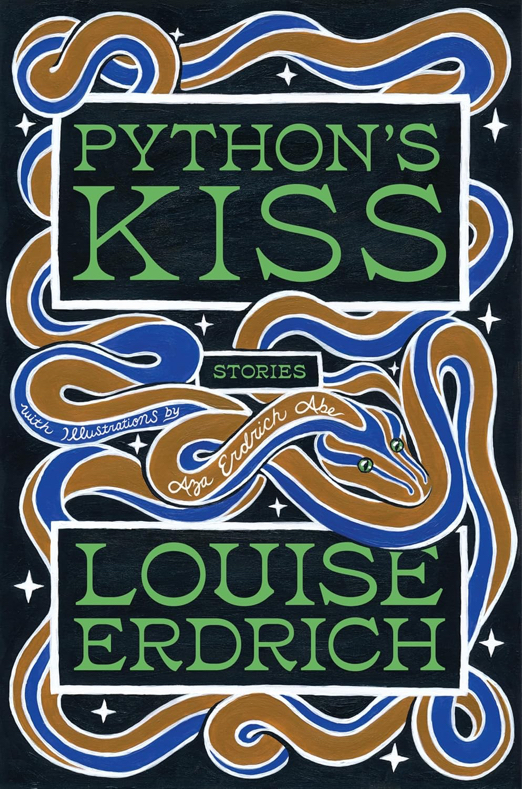
In the recent issue of Condé Nast Traveler, Louise Erdrich writes about visiting Naples, Italy in 2014 with her daughter, Aza Erdrich Abe. Even in this brief story, she manages to bring alive the sights, sounds, and smells of this Italian city, known for pizza, but so much more. Her collection of short stories, Python’s Kiss, includes illustrations by Aza and it’s clear this mother-daughter team is on the same wavelength. Throughout the book, Aza’s black and white drawings echo Louise’s prose. After finishing each story, if there was an illustration, I found myself studying the image for additional insight.
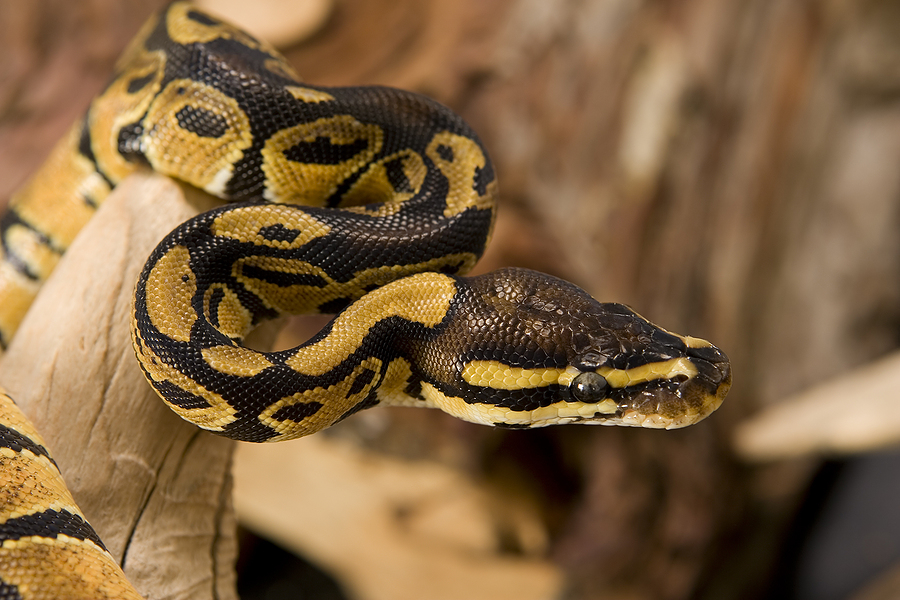
The collection begins with the title story, “Python’s Kiss,” about a grocery store, a little girl, and a dog named Nero, “the second or perhaps the third,” owned by her grandparents. Rail thin at eight years-old, the girl develops a tenuous relationship with the large dog whose brownish gold eyes looked like hers. She is fascinated with his determination to escape his fenced in enclosure to reach a female dog, Mitts, who lives next door. Even tossing Nero gingersnaps does nothing to deter his efforts. Uncle Jurgen keeps building the fence higher, but Nero always manages to climb over. Mitts’ mistress, Priscilla, is much sought after by the men in the town, but time after time, her father, Mr. Gamrod, fights and sends them packing. But, Priscilla tells the little girl, he won’t get rid of the next suitor, who turns out to be Uncle Jurgen. When the two face off in her grandfather’s yard, their fight reminds her of the time a tarantula and two snakes, one a python, terrorized her grade school class.
In “Wedding Dresses,” four of Dora’s wedding dresses are damaged when a pipe bursts in her basement. When her 11 year-old niece, Martha, asks her what those four wedding dresses stand for, she explains the dresses and her four failed marriages. Love affairs that went wrong, but fascinating nonetheless.
Two stories imagine what a life after death looks like. In “Domian” seven corporations control the afterlife. In recognition of those who always need to be at the top, many amass funds to be able to land into the best. But Bernadette has other plans and the manner in which her strategy unfolds is genius. The following story occurs in “Asphodel,” the best after life place. The struggle focused on occurs between a mother and a daughter, both vying for an existence in eternity.
In “December 26,” a son, Devlin, tries to explain to his mother what happened when one of his friends, Wade, takes him to a farm upstate where a couple collects exotic animals, including a Siberian tiger. What he describes is gruesome and shocking, but most upsetting is what his mother learns about her brother, Raf, and her ex, Kenny.
There’s humor in “Big Cat” where a man tries to cope with his wife and her family, all of them snore quite loudly when they sleep. His wife, Elida, is petite and doesn’t look like someone who would snore. But the noise is so overwhelming, he often sleeps in another room. He doesn’t blame her or her relatives, since they have sought out ways, even operations, to stop their snoring. Eventually he divorces Elida, but even with her snoring, she remains his soulmate. Tough decisions are made. Anyone who lives and sleeps with a snorer will relate.
While it’s easy to read this collection straight through, it’s best to take pauses to absorb, reflect, and ponder each one. (And, of course, to look at Aza’s drawings.) These are multi-layered tales and endings are often elusive which allows us to think, pause and perhaps make up our own.
Python’s Kiss
Louise Erdrich
Top Bigstock photo by rhambley
Our editors love to read and independently recommend these books. As an Amazon Affiliate, Woman Around Town may receive a small commission from the sale of any book. Thank you for supporting Woman Around Town.