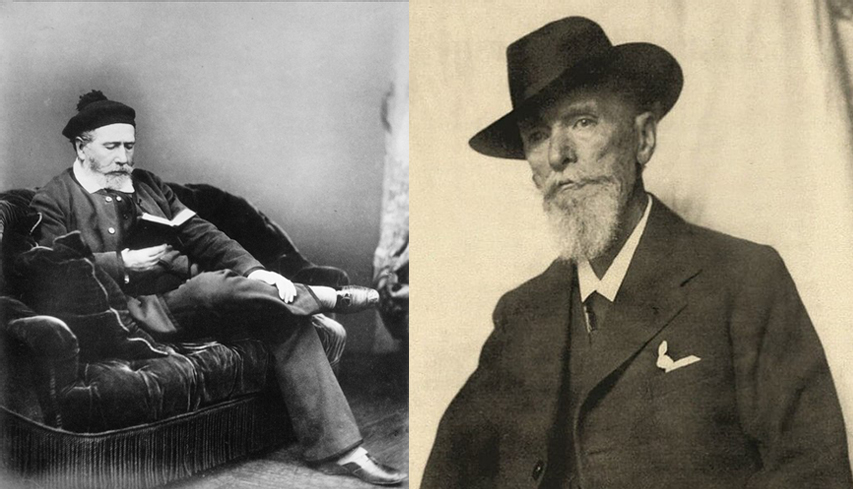
Based in part on a Smithsonian Associates lecture by author/curator, Fabergé expert, Kieran McCarthy and author/curator, Cartier descendant, Francesca Cartier Brickell.
Fabergé and Cartier, historically the most iconic houses known for precious decorative art and jewelry, were both established by young men of modest circumstances. Though both created objects and wearable art, the first is primarily famous for ornamental and functional pieces – including its fabulous eggs – the latter for personal adornment. While competition was constant, business approach couldn’t have been more different.

Peter Carl Fabergé Tea Set before 1896 Creative Commons CC0 1.0 Universal Public Domain Dedication
The Fabergé family’s origins can be traced back to 17th-century France under the name Favri. Religious persecution drove them across Europe to Russia. Gustav Fabergé (1814-1894), who trained as a goldsmith, founded the business in a St. Petersburg basement in 1842. Its name was changed to appeal to Francophile Russian nobility. The establishment was, we’re told, “pedestrian.”
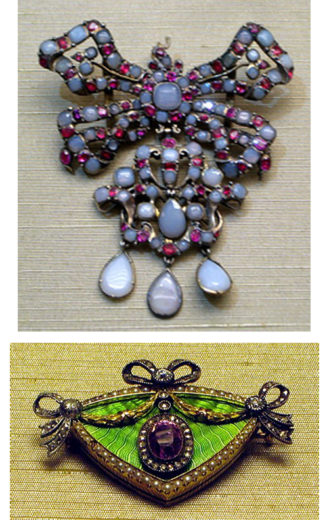
Fabergé Jewelry: Top- Bow Brooch Creative Commons Attribution-Share Alike 3.0 Unported license. Bottom-Topaz Brooch Creative Commons Attribution-Share Alike 3.0 Unported license.
Son Peter Carl was educated in business and studied goldsmithing before taking over the firm. Under him, the atelier, in an industrial area next to the Winter Palace, became a hive of craftspeople who could design and work in any element. Its reputation was established by repairing and restoring objects for the Hermitage Museum after which Fabergé was invited to the Pan-Russian Exhibition in Moscow. Tsar Alexander III then bestowed the title “Goldsmith by special appointment to the Imperial Crown.”
Louis Francois Cartier (1819-1904) was an apprentice jeweler who did so well he was able to buy his master’s Paris workshop in 1847. Timing was terrible. The Franco-Prussian War and siege of Paris made survival difficult. Son Alfred purchased jewelry from desperate Parisians selling it for profit in England. His three sons, Louis (creative), Pierre (a businessman), and Jacques (a mixture), built the foundation for Cartier as it became. All married well, bringing money and cachet to the firm’s signature. Louis wed the daughter of couturier Charles Frederick Worth, creating an association with fashion that would serve the house well.
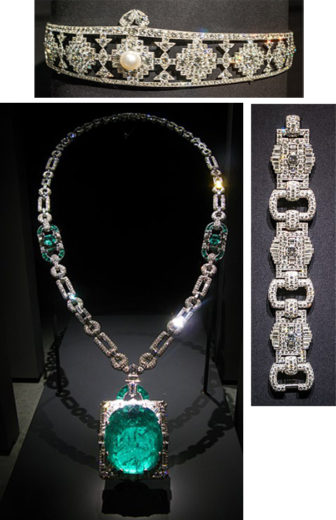
Cartier Jewelry clockwise: Natural pearl, diamonds, and platinum bandeau, a narrow strip worn around the forehead. 1924 Creative Commons Attribution-Share Alike 2.0 Generic license. Cartier Linked Bracelet Creative Commons Attribution-Share Alike 2.0 Generic license; Huge emerald set in art deco diamond and platinum pendant 1931 Creative Commons Attribution-Share Alike 2.0 Generic license.
In 1885, Tsar Alexander III commissioned the House of Fabergé to make an Easter egg as a gift for his wife. Its “shell” is enameled on gold to represent a hen’s egg. This pulls apart to reveal a gold yolk, which in turn opens to produce a gold chicken that also opens to reveal a replica of the Imperial Crown from which a miniature ruby egg was suspended. Two years later, continuing the tradition,, Carl Fabergé was given complete freedom of design, the only stipulation being each egg must contain a surprise. Some of the most imaginative and intricate designs and mechanisms in decorative arts are embodied in the “collection.” Possibly as many as 69 were created, of which 57 survive today.

Diagram of the Third Imperial Egg Creative Commons Attribution-Share Alike 4.0 International license.
Unlike their entrenched competitors, Louis, Pierre, and Jacques Cartier set out to internationally source suppliers, craftsmen and inspiration. Though Fabergé was so successful at Paris’s L’Exposition of 1900 it couldn’t keep up with orders, it was Cartier who installed outposts elsewhere, the first in London. (Both later had pop-ups in one another’s beachheads.) “Oxford Street is for the world, but Bond Street is for princes…the air one breathes is made of gold,” Jacques stated about their shop location. The Queen Mother gave George V a Cartier clock, not one created by Fabergé.

Left: Bouquet of Lillies Egg Creative Commons Attribution-Share Alike 3.0 Unported license. Right:Egg/frame Fabergé Museum St. Petersburg Russia Creative Commons Attribution 2.0 Generic license.
“The Petersburg jewelers are trying to obtain a decision prohibiting our firm from trading in Russia,” Louis Carrier wrote home in 1911. Apparently the Frenchman was actually arrested for smuggling. “One Hundred Years After Napoleon There is Another Invasion of Russia by the French!” one headline exclaimed. There’s no proof the action was promoted by Fabergé, but…Needless to say, things were cleared up without consequence.
Fabergé’s miniature carvings of animals out of semi-precious or hardstones embellished with precious metals and gems preceded those of Cartier. The British Royal family has over 250 of these. Flower sculptures emerged as complete tableaux including small vases in which fauna was permanently set. When Cartier followed suit, its versions were more delicate, arriving encased in glass. Both houses created picture frames and clocks. Cartier’s “mystery clocks” were particularly desirable. Seemingly floating hour and minute hands are mounted to a transparent rock crystal, but give the illusion the clock is running without gears. Cartier also popularized wristwatches for men.
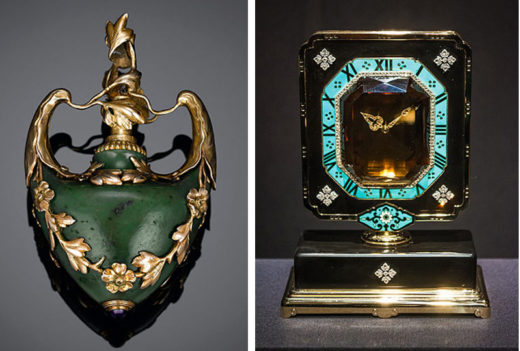
Left: Nephrite Jade Bell Push by Fabergé. Circa 1890 Creative Commons Attribution-Share Alike 4.0 International license. Right: Cartier 1921 Mystery Clock Creative Commons Attribution-Share Alike 2.0 Generic license.
For some time, neither firm advertised. One had to know where they were situated and when they were open. Royalty often appeared in person. Commissions made up a large proportion of business. Royalty kept both firms flush for considerable time. More forward thinking, Cartier exhibited often and eventually “succumbed” to the practice of promotion.
World War I affected both firms. Pierre Cartier enlisted. Jacques moved to London to keep that branch open. In Russia, Fabergé turned to manufacturing munitions and syringes. With wealth being thought of as “what was wrong with Russia” the latter business continued to decline. In 1917, its bricks and mortar space became Abdulla Tobacconists. The “brand” briefly continued in Paris as Fabergé et Cie and was later sold several times in the perfume and cosmetics area.
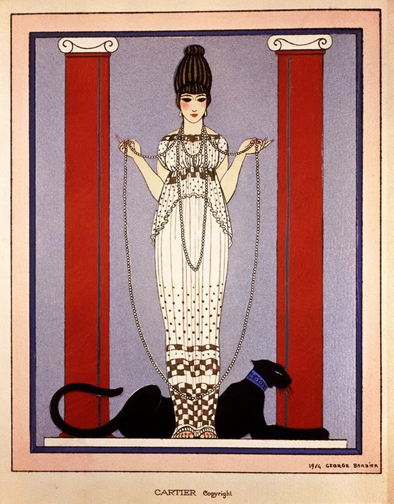
Lady with Panther by George Barbier for Cartier, 1914. (Public Domain)
Cartier innovated even while Fabergé held to output, style, and traditional methods. “As fashions change, we have to change.” (Louis Cartier) When heavy dresses were exchanged for lighter materials, the weight of a brooch adapted. With flapper haircuts came dangling earrings. In the 1920s, tiaras morphed to a style that draped over the forehead. Cigarette and make-up cases arrived appropriately timed.
In 1909, Cartier established itself in New York in a Fifth Avenue building bought from tycoon Morton Freeman Plant in exchange for $100 in cash and a double-stranded natural pearl necklace valued at the time at $1 million. After Pierre’s death in 1954, the business was sold. It still prospers worldwide.
Opening- Left: Louis-François Cartier by Nadar (Public Domain) Right: Peter Carl Fabergé (Public Domain)
‘The Cartiers’ by Francesca Cartier Brickell
‘Faberge in London’ by Kieran McCarthy