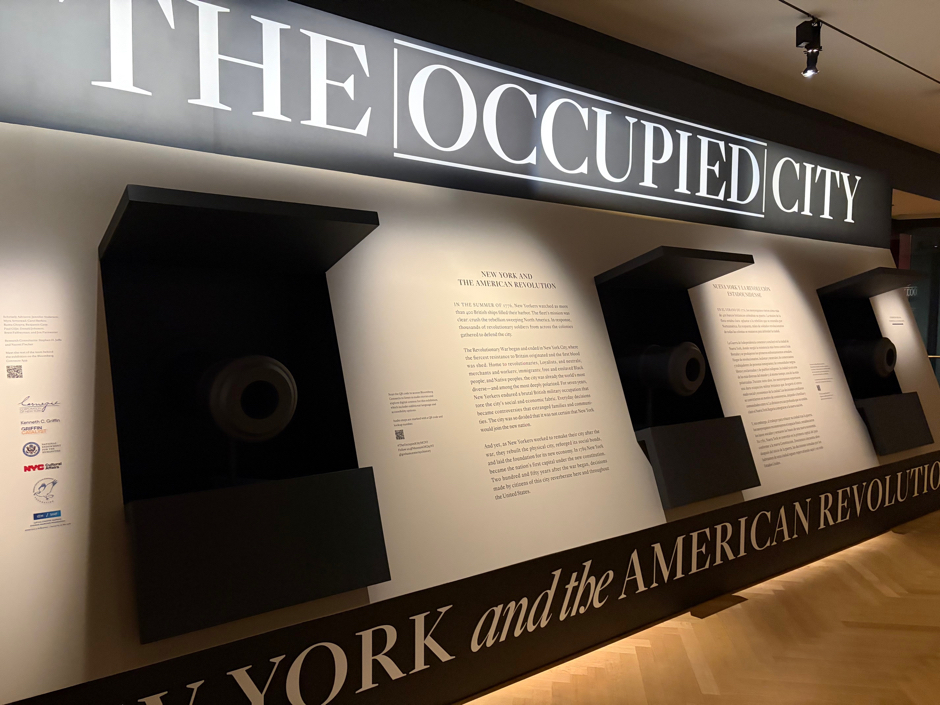
On Wednesday, April 28, the media was able to walk through “The Occupied City: New York and the American Revolution” which takes up the museum’s entire third floor. “This exhibition reminds us that New York was not merely a backdrop for the American Revolution. It was at the center of it—a city shaped by conflict, debate, and the lived experiences of a diverse population navigating profound uncertainty,” Stephanie Hill Wilchfort, Ronay Menschel Director and President of MCNY said in her opening remarks. “Yet this is not simply a story of hardship. For us at the Museum of the City of New York, it is also a story of optimism. It shows how earlier generations faced immense challenges and, through resilience and imagination, helped build the nation we know today.”

Stephanie Hill Wilchfort, Ronay Menschel Director and President of MCNY
That hope and resilience is certainly needed today as we deal with an administration intent on restricting the freedoms enshrined in our constitution, written after we finally freed ourselves from rule under a British king.
Hill Wilchfort noted that New York was the most diverse place in the world in 1776, and it remains so today. “This exhibition reflects that diversity, bringing forward the stories of patriots and loyalists, enslaved and free Black New Yorkers, Native communities, immigrants, and women,” she said. “It highlights how civic life in this city has always been shaped by interactions among people of different backgrounds.”
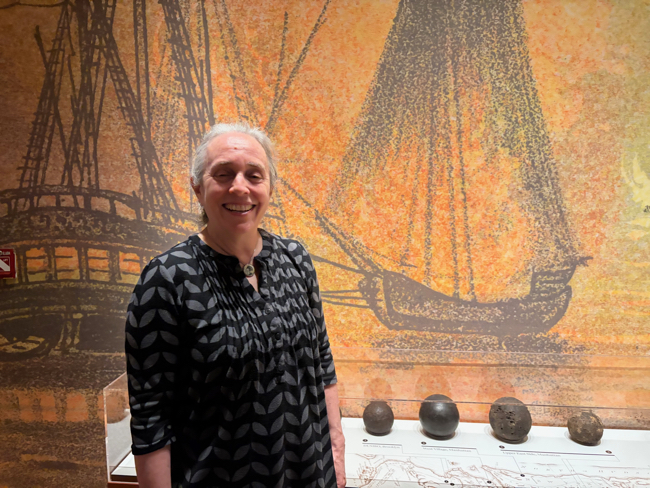
Sarah Henry, Senior Scholar and Curator Emerita of the Museum of the City of New York
It took an army of museum specialists to put together this extensive exhibition, beginning with Sarah Henry, the museum’s senior scholar and curator emerita, whose “enthusiasm helped bring this idea to life from the very beginning,” Hill Wilchfort said. “We invite visitors to see the American Revolution not as a distant event, but as a lived experience—one that continues to resonate. We hope it sparks reflection on enduring questions about freedom, inclusion, and civic responsibility.”
The exhibition does not shy away from exposing the moral complexities that existed, not only in New York, but in the colonies. A new generation of historians, including scholars writing today about figures like Thomas Jefferson, has emphasized this duality: men who spoke powerfully of liberty while remaining deeply entangled in slavery. Nowhere is that contradiction more visible than in New York during the American Revolution.

In 1772, Somerset v Stewart was a landmark English court case where Lord Mansfield ruled that chattel slavery was unsupported by common law in England and that an enslaved person could not be forcibly removed from England by their master. The decision freed James Somerset, an enslaved African, and was widely interpreted as making slavery illegal within England.
With the British battling the colonies where slavery was still legal, many enslaved people wondered what did this war mean for them? The British issued proclamations offering freedom to enslaved people who escaped rebel masters and joined their side, Sarah Henry said. “Almost overnight, New York became a refuge—a magnet for thousands of Black men, women, and children fleeing bondage. They were known as Black Loyalists, and they came not out of loyalty to the Crown, but out of a fierce determination to claim their own freedom.”
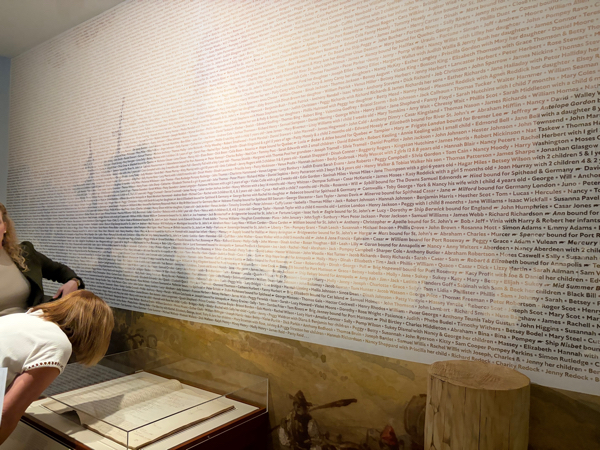
“Inspection Roll of Negroes”
By the war’s end, the city was crowded with them. And as the British prepared to evacuate in 1783, a pressing question arose: what would happen to those who had risked everything to support them? The British answered, at least in part, through a series of hearings known as the Book of Negroes. There, they recorded names and stories, and ultimately granted freedom and safe passage to roughly 3,000 people. It was the largest single act of emancipation in early American history. One wall of the exhibition includes the names of these people.
Among those who left was Harry Washington. Enslaved by George Washington at Mount Vernon, he escaped, joined the British, and later resettled in Nova Scotia. Eventually, he would travel even farther, becoming a leader in Sierra Leone—his life tracing a global arc shaped by the Revolution.
By Evacuation Day, New York was a city in ruins, Hill Wilchfort said. “Its economy had collapsed, its people were exhausted, and its future was deeply uncertain,” she said. “And yet, within a decade, New York emerged as the nation’s economic engine—a position it continues to hold. This transformation reflects a larger truth about our city: out of devastation and loss have come creativity, reinvention, and growth. New ideas often emerge from moments of great struggle.”
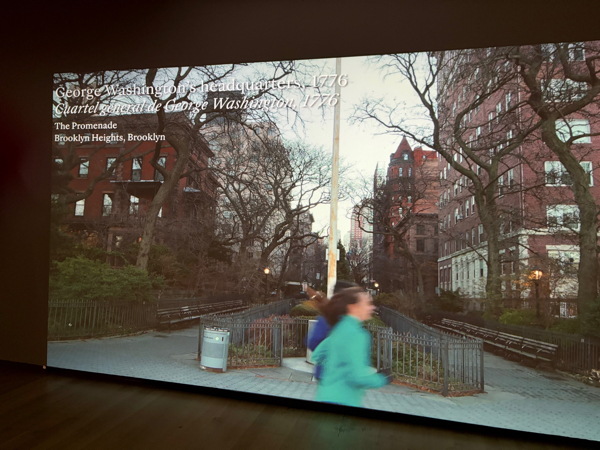
Plan to spend a good deal of time exploring all the facets of this exhibition. In one room, videos of present day New York mark where some of the war’s major events took place. There are recreations of a coffeehouse, tavern, and a vignette devoted to Alexander Hamilton. And there’s that famous portrait of George Washington along with artifacts from his life, including a lock of his hair and eyeglasses.
Elisabeth Sherman, Robert A. and Elizabeth Rohn Jeffe Chief Curator and Deputy Director, shone a spotlight on the “encounter stories” included in the exhibition. “Stories like that of women who resisted British goods by spinning their own cloth at home,” she said. “Or Solomon— a Jewish immigrant from Poland—who joined the Sons of Liberty and advocated for the Patriot cause.” She added: “What struck me most about these stories is how immediate they feel. The people in this exhibition—whether familiar or newly discovered—were living through their own uncertain present. Their moment was as urgent to them as ours is to us today.”
Throughout the exhibition’s run, the museum will host a series of public programs featuring leading historians, journalists, and scholars, who will explore how the American Revolution shaped New York City and the nation. “We are also proud to offer a wide range of educational programs, including field trips, curriculum resources, teacher development, and family programming,” Sherman said. “Each year, the museum serves more than 35,000 students and educators, and through an expansion of our civics education work, we aim to reach many more young New Yorkers in the years ahead.”
The Occupied City: New York and the American Revolution
Opens May 1, 2026
Museum of the City of New York
1220 Fifth Avenue at 103rd Street
Photos by Woman Around Town