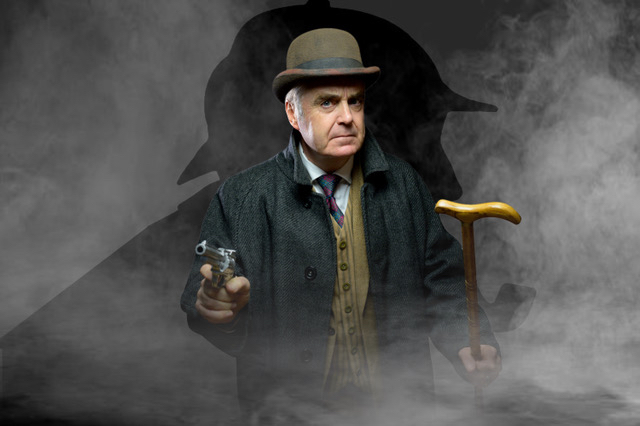
“I believed that one man could make a difference,” says Dr. John Watson. That man was his friend, the consulting detective Sherlock Holmes.
A clever one-act one-man show called Watson: The Final Problem opens in 1894, three years after Holmes’s death, as Dr. Watson (Tim Marriott) limps downstairs. He’s in pain, both literal (from his Afghan war wound) and dramatic, not only from sad memories of Holmes but from the recent death of his wife, whom he met in one of Holmes’s most famous cases, “The Sign of the Four.”
Watson chides the audience over the likelihood that they already know about Holmes, from “The Speckled Band” and other stories that he has written, up through 1894. But it’s an anachronistic joke: no other fictional character has enjoyed such a long and varied afterlife in pastiche stories, movies, cartoons, advertisements, etc. Holmes is a cultural icon if ever there was one. But you don’t have to know much about him to enjoy the play.
Unless you are already a Sherlockian (U.S.) or Holmesian (U.K.) enthusiast, you probably have not read all 56 short stories and four novels that Arthur Conan Doyle wrote in “Watson’s” voice. Some, however, will recognize the source of this clever collaboration between Marriott and his director Bert Coules. It’s the story Conan Doyle titled “The Final Problem”—his (ultimately unsuccessful) attempt to quit writing Holmes stories by killing him off.
In the story and in this play, Holmes dies offstage in hand-to-hand combat with his arch-enemy Professor Moriarty, whom he calls “the Napoleon of Crime.” After a chase across the Continent, they plunge to their deaths together in the chasm below Switzerland’s Reichenbach Falls.

Tim Marriott as Dr. Watson
A good pastiche should advance the sum of Sherlockian/Holmesian knowledge; and Marriott and Coules have done so with a brilliant take on what motivated both the master criminal and the master of detection. Holmes and Moriarty are intellectual equals, but every man, says Watson, has “a shadow self”: an unsavory alternate persona. Thus Moriarty is what Holmes might have become if he had taken up the criminal life instead of fighting against it; whereas Moriarty, in this metaphor, gave up an academic career in mathematics to be “a slave to his shadow.”
That line hits home quietly. Other lines draw a chuckle. One, near the end, comes when Watson explains why he is telling this admittedly melodramatic tale. “Nowadays,” he says in 1894, but still true 130 years later, “it is almost impossible to tell fact from fiction.”
Photos by Carol Rosegg
The play is produced by Twilight Theatre Company and Smokescreen Productions. Enhanced by original music composed by Clive Whitburn, under lightning designed by Anna LeClair, and stage-managed by Madeleine Blossom, Watson: The Final Problem runs through June 9 in the multiplex theater 59E59 at 59 East 59th Street 646-892-7999
If you miss it there, however, you can catch Marriott reprising it aboard the Queen Mary 2, sailing from New York to Southampton on July 27.