Based, in part, on a Smithsonian Associates Lecture by documentary filmmakers Paul Glenshaw and Darroch Greer.
Introduced by Black American Soldiers during and following World War I, jazz became the epitome of cultural bond between France and the United States. Racial discrimination was illegal. The French welcomed the music and its purveyors in a way that segregated America did not.
One of the first proto-jazz artists (bandleader, composer, arranger) to arrive In Paris was James Reese Europe, whom Eubie Blake eventually called “The Martin Luther King of music.” Members of The Clef Club, a society for Black Americans in the music industry, his ten-piece band was traveling with dance originators Vernon and Irene Castle when World War I broke out. The U.S. wouldn’t let African Americans serve with White Americans, so many volunteered in France.
Reese Europe fought with the 369th Infantry Regiment that was known as The Harlem Hellfighters because it was all Black. He lead a regimental band traveling 2,000 miles through France in the last year of the war. Afterwards, the musician returned to the States resolved: “We colored people have our own music that is part of us. It’s the product of our souls.”
New Orleans native and professional drummer Louis Mitchell left James Reese Europe’s band to start Mitchell’s Jazz Kings, the first group to use the word jazz in its name. At the Casino de Paris, this band turned stars Mistinguett and Maurice Chevalier into jazz converts. “The music was a tonic for ailing France,” our hosts tell us.
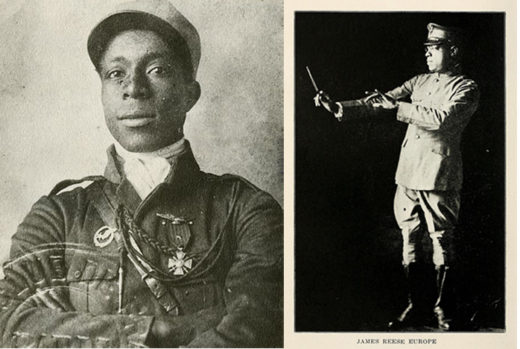
Eugene Bullard in Legionnaire Uniform (Public Domain); James Reese Europe 1922 (Public Domain)
Eugene James Bullard was the first African American fighter pilot and decorated with the Croix de Guerre, one of France’s highest military honors. He became a jazz drummer after lessons from Louis Mitchell. The veteran worked at several post war clubs, later purchasing Le Grand Duc which, though unsegregated, particularly catered to Black entertainers and patrons. One of Bullard’s dishwashers was poet Langston Hughes. Ernest Hemingway based a minor character on him in The Sun Also Rises. When World War II began in 1939, Bullard, who also spoke German, was asked by the French to spy on German citizens who still frequented his venue.
Bullard hired entertainer/hostess Florence Embry Jones who made the club a success. Langston Hughes referred to her as a “Petite, lovely brown vision, the reigning queen of Montmartre after midnight.” Jones then moved to a new club owned by Louis Mitchell who renamed it Chez Florence so customers would know where to find her. Chaplin, Hemingway, Picasso, Fatty Arbuckle, Edward G. Robinson and Gloria Swanson showed up.
When Jones left, Bullard was left without a draw. He imported entertainer Ada “Bricktop” Smith to sing at what she found was his distressingly small club, “about 12 tables and a small bar that would look crowded with six pairs of elbows leaning on it.” (Her quote.) Smith proved able competition to Jones. Cole Porter, the Scott Fitzgeralds and the Duke and Duchess of Windsor were habitués – the Duke liked to sit in on drums. Vocalist Jimmy Hughes observed “she had all the royalty of Europe at her tables.” Eventually, she too opened a club of her own called Bricktop’s.

Syncopated Orchestra on Tour (Creative Commons Share Alike)
And there was Joe Zelli’s self-named boite, whose second location became The Royal Box (so-called ‘royal boxes’ were set along a balcony). Having paid a special tax, his was the only club to stay open till dawn, then closing after breakfast. There were table-to-table telephones and attractive dancers willing to keep patrons company. Zelli squired Josephine Baker around for a time. Eugene Bullard became part of the in-house Zig-Zag club band as the drummer and manager of the club’s musicians.
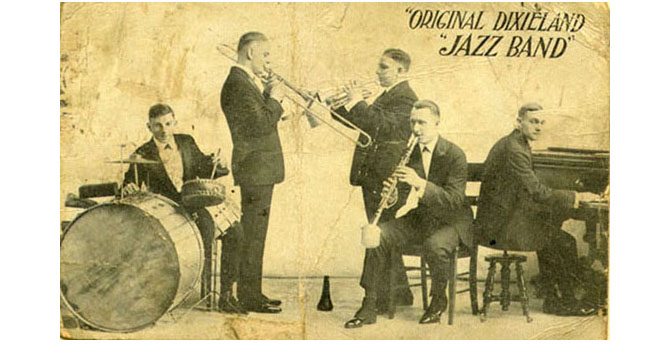
During the war, France was invaded by two million Americans, many of them Black, providing a ready-made audience for this kind of music. The Great American Dixieland Jazz Band, called “a noisy novelty group” by Glenshaw and Greer, took credit for inventing jazz. The Southern Syncopated Orchestra lead by Will Marion Cook arrived with vocalist Noble Sissle and pianist Eubie Blake who would later write the musical Shuffle Along, the first all Black hit Broadway show.
“What was missing up till then were the Blues,” the hosts note. This may have been introduced by soprano/ saxophone/clarinet player Sidney Bechet. The musician couldn’t read music but was the only member of the orchestra permitted to improvise despite difficult temperament. He’s considered by many to be the first jazz soloist and became so attached to Paris, took up residence there in 1950.
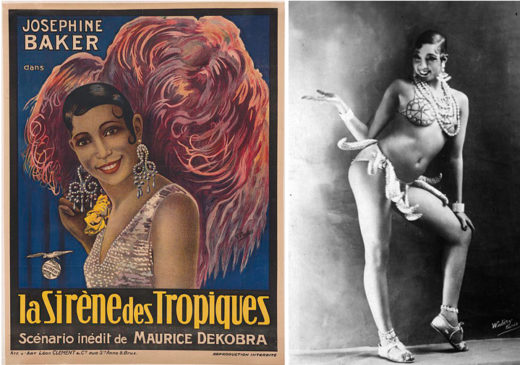
Josephine Baker la Sirene 1927 (Creative Commons: Public Domain); Wallery Girdle of Bananas (Public Domain)
The person Glenshaw and Greer call “the icon of the Jazz Age” didn’t appear until 1925. Nineteen year-old, St. Louis born Josephine Baker began as a chorus girl in Sam Woody and His Chocolate Kiddies. In a short time, the flamboyant, loose-limbed, untrained artist rose to star La Revue Nègre with African dance (gyration). Her provocative, mostly nude banana costume and pet cheetah on a leash enhanced mystique. “Baker wasn’t much of a singer or dancer, but she took Paris for a storm,” our hosts tell us. She lead an extraordinary life, adopting a “rainbow tribe” of children (with questionable methods) and earning the French Legion of Honor for war work.
The Depression followed and with it a mass exit of Americans. French musicians turned to their union who instituted The 10% Law = only 10% of a band could be foreign born. “During this time, two of the most important musicians in jazz came to Paris. Edward Kennedy ‘Duke’ Ellington and Louis Armstrong, the latter who ironically arrived to recuperate having slit his lip during an over extended tour. These rising stars took jazz out of Montmartre to concert hall La Salle Pleyel
In 1932, Journalists Hughes Panassie and Charles Delaunay founded The Hot Club of France (with a magazine) dedicated to the promotion of “traditional” jazz, swing, and blues. (Panassie also authored The Hot Discography and started a record label.) Eventually the club had branches all over Europe, arranged tours, and owned venues.
Recognized as a “hot” guitarist, Belgian Django Reinhardt was a Roma gypsy who lived in a caravan outside Paris. At 18, a fire burned his hand so badly, the musician had only two working fingers. Eight months after the accident he agreed to join Arthur Briggs’ band with the caveat he could play as he wished. When, in 1934, Reinhardt met like-minded French-Italian jazz violinist Stephane Grappelli, they founded Quintette du Hot Club du France offering a new sound. The Quintette disbanded at the start of WWII, but the two would play together afterwards.
In 1940, Hitler invaded Paris. Jazz became a symbol of decadence, yet the Germans took to the music. Musicians had to choose whether to work or go underground. The Hot Jazz Club closed and reopened calling jazz a French art to get around Nazis. “St. Louis Blues” became “La Tristesse de Saint Louis.” Delaunay joined the resistance. The Quintette was in England. Grappelli stayed, Reinhardt returned to France where he found himself more popular than ever. Briggs was sent to a concentration camp but a musician friend arranged for him to be transferred to The St. Denis Camp for Civilians where he started a jazz band that kept him from harm throughout the war.
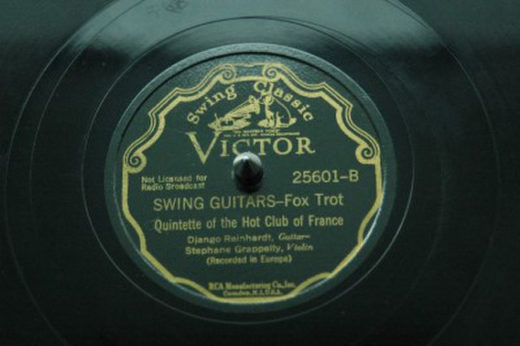
Quintette of the Hot Club of France (Public Domain)
By 1944, the Nazis were gone. Django had his own club, frequented by American GIs. Dizzy Gillespie’s “Salt Peanuts” opened a door to Be-Bop, a revolution in hard-driving, rhythmically complicated jazz. Panassie and Delaunay of The Hot Club parted ways when Delaunay championed the new style as a bold jazz experiment while Panassie contended that it was not, in fact, legitimate.
Dexter Gordon (tenor sax), John Lewis (piano), Lester Young “The Prez” (tenor sax) and Chet Baker (trumpet) all arrived in Paris. The scene moved from Montmartre across to St. Germaine du Pres driven by youth culture.
Miles Davis played at The Paris Jazz Festival in 1949. “This was my first trip out of the country and it changed the way I looked at things forever,” he said even after being there only three weeks. Young filmmaker Louis Malle, a big jazz fan, hired Davis to score Elevator to the Gallows. Having watched the film twice, the musician improvised and recorded the entire soundtrack from 11 p.m. to 5 a.m. in one go. Duke Ellington would later score the film, Paris Blues. He played more in France than any country outside of The United States.
The city was welcoming when this country was not. Musicians lived, played and cross-pollinated. A heady time for jazz.
Opening picture: 918 promotional postcard of the ODJB showing (from left), drummer Tony Sbarbaro (aka Tony Spargo), trombonist Edwin “Daddy” Edwards, cornetist Dominick James “Nick” LaRocca, clarinetist Larry Shields, and pianist Henry Ragas. (Public Domain)
Smithsonian Associates has a wonderful roster of online streaming.