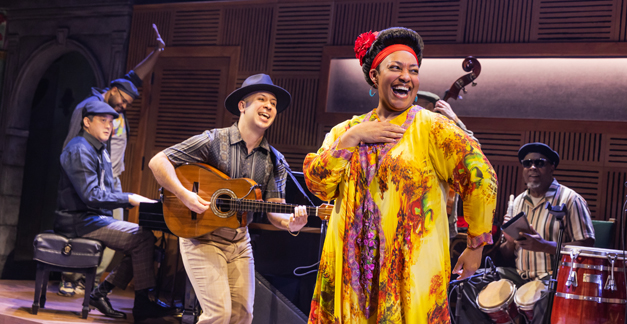
Ebullience doesn’t have a shelf life. The 1997 hit album Buena Vista Social Club (“buena vista” means “good view”) was followed by Wim Wenders 1999 documentary and a first iteration of this musical at Atlantic Theater Company in 2023. Here again is the (mostly) true story of a little known band/club that came to represent true Cubanos, was closed down in 1959 after Castro’s revolution, and reconstituted with respect and enthusiasm in 1996.
1996. Young producer Juan de Marcos (Justin Cunningham) has spent years developing the recording he calls “a love letter to Golden Age Cuban music.” The cherry on top would be to secure then 66 year-old vocalist Omara who hasn’t performed in six years. She turns him down flat.
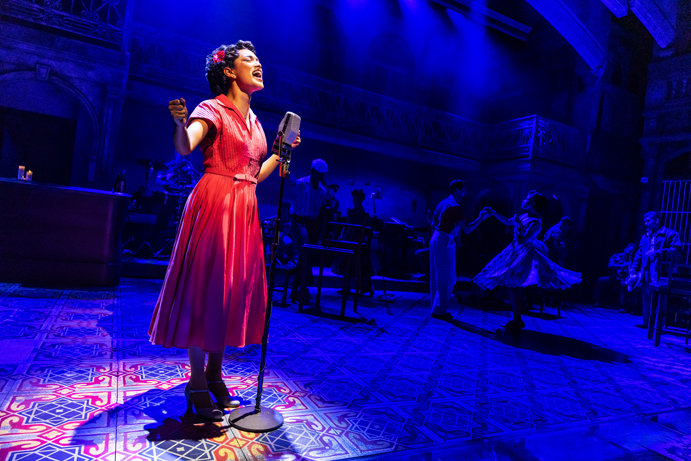
Young Omara – Isa Antonetti
Vocalist Compay (Julio Monge in 1996, Da’ Von T. Moody in 1956), who knew her when, convinces the diva to at least come test the waters. At the studio, she reunites with superb musicians Ruben (Jainardo Batista Sterling in 1996, Leonardo Reyna in 1956) and Eliades (Renestio Avich).“These are old songs…they kick up old feelings,” Copay warns. In fact, the effect of one sends Omara running home.
The slight, yet affecting plot here revolves around a choice Omara (Natalie Venetia Belcom in 1996,
Isa Antonetti in 1956) made at 19 not to accompany her sister Haydee (Ashley De La Rosa) to the USA. Having developed a modest reputation performing cliché material like “El Combanchero” in Havana nightclubs, the girls are offered an American record contract.

The Company
Ambitious, class conscious Haydee believes the career move would secure their futures, not to mention getting them out of Cuba on the cusp of revolution. Meanwhile, Omara’s new exposure to the Buena Vista Social Club, a Black establishment on the wrong side of town, and to busboy/soulful singer Ibrahim
(Mel Semé in 1996, Wesley Wray in 1956), has confirmed her deep connection to the country’s roots music. The siblings part, never to see each other again.
Oddly, it doesn’t make a difference if you recognize every player in both both chapters. Though names are helpfully used, episodes stand on their own. We go back and forth between the two pivotal years with some adroit overlap showing the effect past has on present. Needless to say, there’s a happy ending.
Infectious music is the rhyme and reason of this show with dancing a close second. In the end, Fidel Castro couldn’t eliminate indigenous culture, only sent it underground awhile. Close to facing similar repression here, history resonates.
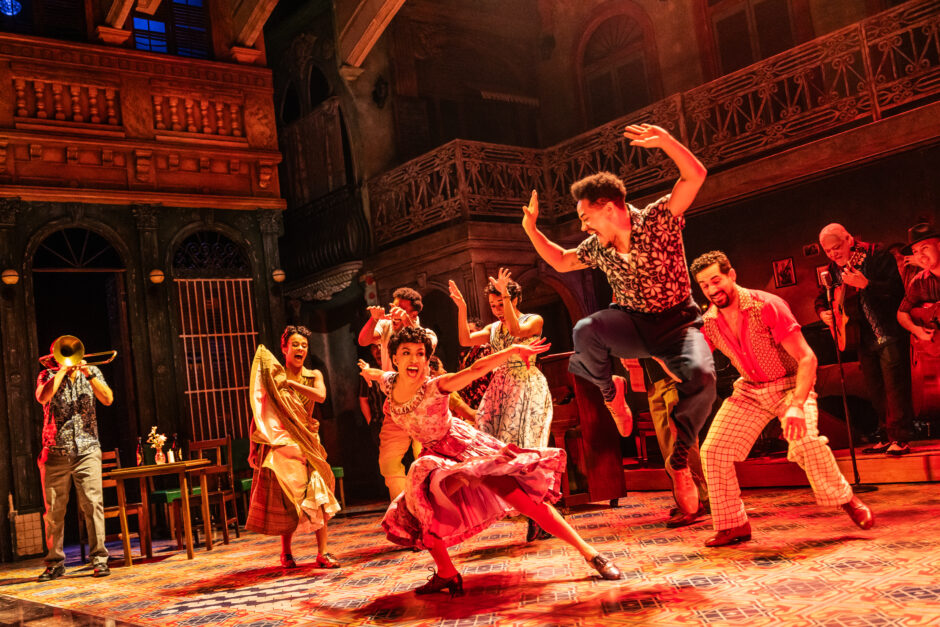
The Company
Both Natalie Venetia Belcon and Isa Antonetti (Omara) have acting chops and simply wonderful, passionate voices. Julio Monge’s mischievous Copay is a delight. Leonardo Reyna (young Ruben) is an extraordinary pianist. The Ibrahims – Mel Semé and Wesley Wray – sing with warmth and style. The band
is great. Every number is met with extended applause.
The book, ably simplified since Off Broadway, emerges more successful. Two thirds of Buena Vista is a concert featuring rich performances of Son: the precursor to salsa, characterized by its syncopated rhythms and infectious melodies; Danzon: a slow, formal partner dance with rhythmic structure considered a precursor to mambo and cha-cha-chá; and Bolero: characterized by sophisticated lyrics, slow tempo, and guitar accompaniment.

Wesley Wray – young Ibrahim, Mel Semé – older Ibrahim (foreground), Natalie Venetia Belcon
Though an insert in the program elucidates each song’s meaning, no lyrics are included. Reading before or after the fact, one doesn’t remember what song was which. More importantly, without lyrics, we miss the poetry and soul of a people – ostensibly the message.
Director/Developer Saheem Ali gives equal attention to musical numbers and character. The moment Omara knows she’s compelled to go to the studio and the moment (mid song) they “have” her are beautifully manifest. We especially feel the artist’s turmoil, regret and pride; Ibrahim’s humility. Years later, the two have a palpably tender reunion.
Choreography (Patricia Delgado and Justin Peck) is marvelous – a dynamic melding of Cuban tradition and Broadway with a smidge of ballet.
Arnulfo Maldonado’s scenic design is romantically evocative. Location changes arrive seamless. A balcony with shuttered windows opens to ocean sunsets. Tyler Micoleau’s lighting design adds symbiotic aesthetics. Costumes (Dede Ayite) are attractive and period perfect.
An evening of devotion and vivacity.
Photos by Matthew Murphy
Opening: Justin Cunningham, Marco Paguia (seated at piano), Renesito Avich, Natalie Venetia Belcon, Román Diaz
Buena Vista Social Club
Book-Marco Ramirez
Music-Buena Vista Social Club
Developed and Directed by Saheem Ali
Gerald Shoenfeld Theatre
236 West 45th Street