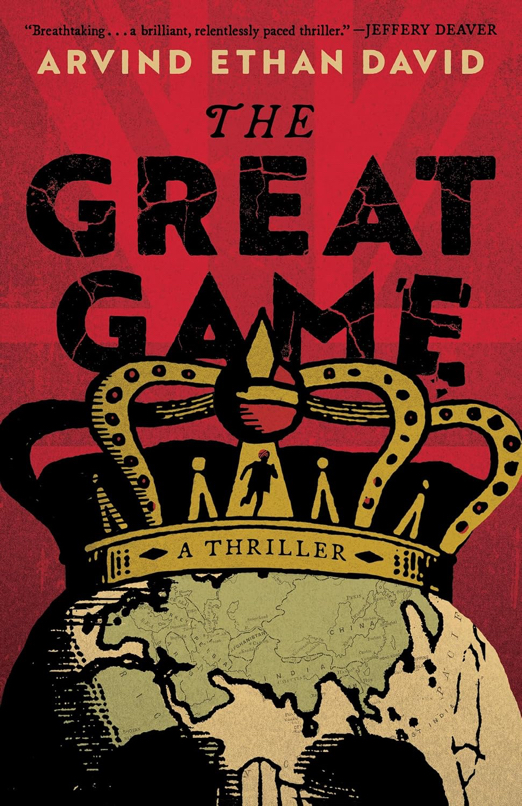
Arvind Ethan David’s novel, The Great Game, is set in 1905 London. But the issues raised reflect many similar conflicts developed countries face right now. Immigrants, no matter when they leave their homelands and settle in a new country, face assimilation challenges.
In the early twentieth century, Britain was losing its grip on the countries once firmly in its empire. Bal “served” with Raffles in the Second Boer War, but not, as he says, “shoulder to shoulder.” He explains: “Despite my combat experience in my native Punjab, the British had decided that I, and nearly two thousand of my fellow Indians, were fit to serve in their war, but not to actually fight alongside them.” Because he served, not with a rifle, but a stretcher, Bal was the one who rescued Raffles, pulling him out from underneath his dead horse and transporting him to the medical tent. Since then, Raffles has treated Bal “not as an uppity Indian but simply as a fellow adventurer, a brother in arms.”
And Raffles is indeed an adventurer. Even though he’s rich and in no need of money, he enjoys dining with his wealthy friends and then robbing them of their possessions. When Bal discovers what Raffles is doing, he’s at first horrified, and then happy to join him. After all, law school is expensive and he needs the money.
But on a cold September evening, Raffles shows up at Bal’s apartment looking like he has seen a ghost. After an enjoyable evening for a poker game at General Fitzwilliam’s home, Raffles returned later to rob the former military man. Instead, he found the general brutally murdered, his head hanging from his body by torn skin. He also saw the assailant who escaped from the building like an animal, or at least a very skilled athlete.
Raffles can’t go to the police, since he would have to explain why he broke into the general’s house long after the poker game had finished. But it seems the killer is only getting started. When Raffles and Bal show up at Mapperton, the magnificent mansion, home to the Earls of Rutledge, they discover that the earl and his two adult sons have also been viciously attacked and killed, the bloody tableau causing both Bal and Raffles to be shaken. Someone has a vendetta against the British upper class. Raffles has no choice but to tell the police what he witnessed at the general’s home.
Raffles and Bal find themselves part of the investigation. This is where the novel becomes even more clever. They are brought on board by none other than Commissioner Sir Gaston Lestrade. And who will this high level police officer also call on to help? None other than the world’s greatest detective, Sherlock Holmes, along with his trusted helper, Dr. Watson. Holmes is older now and not inclined to take every case that comes his way. (Watson’s writing made the detective famous.) And Raffles quickly learns that Holmes and Watson have known for a long time that Raffles is the infamous robber being sought by the police. But this murder investigation is more important, and they will not be turning in Raffles, and Bal, too, of course, for their crimes.
The investigation is taken over by the Colonial Office whose under secretary for colonial affairs, is none other than Winston Churchill. The game, as they say, is truly “afoot.”
For Bal, however, the issues are complicated. When he told his parents he was staying in London, they were very upset, their feelings made clear in a letter. Although he’s involved in the investigation, Bal still feels like an outsider. How much easier would it be to go back to India, be with his family, and be fully accepted into society without having to cling to a friend? When Bal shows up for a meeting at Raffles’ club, he’s refused admission. Fortunately, another club member, J.M. Barrie, author of Peter Pan, shows up, recognizes Bal and lets him in. Is this how it will always be?
Bal meets a young Irish woman named Maud who plays the violin. Because she’s white, he assumes she doesn’t deal with the same issues he does. But she tells him about the conflict between Britain and Ireland and how she also feels like an outsider. Truly, he’s not alone in how he regards his status in Britain.
The investigation takes a nasty turn and will cause much soul searching on Bal’s part. He has to decide how much he’s willing to risk for his new country.
Although Arvind Ethan David has written for the stage and screen, The Great Game is his first novel and a fun thrill ride. It also produces much food for thought about immigration. What does it take to feel accepted and settled in a new country? It wasn’t easy in Bal’s time, and it’s not easy now. The ending leaves open the chance for a follow up, so we look forward to future adventures with Bal and Raffles. Who knows what other famous people might show up?
The Great Game
Arvind Ethan David
Top Shutterstock photo by alexkoral
Our editors love to read and independently recommend these books. As an Amazon Affiliate, Woman Around Town may receive a small commission from the sale of any book. Thank you for supporting Woman Around Town.