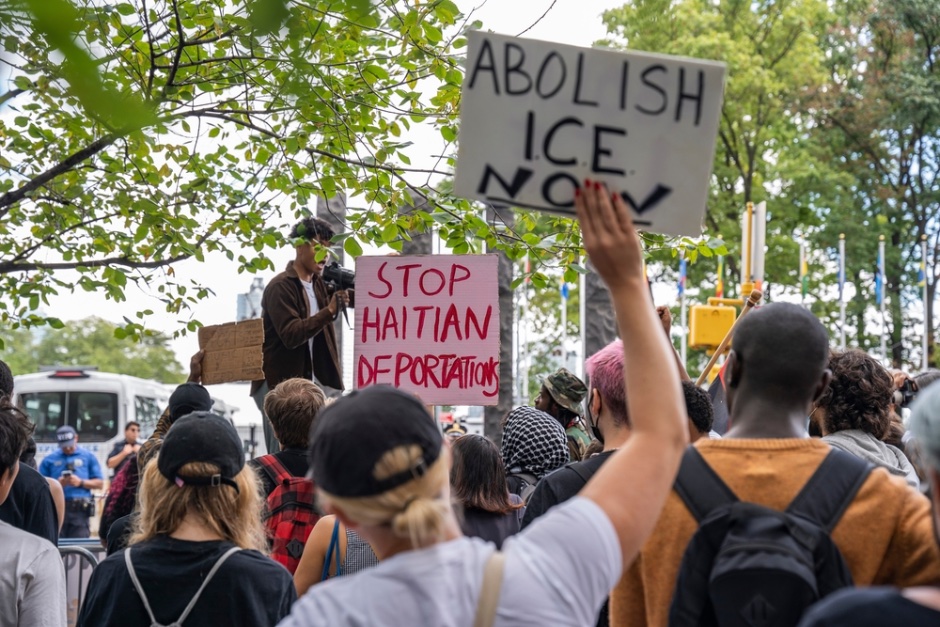
The Trump Administration has done its best to vilify an entire ethnic group. Temporary Protected Status (TPS) protections for approximately 330,000 to 350,000 Haitians in the U.S. officially expired on July 27, 2026, following a Supreme Court decision allowing the administration to proceed with termination.
ICE quickly began implementing enforcement measures, including check-in appointments and requiring many Haitians to wear monitoring equipment in the form of ankle bracelets typically given to those under criminal prosecution. New York City Mayor Zohran Mamdani urged President Trump to restore TSP for the thousands of Haitians living and working in New York City. Those individuals who are city workers have already had their employment terminated because of the Supreme Court decision.
This isn’t the first time Haitians have become targets for hateful rhetoric from Trump and his supporters. During the 2024 election, Republicans alleged that Haitians in Springfield, Ohio, were stealing and eating cats. Trump even repeated that false claim during his debate with Vice President Kamala Harris. The mayor of Springfield, a Republican, shot down the story, and during the debate David Muir, the ABC anchor who was one of the moderators, fact checked Trump.
But Trump and Stephen Miller, who has been instrumental in the administration’s anti-immigration policies, have made it clear that they hate Haitians and want them out of the U.S. Haitians living in New York have two choices: proceeding as an undocumented immigrant, with the uncertainty that status conveys, or return to an island where gang violence has made much of Haiti unsafe. In fact, the State Department has warned Americans not to travel to the country because of the fear of violence and kidnappings. Mamdani has said: “For us in this moment to tell Haitian New Yorkers who have made the city their life for years that they have to go back to that. It is terrifying to imagine what might be waiting for them.”

From 1957 to 1986, Haiti suffered under a brutal dictatorship run by Francois “Papa Doc” Duvalier and his son, Jean-Claude “Baby Doc” Duvalier. Papa Doc died in 1971, his son in 2014. Since then, the country has been roiled by multiple military takeovers and short-lived authoritarian interventions. Democracy is still far off.
Trump and Miller would do well to pick up a copy of Lyonel Trouillot’s most recent book, Simple Stories, a short story collection that celebrates the Haitian people. These portraits are, of course, fictional, but drawn from real life individuals who live in a country that is plagued with dictatorship, poverty, insurrection, and corruption. The weather doesn’t cooperate, either. But Trouillot, through his writing, brings these people alive, taking us inside their lives, how they struggle to live, oftentimes, failing.
Trouillot has won numerous awards for his writing, including for his novel, La Belle Amour humaine. After living in exile in Miami for many years, he is now back living in Port-au-Prince. In the prologue to the book, Trouillot said that the country’s dictatorship is a recurring theme in Simple Stories. “It marked my childhood and adolescence,” he writes. “But romantic and family relationships are also a theme.” He adds: “I dedicate this book to the wounded and the outcast, who have a right to revenge and sometimes take it, if only in words.”
“Sad Guitar” is about a young man named Jean, who played his instrument under the streetlights. He was a dreamer and those around him wanted to help him realize that dream. They got him a visa, an airline ticket, and some warm clothes. In New York, he was never able to make a living as a musician, instead working in a Brooklyn factory. Moving to Florida, he lived in the neighborhood known as “Little Haiti,” and played on the beaches. He was found dead in his bedroom with his guitar.
In “The Colonel’s Mistress,” Marie-Lucie solicits customers in a nightclub. “A tight-laced young officer,” who knew little about women, becomes her protector, despite her youth and slender body. Both were spared when the dictatorship collapsed and officers were singled out for their crimes.
“Portrait of Beauty and Child” finds a way to survive the violence by painting. He gets pulled into attending demonstrations against the country’s dictator, Jojo. Marveling at the diversity of the crowd, young and old, rich and poor, he says: “The miracle Jojo has accomplished is to bring these people together in the street who don’t normally talk to each other.” Sounds like a “No Kings” march, right?
As expected from Trouillot, the 22 stories are beautifully written, lyrical, empathetic, and surprising. The timing for this special collection couldn’t be better. Maybe Mamdani should send a copy to Trump?
Simple Stories
Lyonel Trouillot
Translated by Willard Wood
Top Shutterstock photo by Luigi W Morris
Our editors love to read and independently recommend these books. As an Amazon Affiliate, Woman Around Town may receive a small commission from the sale of any book. Thank you for supporting Woman Around Town.