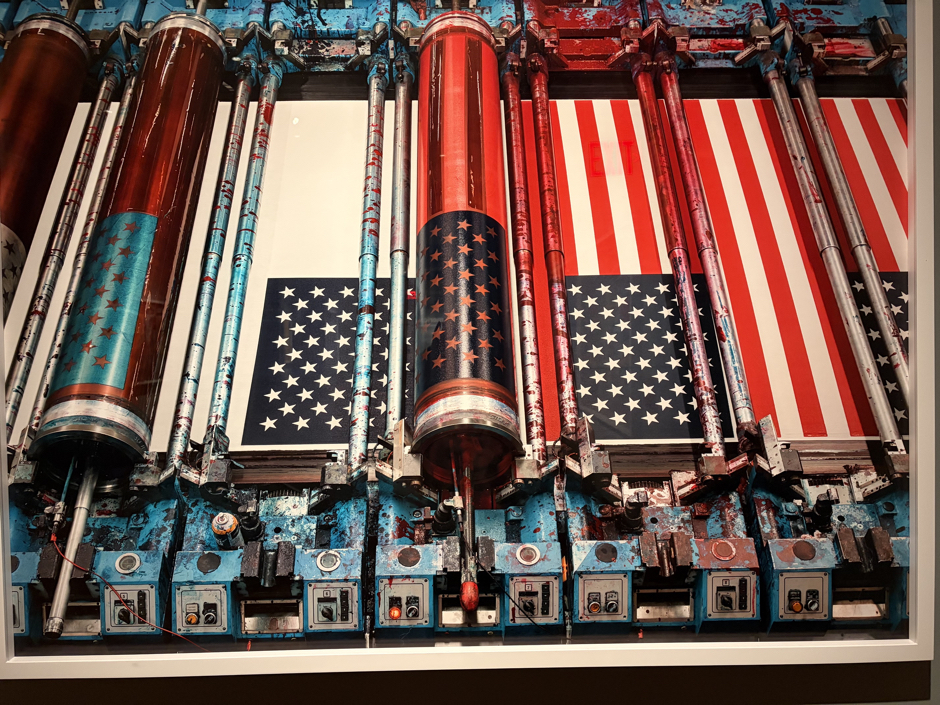
For 15 years, Christopher Payne traveled around the country, visiting factories and photographing the people who produce products, everything from microchips to the Giant Magellan Telescope. Payne said his photographs “are also a celebration of teamwork and community, revealing how people of varying ages and skills come together to work toward a common goal.” In celebration of the nation’s 250th anniversary, more than 70 of Payne’s large-format photographs to consider the American factory as a key site of design ingenuity and innovation are now on display at the Cooper Hewitt.
The U.S. used to be a country where manufacturing provided a livelihood for a large percentage of Americans. Then, companies looking for ways to produce those goods cheaper, closed down many of those factories and began making products in countries like China and Vietnam. President Trump twice ran on a platform of bringing manufacturing back to America. That has not happened. In fact, one of Payne’s photos shows workers from Conn Selmer, in Eastlake, Ohio producing brass instruments like tubas and French horns. On August 1, that factory produced its last musical instruments and 150 people lost their jobs. Those instruments will now be produced in China.
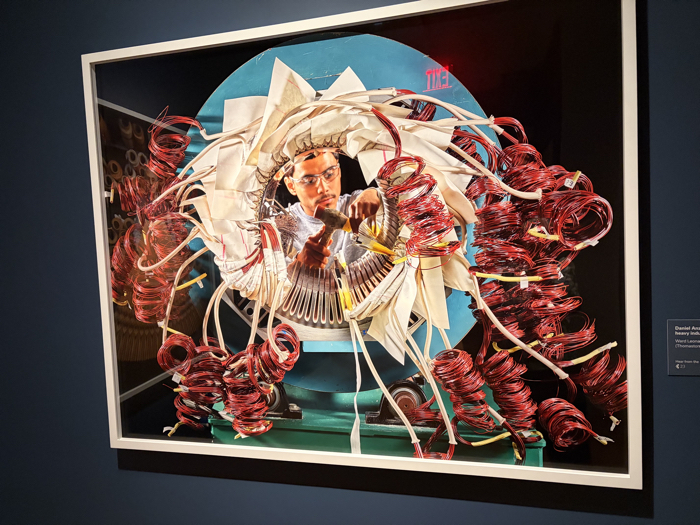
David Anzures assembling a heavy industrial motor (Ward Leonard, Thomaston, Connecticut)
But there are still many factories operating and Payne’s photos capture that activity. People feature prominently in Payne’s photos because he wanted to emphasize that it’s people producing whatever these factories turn out.

Bollman Hat Company, founded in 1868, is the oldest hatmaker in the U.S.
In a short film included in the exhibition, Payne talks about how he became a photographer and how he came to photograph people working in factories. Trained as an architect, Payne began producing measured drawings for the Historic American Engineering Record, an ongoing program of the National Park Service. Because he wasn’t able to finish his drawings on site, he began taking photos. He discovered he enjoyed photographing what he was seeing more than drawing what he saw. HIs first book, New York’s Forgotten Substations: The Power Behind the Subway, included his photographs.
He became a full-time photographer, publishing in 2008 Asylum: Inside the Closed World of State Mental Hospitals. His two most recent books are Making Steinway: Photographs by Christopher Payne (photos of the piano company are included in the exhibition), and Made in America.
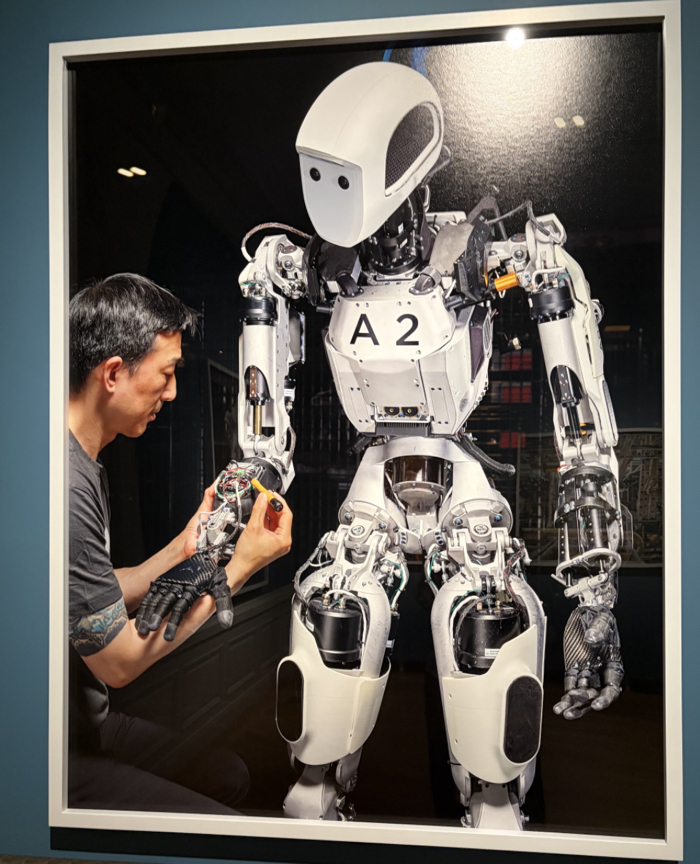
David Lin installing a motor controller into the arm of Apollo 1, a humanoid robot (Apptronik in Austin, Texas)
These large format photographs are stunning. How often do we interact with the products produced in these factories without giving a second thought about how they are put together and who oversees that process? While AI and robots dominate the conversation these days, we tend to forget that people, yes, people, are still needed to oversee the process.
Payne also notes in the film that the people working in these factories include ALL the people – Americans, immigrants, men and women. Appreciating what these workers do should not be a partisan issue, but a time to celebrate and spotlight the work they do, the expertise required, and how those talents and dedication benefit all of us.
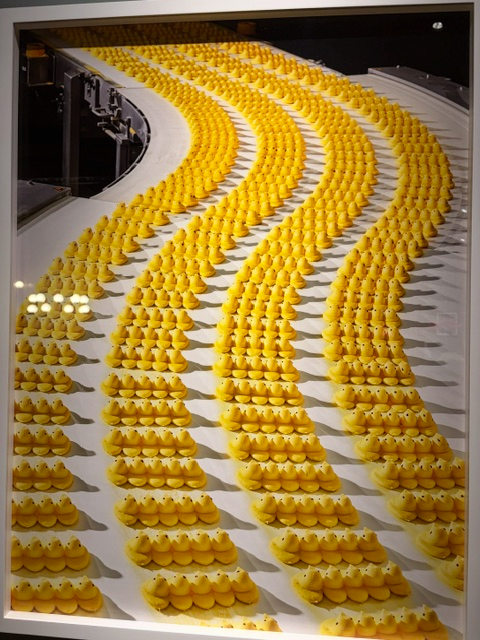
PEEPS marshmallow chicks (Just Born Quality Confections, Bethlehem, Pennsylvania)
There is something to engage everyone, even children, in these photos. There are photos that show how footballs are made, as well as PEEPS, that marshmallow treat that shows up in Easter baskets.

Joseph Adeleke is shown testing a pinball machine (Stern Pinball in Elk Grove, Illinois)
In some photos, people are overwhelmed by the size and scale of the machines they are working on. Payne said that his favorite photo is one showing workers at BVD in Lancaster, California, adding parts to the steel frame of an electric public transit bus in 2011. Stepping back, the photo appears to be a grid. Up close, the meticulous work being performed is astounding.
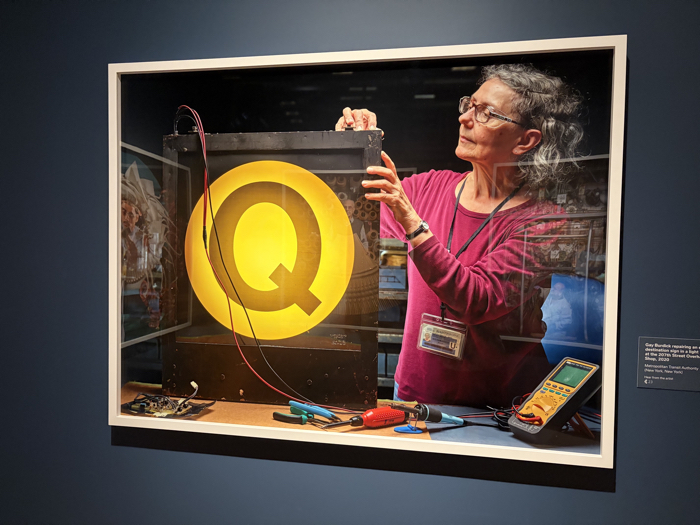
Gay Burdick preparing an end destination sign in a light box at the 207th Street Overhaul Shop (Metropolitan Transit Authority, New York)
New York is aptly represented in the photos. The top photo shows a four-page-wide continuous web of paper traveling through a printing press in the New York Times printing plant in Queens. Another shows Raul Gonzales hand-finishing a terra-cotta lion head for the Flatiron Building.
Made in America: The Industrial Photography of Christopher Payne received support from Smithsonian’s Our Shared Future: 250, a Smithsonian-wide initiative commemorating the nation’s 250th anniversary. Signature support for Smithsonian’s Our Shared Future: 250 has been provided by Lilly Endowment Inc. Additional generous contributions have been made by Target and New Balance.
The exhibition is organized by Susan Brown, Associate Curator and Acting Head of Textiles at Cooper Hewitt.
Photos by Woman Around Town