Voters are more likely to vote in a presidential election year. But even in the 2024 election, many people stayed home. Donald Trump won 77,284,118 votes, while Kamala Harris trailed with 74,999,166 votes. All together, 254 million Americans were eligible to vote. But 89 million of them did not. Just imagine what might have happened if those 89 million people had voted. Harris might have won and we might not be living in the chaos we are experiencing today.
Since the midterms won’t list candidates for the presidency, it will be even tougher to create voter enthusiasm. Although the Supreme Court ruled in favor of mail in ballots, the conservative majority has dealt a major blow to the votings rights act. Trump’s SAVE America Act, which would demand IDs, has little chance of passing the Senate. Trump, as an alternative, has ordered the Department of Homeland Security to withhold funds from the Federal Emergency Management Agency from states that don’t “adopt common-sense election security measures.” To qualify for those funds, states must use a federal system for verifying voters’ citizenship and accept hand-marked paper ballots. That directive is already being challenged in the courts.
Trump is obsessed with the idea that millions of illegal immigrants vote in elections. He has never managed to produce any proof backing up that claim, and state elections officials, even in red states, have repeatedly said that very few illegals cast ballots and those votes are quickly intercepted and thrown out.
But Trump’s persistent claims that the 2020 election was “stolen” and that he really won, continues to erode people’s confidence in our election system. What Trump doesn’t seem to realize is that any effort to prevent people from voting is just as likely to keep his MAGA supporters home, especially this time around when he’s not on the ballot.
Why do eligible voters opt out? Here are some reasons and a rebuttable.
“I don’t like any of the candidates.”
I heard a lot of this during the run up to the 2024 election, especially when I was canvassing for Kamala Harris in Pennsylvania. While many people were still recovering from Trump’s first term, they couldn’t bring themselves to vote for Harris. Let’s be blunt. Racism was at work here. While some said they didn’t like Harris because she hid from the public President Biden’s increasing infirmities, at the core was racism. They, particularly some Black and hispanic men, could not vote for a Black woman.
So you stayed home and Trump achieved the impossible and became president again. I ask these absent voters: how is that working out for you now? If you had a do-over, would you get your butt to the polls and vote for Harris?
“It’s tough for me to get to the polls to vote.”
I get it. You are homebound because of an operation or illness. You work full-time and often overtime and your employer isn’t understanding about you taking time off to vote. You are living in another location on a temporary basis and can’t get home to vote.
You may think any one of these excuses is acceptable. Not one is.
Mail in ballots! The issues was critical enough that Trump, who always votes with a mail in ballot, tried to throw them out. And the Supreme Court protected this option.
You can arrange this with little trouble. Here’s the website for New Yorkers. Voters from other states can find the appropriate website online.
Arrange for a mail in ballot and never claim you are too busy to vote.
“Even if I vote, my vote won’t matter.”
Every vote counts, especially in elections when turnout is expected to be low. In New York City, the margins were very tight in the most recent primaries. For a House seat on Manhattan’s westside, Daria Avila Chevalier defeated Adriano Espaillat by around 2,000 votes. The race was also close between Micah Lasher and Alex Bores for the 12th Congressional seat which takes in parts of the east and west sides of Manhattan. If more people had voted, the results might have been different.
“Elections are rigged.”
Again, if you believe this, then you have consumed the Kool Aid Trump is pouring out, most likely a red drink. There is no – let me repeat – no concrete evidence to back up the president’s claim that the 2020 election was rigged and only paper ballots can ensure a fair election. Even the red state of Georgia keeps telling Trump, and now FBI Director Kash Patel, that the state’s elections are protected and safe. Trump knows it, too. Isn’t it strange that he isn’t saying the 2024 election was stolen. Why? Because he won! If he wins it’s fair, if he doesn’t it’s rigged. Remember what Fred Trump told his son – don’t be a loser. Whatever Trump can do to avoid that label, he will do. Don’t fall into his trap.
“Why should I vote?”
Even though more than 80 percent of countries vote, less than 40 percent have elections that are free and fair. The U.S. still has free and fair elections and we need to preserve that going forward.
John F. Kennedy once said: “Ask not what your country can do for you, ask what you can do for your country.”
One of the most critical things you can do is to get out and vote. Do it to preserve our democracy. Do it to honor those who fought and died to make sure we can vote.
Do it because if you don’t you may regret the results the next morning and be thinking, “I should have voted.”
How can I help?
As a first step, talk to your family and friends. You don’t have to ask them who they are voting for, but encourage them to vote.
Make a contribution to a candidate you hope will win. And with the balance in the House and Senate up for grabs, don’t stay local. There are competitive races in Texas, Ohio, Georgia, and Alaska. A small donation might make the difference.
Volunteer. If you can, volunteer to make phone calls to get people out to vote. If your local poll is looking for people to work there, volunteer. It will give you a front row seat to see that our elections truly are free and fair.
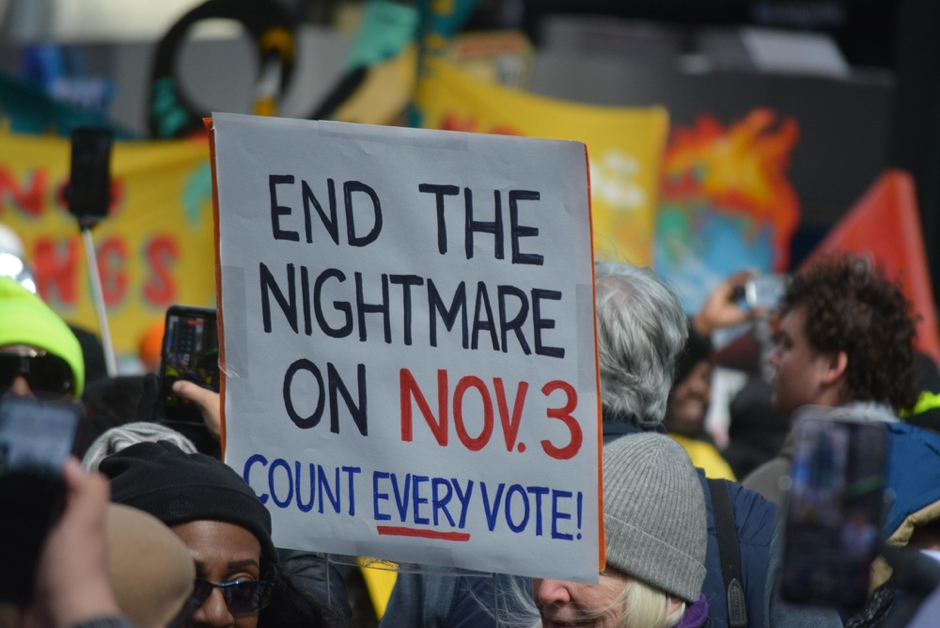
Top Shutterstock photo by Christopher Penler