At 279 feet long, Wavertree is the largest riveted wrought iron sailing vessel afloat in the world. To gaze down at her 130 year-old underbelly – general science lessons aside – evokes wonder as to how something so perceptibly heavy can actually float. Keeping its ribs rust-free is an unimaginable task. Built in Southampton, Great Britain 1885, the tall ship was a cargo hauler until thirty-five years later when she was blindsided by a November storm rounding Cape Horn. Masts were literally torn down, some falling across the bow, ending her career. She had circled the globe four times.

Wavertree was being employed as a storage hulk (a ship that’s afloat, but unable to put out to sea) and sand barge when discovered in 1967 by president of the San Francisco Maritime Museum, Karl Kortum who suggested to the president of the new South Street Seaport Museum, Peter Stanford, that he should save it. She was purchased for $70,000, sailed back to New York, and put in the hands of a 28 year-old shipwright named Richard Fretwell.
“The work of completely refitting a sailing ship conceived almost a century ago is a process that requires knowing how it should have been used, using the skills of today, and making adjustments when they won’t do, he said…” The New York Times December 1975.
Nor has restoration ceased. Employees and volunteers keep the ship in health continuing to refit and replicate wherever possible.
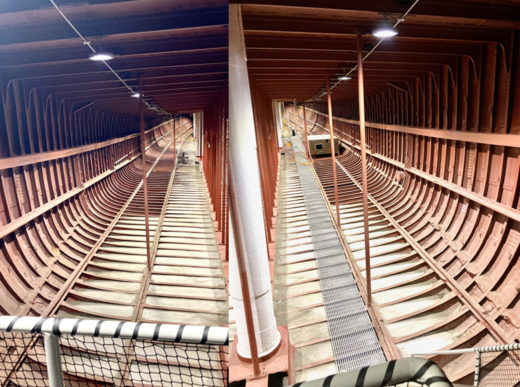
Of interest: “Wavertree is a full-rigged ship, meaning she carries square sails on all three of her masts. The earliest full riggers carried three yards-horizontal spars on each mast, for a total of nine. This is possibly the origin of the phrase “the whole nine yards.”
We walk up the sharply inclined gang plank. No narrow heels, ladies; there are also steep metal stairs and wooden lips over which you must step into rooms. Tours are ordinarily self-guided along a suggested route with intermittent signage and staff placed at key areas to answer questions. We, however, had a guide in the excellent Anna Frenkel.

The crew’s quarters, where the crew both slept and ate, is a relatively small room considering it housed at least half the sailors at a time while others were on duty elsewhere. A ship this size, we’re told, would sail with 30-35 crew members, 6-12 would be officers. Imagine tensions, bonding, the smell! We’re reminded that voyages were often dangerous and seamen lost. “The crew that embarked was not the crew that returned.” Stripped of its bunks (there’s a period photo to show what it looked like), we see a long table, benches, and a pot-bellied stove.

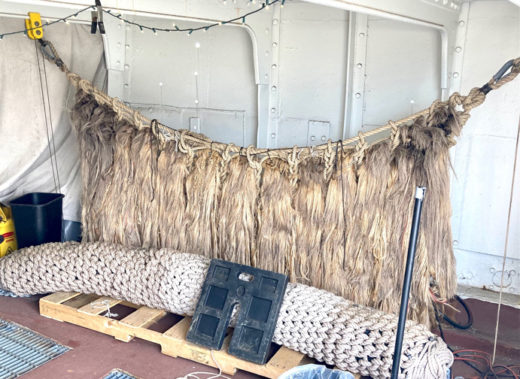
In an alcove on deck, there’s a large skein of twisted jute and a curtain-like “cloth” called a “Baggywinkle” made up of short pieces of yarn cut from old lines taken out of service. Two parallel lengths of marline are stretched between fixed points and lengths of yarn are attached using a hitch called a “railroad sennit.” A Baggywinkle is chafing gear traditionally hung to create a buffer between sails and rigging lines.
On one side of the broad deck is a narrow ship’s galley, much like railroad kitchens in post war brownstone apartments. Voyages took many months. Live chickens and pigs would be brought aboard to provide food. It was an area where distinct social order was imposed. Captains and officers would be given freshly baked bread and fresh meat initially packed in barrels full of salt and brine to prevent spoilage. They had access to spices, flour, sugar, butter, canned milk and alcohol.
Sailors ate considerable “hardtack” – a biscuit made from flour, water and salt – and stews, “thickened” with water. Both echelons might’ve been served “steamed pudding with dried fruit, but the officer’s dessert would be prepared with sugar, fruit and rum, while the sailors would have only molasses as a sweetener.” Amy Anderson- The Forecaster February 2009
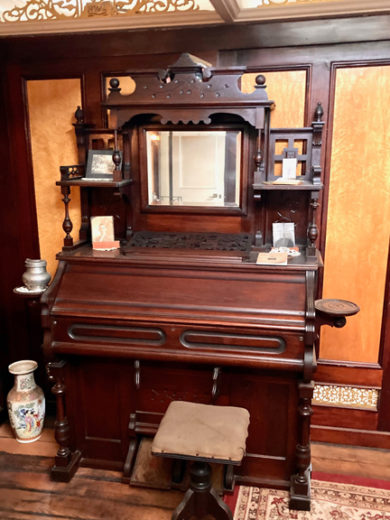
Down a ladder (some stairs) is a long, tight corridor (bulkhead) lined with closed doors to officers’ quarters, probably big enough for a bed and small storage. At its end, the captain’s sitting room is gracious and would be well furnished. We see a period table and chairs, an ornate desk and rug. Unlike other areas, windows let in fresh air and a skylight looks up though the upper deck. An adjacent smaller space, now empty, is big enough to hold an actual bed, occupied by the captain and sometimes his wife – on short trips. Everything would have been illuminated by oil lamps. (Restoration added electricity.)
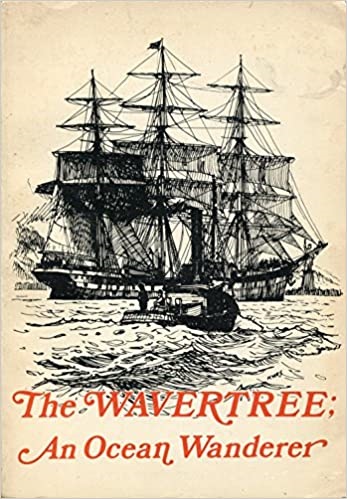
Captain George Spiers who sailed in 1907 wrote about the ship in his memoirs, The Wavertree-An Ocean Wanderer– 1969.
Up a narrower ladder is the helm with a large tiller (steering wheel). Try to move it. These men must’ve had exceedingly strong arms. In a storm, one would have to fight for control. The tiller mechanism reaches down through the belly of the ship where a system of gears alters the vertical angle of a rudder.
Also on this deck is a “capstan,” which, when assembled, looks like a horizontal steering wheel. A row of wooden rods that fit into side holes are manned by nine to ten sailors who walk/push the capstan in a circle. Attached to a set of pulleys and ropes below, this hauls cargo into the hold. “A sailor’s life he chose/Off the Nova Scotian coast/Do another lap ’round the capstan Johnnie/’Round and ’round she goes…” (Capstan Shanty)
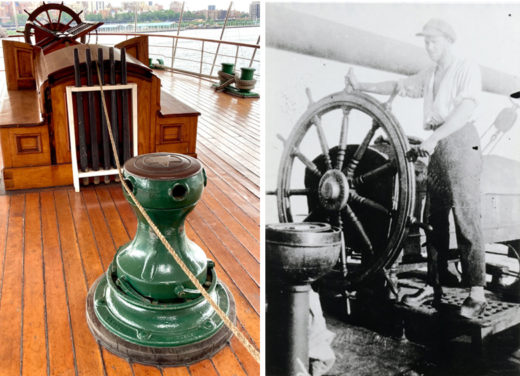
One deck tier up, a “Binnacle” which houses navigational instruments including the ship’s large compass mounted in gimbals to allow for rotation. Iron balls attached to either side counter magnetic deviation caused by the ship’s being made of iron as well as keeping it at magnetic north. Metals used to construct binnacles must be non-ferrous (containing no iron). Traditionally, a binnacle comes up to the waist of the steersman so one eye is on the sea.
It’s been a fascinating tour with a palpable sense of the past. The only time we felt the vessel bob slightly was going down the gang plank. Additional information and photos can be found on kiosks outside the ship.
Wavertree is listed in the National Register of Historic Places, yet gets zero federal funding. There are opportunities for grants, but no ongoing financial feed for what caregivers think of as the living museum. The organization is, however, currently a recipient of a National Maritime Heritage Grant to further build out the forecastle and aft accommodations. The ship is open free to the public Fridays, Saturdays, and Sundays through October 2021, with timed entry, from 11 a.m.-5 p.m. at Pier 16 (Fulton and South Streets). https://southstreetseaportmuseum.org/visitwavertree/
The Museum will allow no more than 150 guests on board the ship at any time to encourage social distancing. Guests above the age of two will be required to wear a face covering at all times aboard Wavertree and at the Museum’s pop-up gift shop. Additional activities for Wavertree Open Days and eventual tours of the 1908 lightship Ambrose will be announced throughout the summer. The Ambrose is docked across from The Wavertree on Pier 16. A floating lighthouse ship in its working days, it would have been the first thing immigrants saw (anchored) coming into New York Harbor, yet one never sees it in a film.
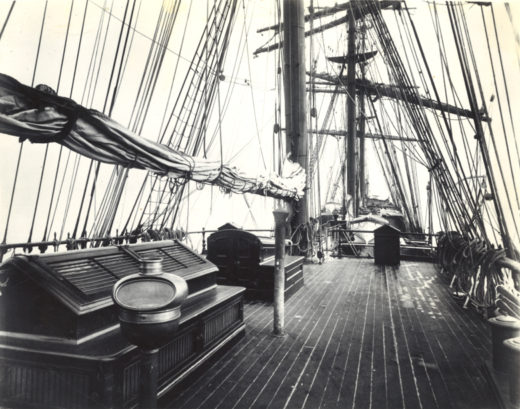
Opening photo by Richard Bowditch Courtesy of the South Street Seaport Museum
Bowne & Co.
After Wavertree, we walked to Bowne and Co. 209-211 Water Street. Established in 1775, Bowne & Co. Inc. partnered with the Seaport Museum to open a 19th-century-style print shop in 1975 to celebrate the business’ bicentennial. . New York’s oldest operating business under the same name is a working concern utilizing 19th century, hand operated presses and thousands of individual letters, symbols and numbers of movable type. Thick ink is applied with something that looks like a spatula. The shop creates business cards, announcements, stationery, invitations.

Demonstrations with a small press show the mechanism with an ink covered disc against which paper presses. A “paul” hits the disc, slightly turning it so that ink is evenly applied. The largest press Bowne’s employs is a “high-speed cylinder letterpress” (all things being relative) called Heidelberg Windmill (1929). “Its double blade, with grippers on both ends, moves in quarter turns from automatic feeding, to print, to delivery positions. Vacuum suckers lift unprinted sheets from the pile holding them until seized by grippers in either end of the windmill blade, which revolves, carrying the sheet to the edge of the platen. While the grippers still hold the sheet, the press closes, making the impression. After the platen opens, the windmill revolves another quarter-turn, delivering printed sheet.” (Original Heidelberg-The Prince of Presses by Fred Williams 1981.) The machine looks decidedly steampunk.
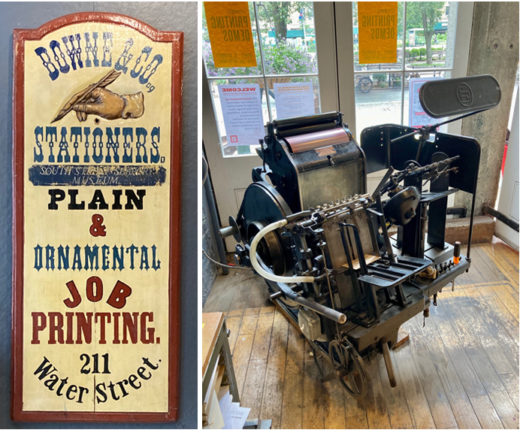
On Fridays and Saturdays through October, a selection of historic presses will be set up outside demonstrating 19th century printing processes hourly between 11 a.m. and 5 p.m.. Printed items are given away as souvenirs. A small shop next door and online offers printed stationery, journals and the like. Bowne & Co public programs are made possible by the New York State Council on the Arts with the support of Governor Andrew M. Cuomo and the New York State Legislature.
The bricks and mortar South Street Seaport Museum remains closed for the moment. Its galleries are housed inside an 1800s building with low ceilings, it has little ventilation and would be unsafe during COVID. Additionally, the museum suffered mightily during Hurricane Sandy and is not yet in full repair.