In April, 1976, Windows on the World opened in the World Trade Center. Could a restaurant save a city?
When the World Trade Center first opened, critics were not kind. Many small businesses had to be knocked down to make way for the two tall buildings. Others found that the towers lacked artistic value and loomed like monsters over downtown Manhattan. Opening a restaurant in one of the towers was seen as a way for people to come, enjoy the view, and maybe have a good meal.
Joe Baum and his partner Michael Whiteman oversaw the design, development, and the operation of Windows on the World. Panoramic views did indeed draw people to the restaurant. They didn’t come for the food, which was mediocre. The New York Times restaurant critic Ruth Reichl gave the restaurant a measly two stars. But there weren’t many restaurants in lower Manhattan that stayed open after the financial markets closed. Windows on the World gave people a reason to stay and the restaurant soon became the place to see and be seen.
Over the years, we made many visits to Windows on the World, usually for a special occasion or to entertain out of town guests. My parents loved the restaurant and so we tried to go whenever they were in the city. Being on the 107th floor felt like Reichl once said: “You feel like you were leaving earth.” The planes that flew by often seemed too close. A harbinger of what was to come?
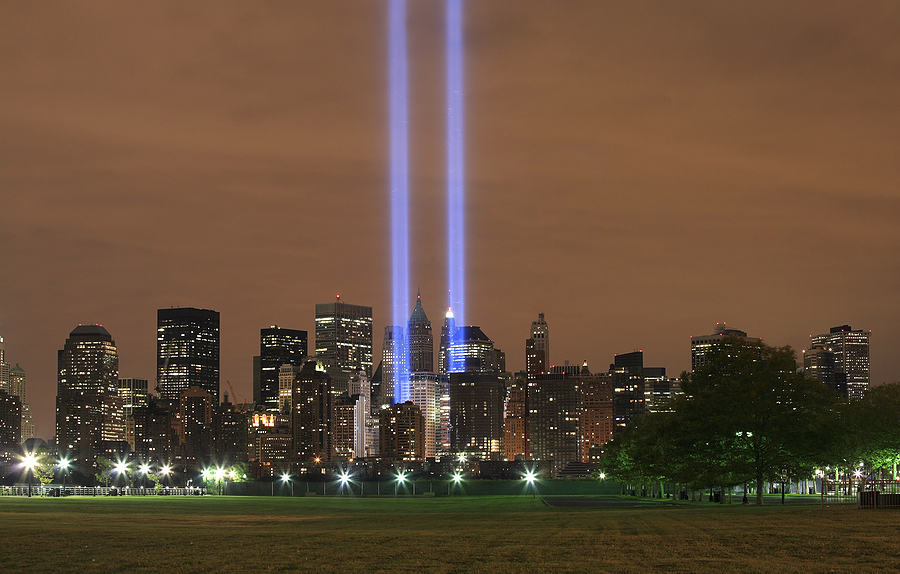
On the 25th anniversary of 9/11, CNN has released Top of the World: The Untold Story of the Restaurant in the Twin Towers. When the towers came down on that day, the restaurant came down, too. Because the plane hit on the 93th floor, those who were trapped on higher floors had no way to escape. The 72 staff members who were already at work perished.
It wasn’t the first time the towers were targeted by terrorists. In 1993, a bomb was detonated in the basement of the north tower. Six people were killed. The restaurant wasn’t damaged but nonetheless was forced to close so that repairs could be made to other parts of the building. Baum was asked to renovate the restaurant for a reopening.
Baum was a restaurant genius, responsible for the Four Seasons, Tavern on the Green, and the Rainbow Room. He didn’t think of dining as just consuming a meal, but as a theatrical experience. And with Windows on the World he had a fabulous stage.
Perhaps his best move was to hire Michael Lomonaco as executive chef. Milton Glaser was tapped to design the place settings, the menu and paper products. And when Kevin Zraly, a wine salesman, stopped in hoping Baum would place an order, Baum hired him and gave him an unlimited budget to create “the best wine collection in the world.” Zraly did just that and his wine list became a standard by which others were judged.
Windows on the World became the highest grossing restaurant in the country. Lomonaco worked for a long time on the menu. “I created a menu that I thought made sense, that was fresh, that was cooked in the moment for the guests,” he said. “Windows on the World had to reflect the food of our region, the places we could see from the windows of the restaurant – New Jersey, the Hudson Valley, Connecticut. Within a hundred miles of here we could get all the ingredients we would need.”
When Reichl went back to Windows, she saw that many things had changed. Her next review was titled: “Food That’s Nearly Worthy of the View.” She praised the skilled roasted bluepoint oysters, as well as the braised short ribs that were cooked until the meat was like paté and could be spread on bread. Baum’s best move was hiring Lomonaco, she said. “The food was finally competition for the food.”
More than 450 people worked in the restaurant – chefs, wait staff, porters, and many others. “There was a lot of camaraderie,” Lomonaco said. “Windows was like the UN of the restaurant world.” Nathalie Tolentino, who was from Peru and worked as a hostess, said: “it was like New York, a melting pot.”
Sekon Siby, who worked as a banquet cook, came to the U.S. from the Ivory Coast. On September 11, he had an outside commitment and traded shifts with a recent, younger hire, Moises Rivas, who was from Ecuador. “Mosies was there, working in my place,” he said. Nathalie was scheduled to work at 4 p.m. on September 11. Her father woke her up to say something was happening in her building.
That morning, there was a breakfast meeting in the restaurant with more than 100 people expected. Before going up to the 107th floor, Lomonaco stopped in the basement of the North Tower to have his eyeglasses adjusted. As he was sitting in a chair having his eyes examined, he felt the building shake. “That can’t be the subway,” he thought. After the lights went out, security began evacuating everyone.
2001 was the 25th anniversary of Windows on the World. Planned were a series of parties for October. Veuve Clicquot Champagne printed a special label that said “Windows on the World – 1976 – 2001.” Recently, Zraly got former staff together to finally drink that Champagne. “We weren’t just co-workers, we were a family,” one former worker said.
Twenty-five years later, some still haven’t traveled to see the new Freedom Tower or even to go down to Lower Manhattan. “It’s going to take some time,” one man said. Siby has been there several times, always stopping at the reflecting pool to touch the names engraved in the wall, including Rivas’s.
Baum died in 1998 so never had to see what happened to the Towers and to Windows on the World. “My intent was to make it the best known restaurant in the world,” he once said. “I think that was accomplished.”
Top Bigstock photo by eddtoro