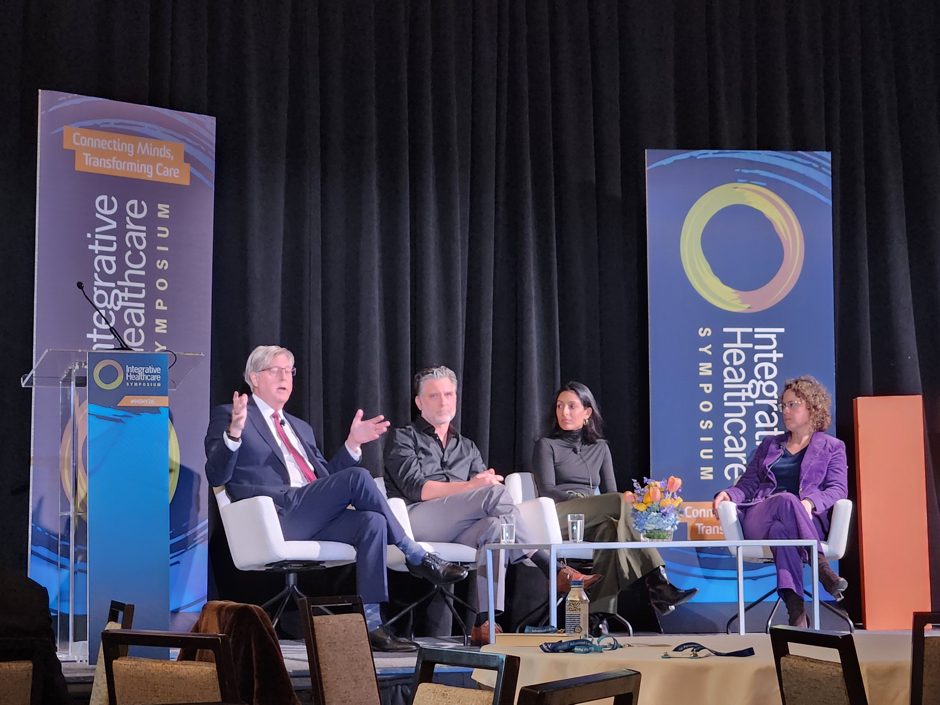
The New York Hilton Hotel recently hosted the 21st Integrative Healthcare Symposium which, according to its mission statement, brings together experts and services that treat the whole person rather than individual symptoms. While this three-day affair was geared towards those who work in the industry: physicians, dieticians, nurse practitioners, and nutritionists, there were company reps exhibiting health products and plenty of lectures and panel discussions making the event equally engaging for all.
Of particular interest was the panel discussion on the AI Healthcare Conundrum for Practitioners which was on the final day’s schedule. The panelists included the CEO from NOOM, the weight loss app; the CEO from BioInsights which creates AI software for physicians; and the President of Midi Health, a holistic and personalized care plan organization for women.

The moderator, Ashley Koff, RD of The Better Nutrition Program, asked questions relevant to the subject, and kept the panelists on topic. The big takeaway from the session was that AI is not meant to replace the human in the room, but to lessen the time it takes to perform tedious tasks, help the practitioner stay up to date on research and regimens, and by its ability to transcribe the doctor-patient conversation, physicians can keep their focus on their patient rather than taking notes on their laptop. It was a very hopeful and encouraging conversation.
One panelist remarked that physicians will be able to access new data and research that may have just become available, or something that would’ve taken more time to gather. Doctors who were unfamiliar with diagnostic tests, and may have avoided ordering them, will be more apt to include them in their patient’s care plan. The assistance AI can provide to the physician in these, and laborious tasks may decrease stress and “burn out” rates. Another panelist stated that if the physician can be replaced by a robot, then maybe they should.
All agreed that AI should be allowed in the room, but a human should still oversee how it behaves.
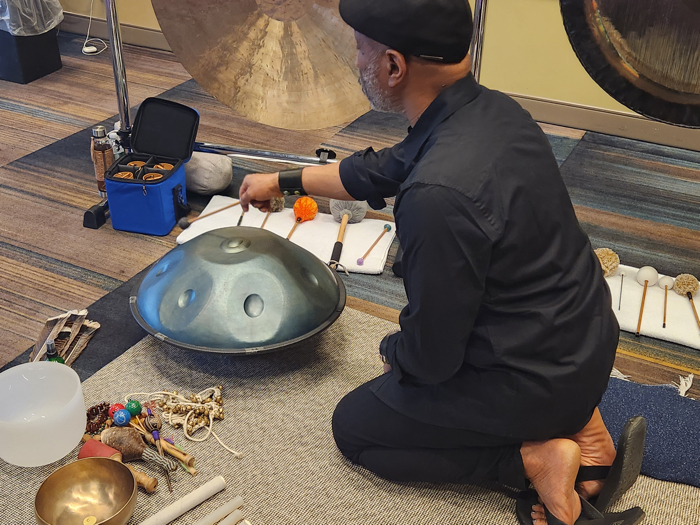
Ben Brown sets up for sound healing class
Another event was a relaxing 90-minute sound therapy session led by Ben Brown, sound practitioner, which took place in an upper floor auditorium. Yoga mats and towels were available for 50 or so participants and after getting comfortable on our backs, eye mask in place, Brown went to work tapping gongs, rattling clackers, and striking tuning forks meant to soothe the nervous system and send out vibrational frequencies that can heal. I am happy to say that it soothed me enough to dose off.
Wandering row upon row of exhibitors can be overwhelming. Each rep is eager to share their product, and for those not fully familiar with the world of supplements, it all goes in one ear and out the other. Not on purpose, but the excitement of harvesting a particular plant in another country, one that can alter a body system so remarkably well can be lost on the untrained ear. But, in the end, one must be glad that there are folks out there devoted to this work.

One physician/exhibitor offered signed copies of his book, Finally Hopeful: The Personalized, Whole-Body Plan to Find and Fix the Root Causes of Your Depression. It’s encouraging to see physicians, like author James Greenblatt, MD, promoting functional medicine and advocating for nutritional interventions in psychiatry and mental illness. His book is a guide, he writes, to address nutritional deficiencies, biochemical factors that play a role in depression.
Attendees leave with tote bags full of free samples, brochures, catalogs, buttons, and pens. Lots of pens. While I applaud the exhibitors who reached out to share health tips and supplement suggestions, the many who came up to me wanting to erase my wrinkles and sagging skin around my eyes with new inventions…well, I will assume they made the same offering to every passerby.
Top: Panelists discussing the future of AI
Photos by MJ Hanley-Goff