Most of my dinners, even those I make for friends, are on the rustic side. I tend to prepare the kinds of dishes made in homes around the world and served family-style on help-yourself platters set in the middle of the table. Pad Thai. Lebanese braised lamb and green beans. Chinese stir fries. Vietnamese summer rolls. Hungarian stuffed cabbage. Shrimp tacos. And more.
Don’t get me wrong. I love watching station chefs work with tiny utensils to plate dishes – topped with tiny flowers, infused tapioca pearls and squiggles of fig reduction. But the only pair of tweezers doesn’t leave the cabinet over my bathroom sink. Such precision and beauty are for my next life, not this one.
Still, there are times now and then when even I feel like serving my friends a dinner that’s a little more festive. As in just last week, when I was planning a celebratory dinner for six. Never mind that we would be celebrating not a birthday or milestone but the successful medical procedure of one of our guests. I wanted to make it special. My idea of special: a prosecco toast with our appetizers, followed by an appropriately heart-friendly main that was a little more elegant than my usual fare.
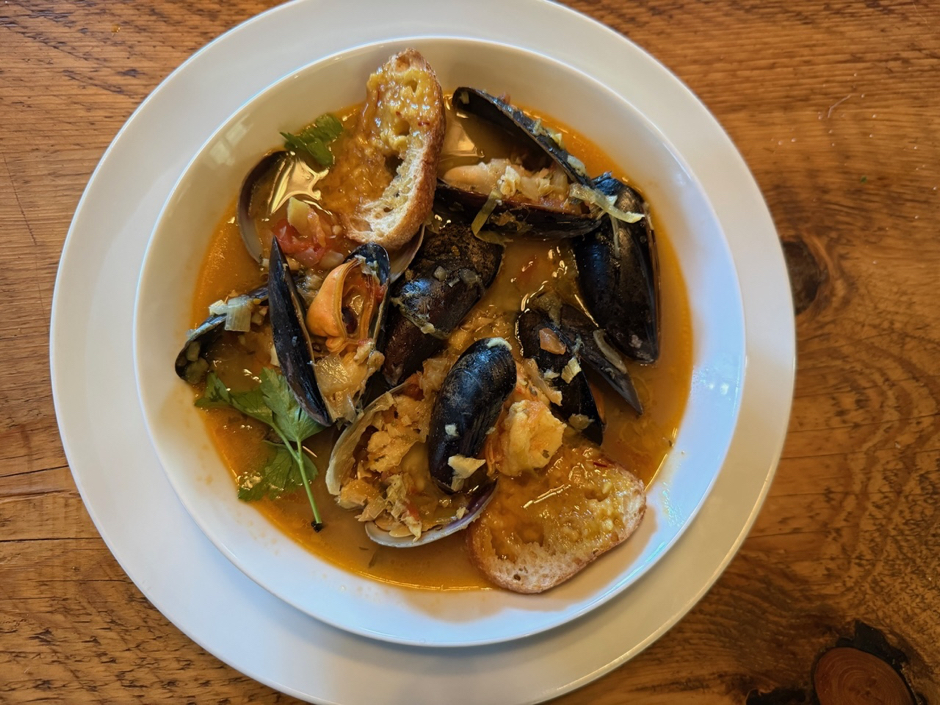
Bottom line, I didn’t want to be fussing last minute—worried that something might go wrong. So I turned to an old failsafe favorite: that a red-gold, garlicky, saffron-y seafood stew, bouillabaisse.
Despite a rarified-sounding name, bouillabaisse (BWEE’-a-bez) started out as a quick-cooking soup made from the leftover catch of fishermen in the south of France. The name combines bolhir, Provençal dialect for boil, with abaissar: to reduce heat or simmer. Boil. Simmer. Serve. Bouillabaisse may be elegant. But it’s still my kind of dish.
You can use any combination of white fish or shellfish in any proportions you and your budget like. I no longer use lobster for obvious reasons. And always avoid oily fish like salmon, swordfish, and tuna.
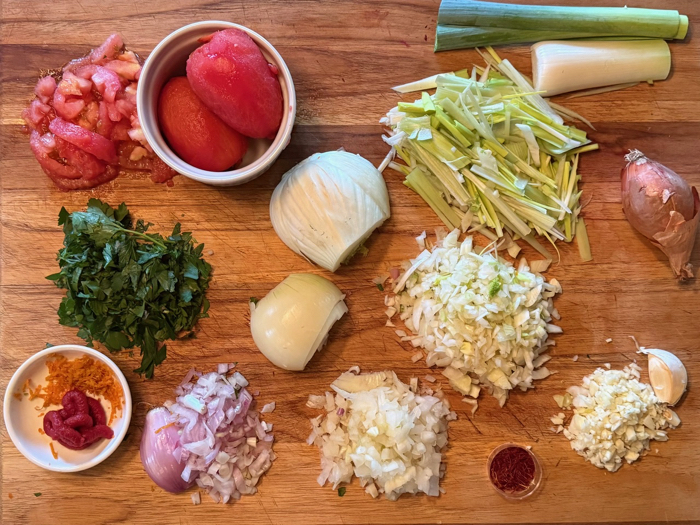
The only part of making bouillabaisse that takes a little time (but not much skill) is chopping and sweating the aromatics: the leek, onion, shallot, fennel, saffron, parsley and orange zest that give the broth its heady aroma and rich, complex taste. You can do this well before guests arrive and leave everything in the pot on the stove. Trust me: nothing bad will happen to it, to you, or your guests.
Bouillabaisse also calls for chopped tomatoes, white wine, and fumet— the fish stock that everything cooks in. I made mine the day before from halibut frames (bones) I got from my fishmonger. But seriously, you don’t have to. Frozen stock is sold in any good fish market. The rational part of my brain knows that making your own will not get you into heaven. Nor will it necessarily get you a more heavenly bouillabaisse—which gets so much from all the other ingredients.
If you’ve prepped in advance (and why wouldn’t you?) you can finish the dish in about the time it takes for your guests to tear themselves away from appetizers and sit down at your dining table.
To serve: family style in a tureen is okay. Or do what I do: ladle the stew into individual bowls. Only I know the shellfish count, and this way I can be sure that everyone gets the full complement.
You can also put on the table a basket of crisp, oven-toasted French bread (fine to make earlier), and—optionally—a small bowl of rouille, a saffron-y emulsion that’s a cousin of aioli. You’ll find info on both in the recipe below.
Bouillabaisse (Serves six)
Ingredients
Group 1
- 12 /cup extra virgin olive oil.
- 1 leek, julienned, white and tender green only
- 1 medium onion, finely chopped
- 1 medium bulb fresh fennel, finely chopped
Group 2:
- 2 shallots, finely chopped
- 5 cloves of garlic, finely chopped
- Healthy pinch of saffron threads (1/2+ teaspoon)
- 2 T tomato paste
- zest of one orange
- 3 T finely chopped parsley
- Group
Group 3
- 4 tomatoes, seeded, skinned and chopped OR 1 cup of canned tomatoes, chopped
- Juice of the orange you zested
- Kosher salt and freshly ground pepper
- 1 cup dry white wine, such as Sauvignon Blanc
Fish, shellfish, fish stock, wine
- 4-5 cups fish stock or fumet, bought or homemade
- 1 dozen littleneck or top neck clams
- 2 pounds mussels
- 1 pound shrimp
- 1.5-2 lbs. white fish, cut into 2′ pieces
- 1 1/2- 2 cups dry white wine.
Directions:
Prep, early in the day
In a large stock pot, heat olive oil over a low flame. Add Group 1 aromatics and sweat several minutes until soft. Add Group 2 aromatics and do the same. Add Group 3 ingredients and raise heat to medium. Simmer for five minutes. Turn off heat. Leave the pot on the stove.
Just before guests arrive
Remove fish, shellfish and stock from the fridge. Pour the stock into a pot and place on a burner. Place fish on one platter and shellfish in separate bowls.
During drinks and appetizers
Sit with your friends and enjoy them. When the time is right, slip off to the kitchen and fire up the stock.
5-10 minutes before serving:
- Add the now-simmering stock to the pot of aromatics. Add the wine. Bring to a boil.
- Add the bivalves first. Cover. Check in a minute or two and if they’re just begun to open, add the fish. Reduce heat and simmer 2-3 minutes. Once the fish is opaque, add the shrimp, turn off the heat and cover. The residual heat will cook the shrimp. The point is to cook but not overcook. Uncover and you’re ready to serve.
Make in advance go-withs:
Baguette
On a cookie sheet, brush slices of French bread with olive oil and place in a 275-degrees oven for ten minutes. When crisp and golden, pile the bread into a bowl for guests to add to their stew if they wish.
Rouille
A rouille is like an aioli (with the addition of saffron and tomato paste) that can be spooned onto the toasted bread or directly into the stew. You can find recipes online or buy Aioli (Whole Foods carries it) and doctor it with saffron and tomato paste. Last resort: add garlic, saffron, tomato paste and olive oil to Hellman’s mayonnaise. Whisk thoroughly and hope for the best.
Photos by Carolyn Swartz