

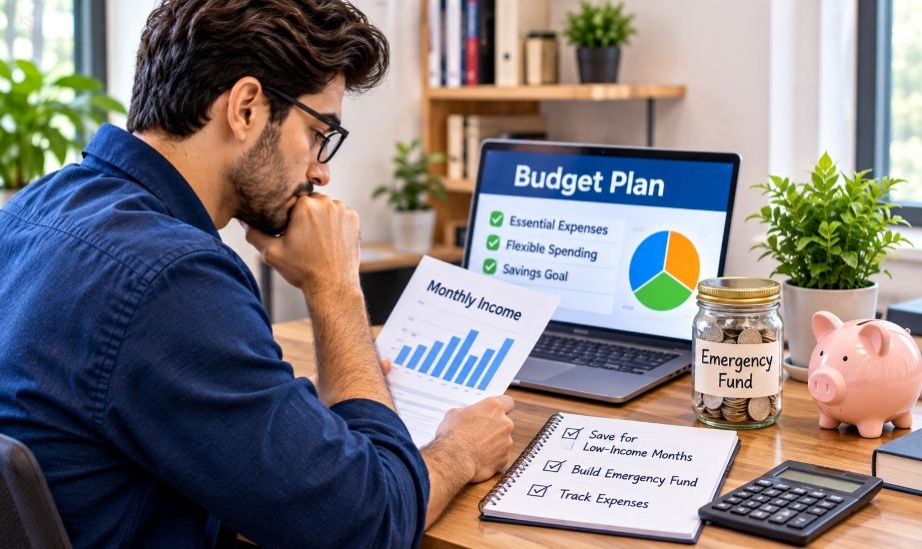
Managing money becomes more challenging when your income is not the same every month. Freelancers, independent contractors, commission-based workers, seasonal employees, and small business owners may earn more during certain months and considerably less during others.
The difficulty is not always how much money someone earns. It is knowing how to manage expenses when the next paycheck or client payment is uncertain.
A high-income month can create a false sense of financial security, while a slower month may make ordinary bills difficult to cover. Without a clear system, people can end up spending too much when earnings are strong and relying on credit when income falls.
Managing variable income requires a different approach from budgeting around a fixed salary. The goal is to create consistency in your spending, build financial reserves, and make decisions based on money you can reasonably expect to have available.
1. Calculate Your Reliable Monthly Income
When earnings fluctuate, using your best month as the foundation for a budget can create problems. A better starting point is to review your actual income history.
Collect payment records, bank statements, invoices, and other earnings information from the previous 6 to 12 months. Calculate your average monthly income, but also identify the lowest-earning months.
For example, someone who earns $2,000 in one month and $4,500 in another should not automatically build a $4,500 monthly spending plan.
Look at the consistency of your earnings and identify a conservative amount that you can reasonably expect to receive. If your income varies significantly, using a lower baseline can help protect you against slower periods.
Also distinguish between money already received and payments that are still expected. An unpaid invoice is not the same as cash available to cover this month’s bills.
2. Separate Essential Expenses From Flexible Spending
When income changes, essential expenses should receive priority.
Start by listing the payments that must be covered regardless of how much you earn. These commonly include:
- Housing payments and basic utilities
- Groceries and necessary household supplies
- Transportation and fuel
- Insurance premiums
- Minimum debt payments
- Essential medical and family expenses
Next, identify flexible spending such as entertainment, restaurant meals, subscriptions, shopping, and optional purchases.
This distinction helps you understand the minimum amount needed to keep your household running. It also makes it easier to reduce spending during a low-income month without immediately affecting essential needs.
Review recurring subscriptions and services regularly. Even relatively small monthly charges can become significant when several are combined.
3. Build Your Budget Around a Conservative Income Figure
A variable-income budget should be based on what you can reliably afford, not what you hope to earn.
Suppose your average monthly income is $3,200, but some months are considerably lower. You might decide to build your regular spending plan around $2,500, provided that amount is realistic for your circumstances.
Your budget could then prioritize housing, food, transportation, insurance, and minimum debt obligations within that baseline.
When income exceeds the planned amount, avoid immediately increasing your lifestyle spending. Instead, use the additional money to strengthen savings, prepare for upcoming expenses, and reduce outstanding debt.
A structured financial planning approach can help organize these priorities and make your decisions more consistent.
The exact baseline will depend on your earnings history, household responsibilities, and existing financial commitments.
4. Create an Income Buffer for Low-Earning Months
One of the most useful strategies for people with irregular earnings is maintaining a separate income buffer.
This reserve helps cover essential expenses when payments are delayed or work becomes less available. It is different from money intended for holidays, investments, or optional purchases.
Start with a manageable target. Even saving enough to cover a portion of one month’s essential expenses can provide some protection.
As your financial position improves, gradually work toward covering one full month of essential costs and then building a larger reserve.
For example, if your essential monthly expenses total $1,800, an income buffer of $1,800 would provide a useful starting point. You can increase that amount according to how unpredictable your income is.
Keep this money accessible but separate from your everyday spending account. Having a dedicated reserve makes it easier to avoid using funds intended for other purposes.
5. Pay Yourself a Consistent Monthly Amount
When earnings arrive irregularly, it can help to create a regular personal payment from your available income.
Instead of spending directly from every payment received, transfer money into a separate account used for monthly household expenses.
For example, a freelancer may receive several client payments during the month. Rather than treating every payment as available spending money, they can deposit earnings into an income account and transfer a predetermined amount into their household account.
This creates a more predictable spending routine.
However, the monthly transfer should never exceed what your actual cash reserves and expected income can support. Keep enough money available for taxes, business expenses, and upcoming obligations before deciding how much to pay yourself.
6. Plan Ahead for Taxes and Business Expenses
People who earn money through freelancing, contracting, or self-employment may have financial responsibilities that are not automatically deducted from every payment.
Depending on the country and employment arrangement, income taxes, estimated payments, business insurance, software subscriptions, equipment, and professional expenses may need to be handled separately.
Treat these obligations as part of your financial plan rather than waiting until a payment deadline approaches.
Keep records of income and deductible expenses, and set aside money according to the tax rules that apply to your situation. If you are unsure how much to reserve, consult a qualified tax professional.
It is also important to separate personal spending from business finances. Mixing the two can make it difficult to understand how much money is genuinely available for household expenses.
7. Avoid Lifestyle Inflation During High-Income Months
A particularly difficult habit to manage is increasing spending whenever earnings rise.
A strong month may create the temptation to upgrade a vehicle, purchase expensive electronics, or commit to new recurring payments. These decisions can become burdensome when income returns to its usual level.
Instead, give extra earnings a clear purpose.
You can divide additional income among several priorities:
- Strengthening your income buffer
- Paying down expensive debt
- Saving toward planned financial goals
- Covering upcoming annual expenses
- Investing when your financial position and risk tolerance allow
This approach makes high-income months useful beyond immediate spending. It also reduces the pressure to maintain a lifestyle that depends on consistently strong earnings.
8. Adjust Your Savings Goals to Match Your Cash Flow
Saving a fixed amount every month may not be realistic when income changes significantly.
Rather than abandoning savings during slower periods, create a flexible contribution system. You might save a smaller amount when earnings are limited and increase contributions when income is stronger.
For example, someone may save $50 during a difficult month and $300 during a better month. The contribution changes, but saving remains part of the financial routine.
Start by identifying what you are saving for. Short-term goals, emergency reserves, retirement, and major purchases may require different timelines and savings arrangements.
Avoid committing money to long-term investments if you may need it for essential expenses in the near future.
For additional guidance on organizing household finances and improving everyday money decisions, explore these personal finance tips.
9. Review Your Financial Position Every Month
A budget for variable income should be reviewed regularly because circumstances can change quickly.
At the end of each month, compare actual earnings with expected income. Check whether essential expenses were covered, whether savings increased, and whether any unexpected costs affected your plan.
Look for patterns in your income history. You may discover that certain months are consistently slower or that particular expenses occur at the same time every year.
These patterns can help you prepare in advance instead of reacting when money becomes tight.
A simple spreadsheet can track income received, essential expenses, savings transfers, debt payments, and remaining cash. You do not need complicated financial software to maintain a useful record.
Build Financial Stability Without Depending on a Perfect Month
Irregular income does not make financial stability impossible. It simply requires more attention to cash flow, spending priorities, and savings.
Start by understanding your actual earnings, building a budget around a conservative income figure, and separating essential expenses from optional spending. Use stronger earning months to prepare for slower periods rather than automatically increasing your regular expenses.
Over time, a consistent system can make uncertain income easier to manage. The objective is not to earn exactly the same amount every month. It is to build financial habits that continue working even when earnings change.
For more useful insights on budgeting, saving money, personal finance, and financial planning, visit Invest Daily Times to explore practical guides and make smarter financial decisions. For questions or inquiries, feel free to contact us.
Website: https://investdailytimes.com/
Email: investdailytimes@gmail.com
Photo created in AI
Contributed posts are advertisements written by third parties who have paid Woman Around Town for publication.