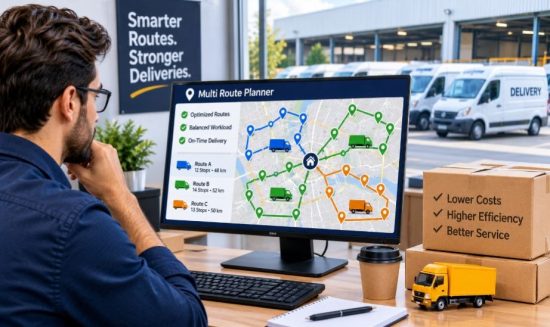
Every dispatch morning begins the same way: hundreds of orders, a finite fleet, and narrow delivery windows. A multi route planner converts that scattered demand into sequenced, balanced routes that drivers can actually execute. It weighs vehicle capacity, driver hours, service times, and traffic together, not in isolation.
The result is fewer miles, fuller vehicles, and delivery promises that hold through the shift. Manual planning cannot match this at scale, because constraints interact in ways spreadsheets never capture. Let’s learn what a multi route planner does, how it balances workloads, and how logistics teams should evaluate and deploy one across high-volume networks.
What is a Multi Route Planner?
A multi route planner is software that assigns orders across an entire fleet and sequences every stop against operational constraints. It solves the multi-vehicle routing problem, balancing capacity, delivery windows, driver skills, and cost simultaneously.
Unlike a single-driver route planner, a multi route planner optimizes many vehicles, depots, and territories at once. It also re-sequences active routes when traffic, cancellations, or urgent orders disrupt the original plan.
Key insight: A multi route planner does not find the shortest path. It finds the most executable set of routes across the whole fleet.
Why do Scattered Orders Create Routing Problems?
Orders arrive continuously from disconnected channels, each with different addresses, priorities, and service requirements. Without consolidation, dispatchers assign work by proximity or habit, which produces uneven, costly routes.
| Scattered-order Symptom | Operational Consequence |
| Orders assigned by proximity alone | One vehicle overloads while nearby routes run half-empty |
| Delivery windows ignored during planning | Missed appointments and failed first attempts |
| Manual sequencing across many drivers | Slow planning and inconsistent daily output |
| No mid-shift replanning | Cascading delays after a single disruption |
| Disconnected order, fleet, and carrier data | Inaccurate ETAs and blind spots during execution |
How Does a Multi Route Planner Balance Daily Routes?
Balancing routes means distributing stops, service time, and travel hours evenly, not simply minimizing distance. A multi route planner applies constraints and objectives together to keep every route feasible.
- Consolidate Demand
The planner ingests orders, addresses, priorities, and service requirements into one environment.
- Model Fleet Capacity
Vehicle weight, volume, driver skills, and shift limits define what each route can hold.
- Assign and Sequence Stops
Algorithms compare route combinations against every constraint at once.
- Distribute Workload Evenly
Stops and hours spread across drivers to prevent overload and idle time.
- Dispatch to Driver Apps
Sequences reach drivers with navigation, tasks, and proof-of-delivery capture.
- Re-optimize During Execution
Affected stops recalculate when conditions change, protecting nearby commitments.
Enterprise-grade routing engines can plan over one million stops in under fifteen minutes, generating routes far faster than manual methods ever allow.
Which Features Should a Multi Route Planner Include?
Feature depth determines whether a planner produces routes that survive contact with real operating conditions. The capabilities below separate enterprise route optimization software from basic tools.
| Feature | What it Delivers |
| Constraint-based Optimization | Capacity, windows, skills, and driver hours modeled together |
| Dynamic Re-optimization | Affected stops recalculate mid-shift without rebuilding whole routes |
| Multi-vehicle, Multi-depot Planning | Whole-fleet sequencing across hubs and territories |
| Service-time Intelligence | Learned stop durations replace generic assumptions |
| Mixed-fleet Support | Owned, outsourced, gig, and EV vehicles in one plan |
| Driver App Integration | Navigation, tasks, and proof capture in one workflow |
| Real-time Visibility | ETA drift, long halts, and exceptions surfaced early |
| Operational takeaway: Features that ignore mid-shift change produce plans that look efficient at 8 a.m. and fail by 10 a.m. |
What Business Outcomes Does a Multi Route Planner Deliver?
A multi route planner affects cost, productivity, and service reliability at the same time. Improvements should appear across the full scorecard, not one metric alone.
- Lower delivery costs through consolidated stops and reduced empty miles.
- Higher capacity utilization as vehicles carry fuller, better-balanced loads.
- More stops per route without adding vehicles or overtime.
- Stronger first-attempt delivery from feasible, window-aware sequencing.
- Fewer WISMO contacts because ETAs stay accurate through execution.
Enterprises deploying mature route optimization commonly report double-digit reductions in average cost per delivery alongside meaningful gains in stops per route, showing that cost and productivity improve together rather than at each other’s expense.
How Should You Choose a Multi Route Planner?
Software evaluation should start from your operating model and delivery commitments, not a generic feature checklist. Test each option against the conditions your fleet actually faces.
- Constraint Depth
Confirm support for capacity, windows, driver hours, skills, and vehicle restrictions.
- Dynamic Routing
Verify mid-shift resequencing after traffic, cancellations, and urgent orders.
- Fleet Flexibility
Check coordination of owned, outsourced, gig, and EV fleets in one plan.
- Scalability
Test planning speed at peak volumes across multiple hubs and territories.
- Integrations
Require connectivity with TMS, OMS, WMS, telematics, and carrier systems.
- Governance
Look for permissions, audit trails, and human oversight of automated decisions.
What Steps Ensure a Successful Multi Route Planner Implementation?
A multi route planner delivers better results when implementation follows a structured operational process.
| Implementation Best Practice | Details |
| Clean the Order Data | Standardize addresses, delivery windows, package dimensions, priorities, and customer information. |
| Define Routing Constraints | Document capacity, driver shifts, vehicle restrictions, service times, and depot rules. |
| Start With a Controlled Pilot | Select representative routes across different territories and operating conditions. |
| Compare Baseline Performance | Measure planning time, mileage, route duration, utilization, and on-time delivery before deployment. |
| Train Dispatch Teams | Ensure planners understand route review, exception handling, manual overrides, and route monitoring. |
| Connect Execution Data | Integrate driver applications, telematics, tracking, and proof-of-delivery information. |
| Review Results Continuously | Use route adherence and planned-versus-actual data to refine planning rules. |
This creates an operating cycle where planning decisions become measurable and future routes improve from execution data.
| Expert note: The planner learns from completed routes, so accurate proof-of-delivery data compounds into better future sequencing. |
What Should You Measure After Deployment?
A multi route planner should be evaluated through operational outcomes rather than route-generation speed alone.
| KPI | What it indicates |
| Route Planning Time | Dispatcher productivity and planning automation |
| Vehicle Utilization | How effectively available capacity is used |
| Miles Per Delivery | Routing efficiency and unnecessary travel |
| On-time Delivery Rate | Ability to meet customer commitments |
| Route Adherence | Difference between planned and executed routes |
| Driver Overtime | Accuracy of route duration and workload balancing |
| First-attempt Delivery Rate | Effectiveness of sequencing and scheduling |
| Cost Per Delivery | Overall financial efficiency |
Tracking these measures establishes whether route changes actually improve the operation. It also creates a baseline for evaluating future routing adjustments.
Turn Scattered Orders Into Balanced Routes Today
A multi route planner helps logistics teams turn scattered orders into balanced, executable routes across the available fleet. It considers capacity, delivery windows, driver schedules, service times, and route constraints together.
Effective planning also requires dynamic re-optimization when traffic, cancellations, or urgent orders disrupt the original schedule. Technology partners such as FarEye can connect route planning with dispatch, tracking, and broader delivery orchestration workflows.
The strongest results come from accurate data, defined routing rules, and measurable KPIs. Teams that continuously compare planned and actual performance can improve utilization, delivery reliability, and cost control across their networks.
Photo created in AI
Contributed posts are advertisements written by third parties who have paid Woman Around Town for publication.