
Of course, the interior of NYC, like Times Square, Central Park, the Battery, Hudson Yards, etc. are well-known; we see them often, pass by them daily. But when was the last time you sailed under the George Washington Bridge, or saw where the Titanic would have docked, or learned why Yankee Stadium was moved to their spot in the Bronx? Now you’re talking.
On a recent and mild October afternoon, the yacht called “Manhattan I” was docked at Chelsea Piers and gently swaying to the movement of the Hudson River. The guests for the 2:30 p.m. sailing are lined up. Once aboard, we are welcomed by Ginny, our expert guide from the AIA (the Architectural Institute of America), presented with a complementary cocktail, before taking our seats in the elegant main room. Comfy and spacious booths line each side of the area, with table service for lunch, snacks and drinks.

View from the interior of the Manhattan I yacht
The cruises are narrated by these learned members of the AIA, well versed with extensive knowledge of the city’s infrastructure, and the powerful government officials who planned out the roadways, bridges and mass transit systems. While these stories are fascinating on their own, it’s the buildings and architecture along the stretch of the Manhattan waterfront, as well as the surrounding boroughs that’s front and center today.
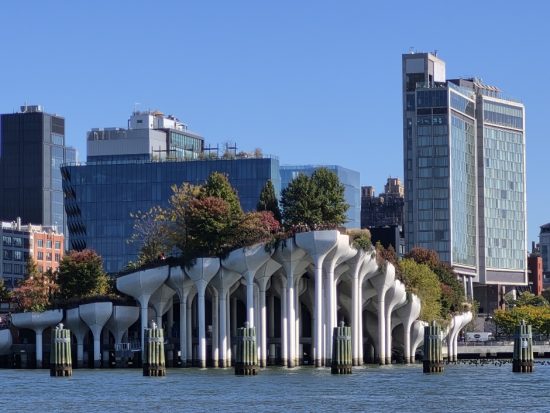
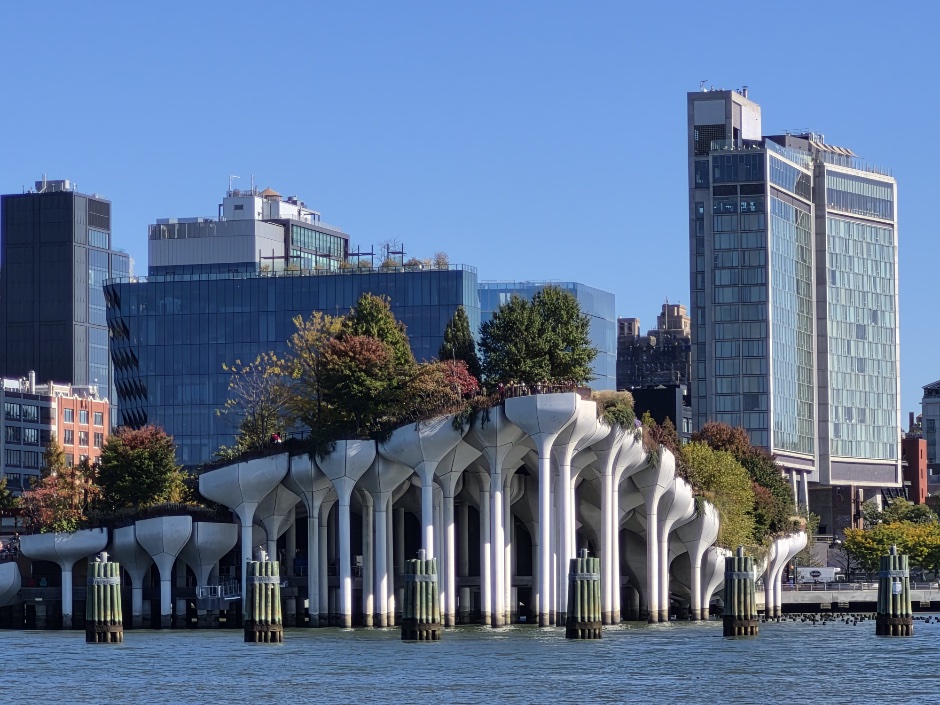
The yacht moves slowly south as Ginny points out the Hoboken Lackawanna Terminal on the Jersey side, built in 1907, used as a transportation hub for commuters to NYC; next, the ventilation towers of the Holland Tunnel which rise up on each side of the river; then what looks like a floating island, called Little Island. Finally, the towering tops of the office buildings that make up downtown.
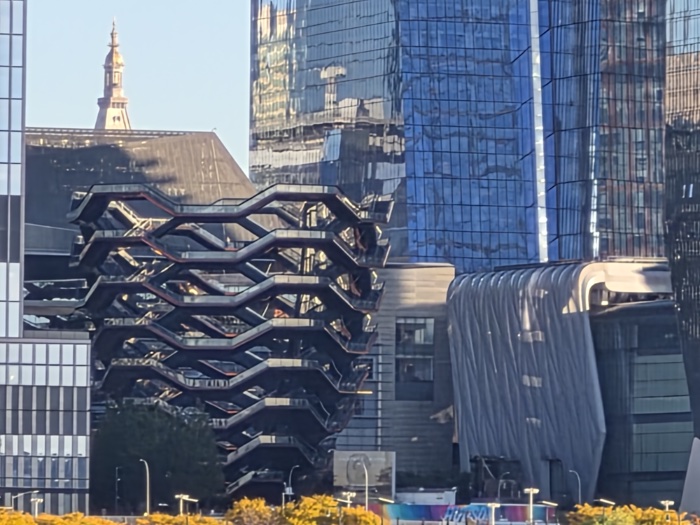
The Vessel at Hudson Yards
Around the tip of the island, we get a close-up view of the Statue of Liberty, and Ellis Island, as Ginny describes the ordeal of those coming through immigration during that time. After more than two months at sea, thousands were ushered through a variety of checkpoints and either allowed entry or if found to be ill, sent back. Coming up the Brooklyn Bridge, we hear stories about Staten Island, the Verrazano Bridge, and both waterfronts of Brooklyn and Queens with its distinctive Domino Sugar sign.
Returning our attention to the east side of Manhattan, we see the apartments that make up Stuyvesant Town, then the United Nations, Queensboro Bridge, Roosevelt Island, Gracie Mansion as we head north to the Marble Hill section of the Bronx and back down to our starting point.
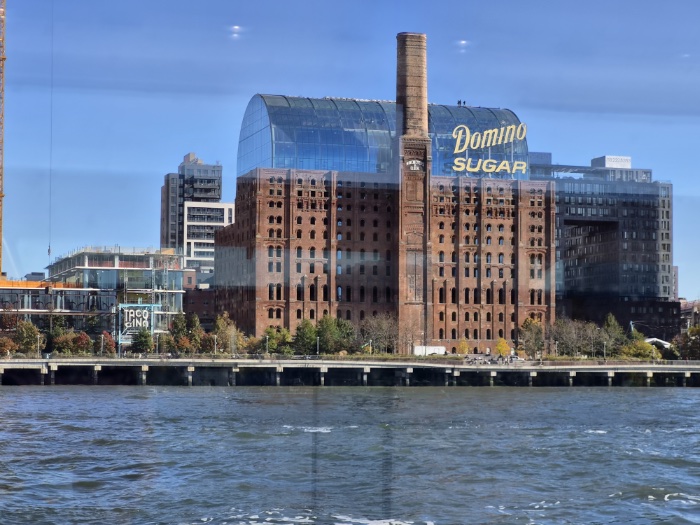
Domino Sugar sign on Queens waterfront
The sailing lasts for almost three hours, and the time flies by quickly. All the while, our narrator provides the captivating stories behind the rich families of the Gilded Age who funded many of the projects. We hear about the egos of the architects who wanted to better each other with their project’s height or décor. And the story of the Polo Grounds, the four stadiums in upper Manhattan and how the popularity of baseball changed the way it was presented in New York. We learned also why the New York Mets chose their blue and orange logo colors. Nope, we’re not giving it all away here.
If you want to expand your knowledge of New York City history, skip the textbook and jump on one of the upcoming cruises. It’s a lovely day to be out on the water, and see our great city in a new light.
Top photo: Little Island
Photos by MJ Hanley-Goff
For upcoming sailings, and other specialty tours, visit Sail NYC
For information on the Architecture Institute of America, visit The American Institute of Architects