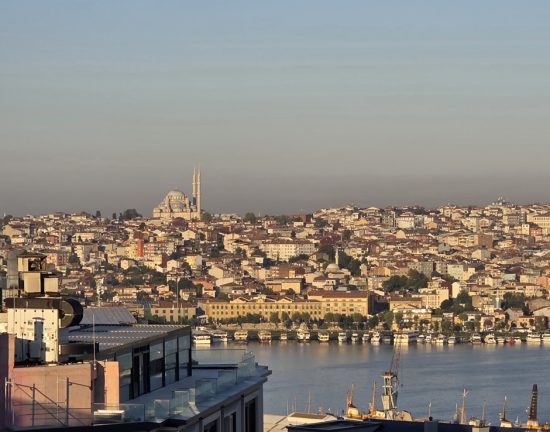
There is a symphonic resonance to Istanbul that a traveler feels long before fully understanding it. It begins in the early morning: the low, sonorous baritone of a ferry horn cut across by the sharp cries of gulls over the Bosphorus, all before the first melodious call to prayer rises and echoes across the centuries-old hills. To sit by the water with a steaming glass of çay (tea) is to realize that this city doesn’t just have a history; it has a living, distinct soundtrack.
As the day deepens, the visual movements take over. Peeling back the layers of Istanbul feels like uncovering paint on an ancient canvas. By dusk, the sky above the Golden Horn shifts into a burnished, cinematic violet, casting long shadows across dome and minaret. The scents of roasted chestnuts, coffee, and spices mingle with the salty sea air, and there arises an awe-inspiring feeling when you realize you are in a city that embraces two continents.
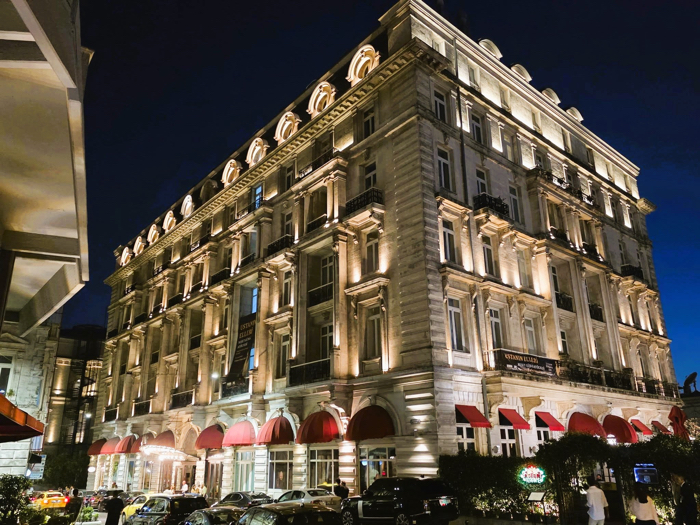
Pera Palace Hotel
My immersion into this spellbinding crossroads began not on its crowded avenues, but within the historic Pera Palace Hotel. Built in the late 19th century to host passengers arriving on the Orient Express, the hotel carries an atmosphere thick with literary ghosts. Room 411 is famously associated with Agatha Christie and Murder on the Orient Express.
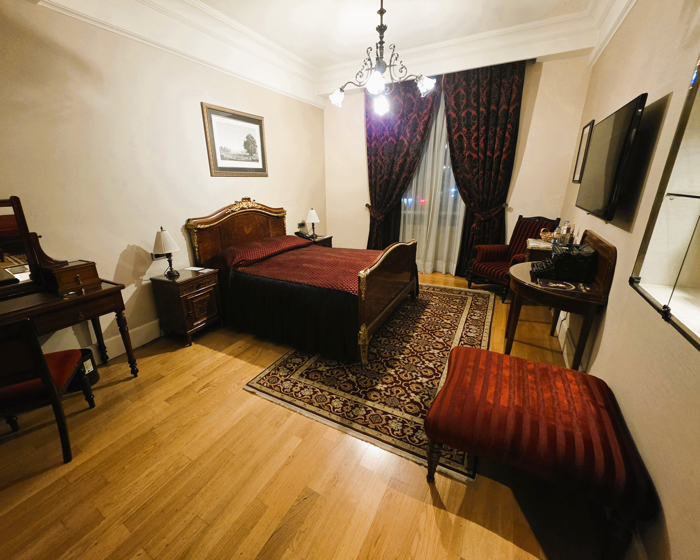
Agatha Christie Room at Pera Palace Hotel
Upon discovering I was a writer, the reception desk extended a serendipitous invitation: a complimentary visit to the iconic Agatha Christie Room, vacant for that one evening. Stepping across the threshold, blissfully jet-lagged and dreamy, felt like an encounter with the famed writer’s spirit. Greeted by a replica of Christie’s typewriter, surrounded by period antiques and her books, I could almost feel the electricity of her mysteries lingering in the air.
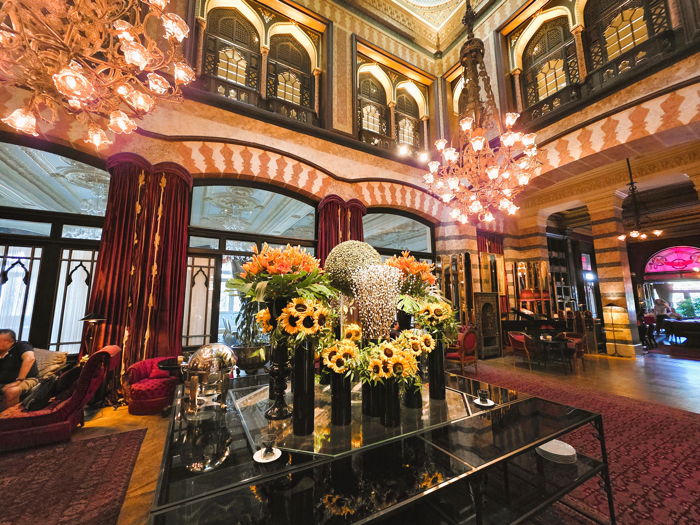
Kubbeli Lounge in the Pera Palace Hotel
The next morning, the hotel continued its sensory courtship in the spa-level breakfast room. I quickly established a ritual, indulging in a lavish buffet that culminated in pure honeycomb folded into fresh, thick kaymak, Turkish clotted cream. Fortified by this lavish sweetness and the sunrise viewed from my balcony, I explored the hotel’s public spaces. In the majestic Kubbeli Lounge—where guests can enjoy afternoon tea accompanied by delicious mini sandwiches and desserts—gilded moldings frame an atrium where a pianist fills the air with the graceful, cascading notes of Chopin. Nearby, Room 101, where Mustafa Kemal Atatürk, founder of the Republic of Turkey, stayed and worked during his visits to Istanbul and which is now preserved as a museum, anchors the hotel’s glamorous romance to the birth of modern Turkey.
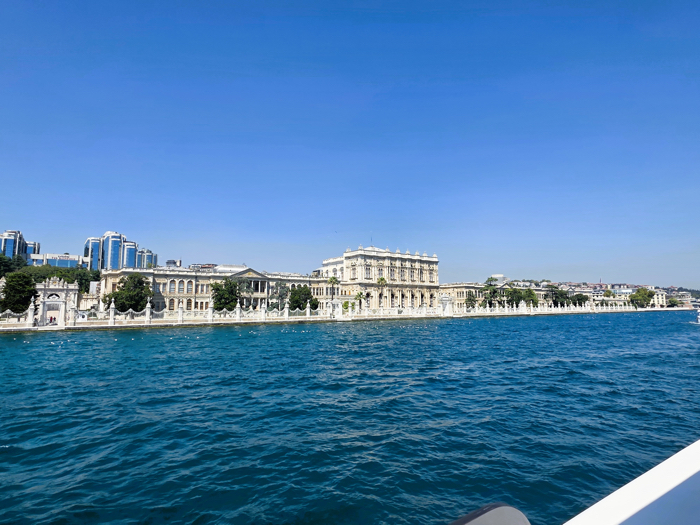
Cruise on the Bosphorus
Only after basking in the hotel’s historic and artistic aura did I venture out to meet the city itself. My first true excursion was an afternoon cruise along the Bosphorus, organized by Velena Travel. Floating upon blue, lulling waters accompanied by undulating Turkish folk songs—tunes carrying a deep, ancient longing I never knew I possessed myself—I watched the majestic silhouettes of the shoreline drift by. We glided past the formidable Rumeli Fortress, built by Sultan Mehmed II in 1452, shortly before the conquest of Constantinople, and the sweeping, opulent façade of Dolmabahçe Palace.
When the boat docked on the eastern shore, I experienced a thrilling personal milestone: stepping onto the continent of Asia for the first time. I wandered into a quiet neighborhood mosque whose peaceful sanctity stayed with me long afterward. Melting into the golden afternoon light pouring over the strait, with those haunting Turkish melodies resounding around me and within me, I knew definitively that I was falling in love with Istanbul.
Perhaps some part of that recognition had begun even before I arrived. Having spent countless hours immersed in the Turkish historical drama Magnificent Century and being Romanian, I came armed with some knowledge of Ottoman history, along with a fledgling Turkish vocabulary cultivated through Duolingo. To the delight of hotel receptionists, taxi drivers, and Murat, the exceptional guide who led the next day’s historic sites tour, also courtesy of Velena Travel, I eagerly practiced my Turkish phrases.

Room in the Topkapi Palace
When we entered Topkapi Palace, it felt as though the screen had dissolved and I had stepped directly into the 16th-century reign of Sultan Süleyman the Magnificent. Walking through the seat of Ottoman power, I was struck by the convergence of its strict imperial traditions and its inviting beauty.
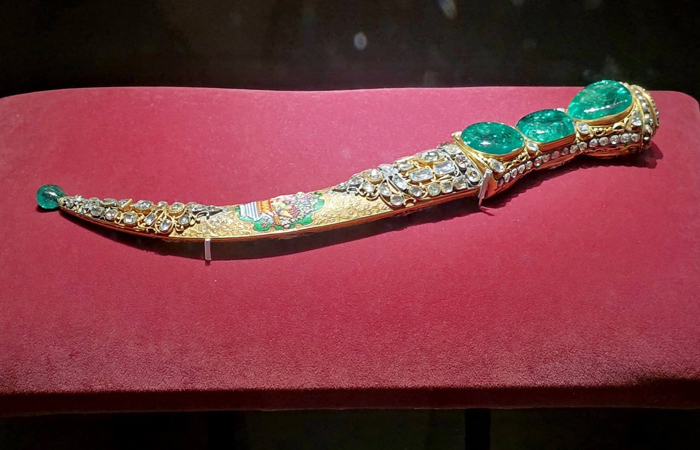
The Topkapi Palace dagger
In the Imperial Treasury, the legendary Spoonmaker’s Diamond and the Topkapi Dagger, encrusted with three enormous emeralds, glowed with the fierce majesty of the three-continent spanning empire.

Inside the Blue Mosque
Our pilgrimage led us next to the Sultanahmet Mosque, universally known as the Blue Mosque. Stepping inside its vast, ethereally luminous interior, I felt awe beneath the canopy of tens of thousands of blue iznik tiles. The Blue Mosque’s six slender minarets have inspired a delightful piece of local lore: Sultan Ahmed I supposedly requested golden (altin) minarets, only for the architect to hear the Turkish word for six (alti). Whether history or legend, the story seems entirely at home in a city where fact and myth so often appear to stroll side by side.
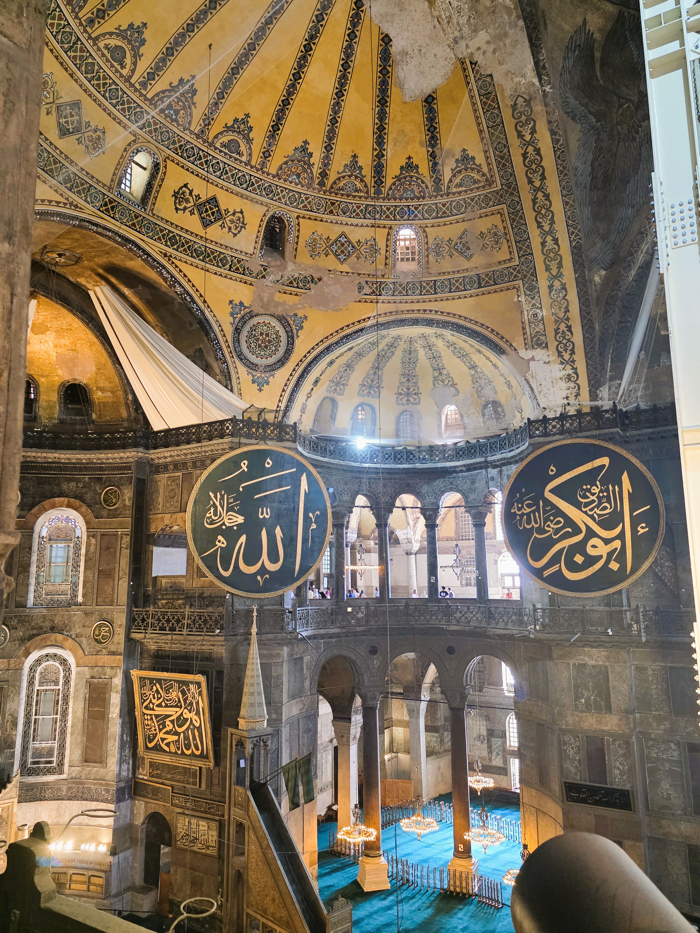
Inside the Hagia Sophia Mosque
Directly across the square, we entered Hagia Sophia. From the upper gallery, Byzantine grandeur and Ottoman history coexist within the same staggering space. Peering at the ancient, weathered walls, I was deeply moved by glimpses of Christian mosaics amid enormous discs of Islamic calligraphy, different centuries and faiths inhabiting the same monumental interior.
By midday, the heat drove our group to a lively rooftop tavern, where lunch featured a beautifully grilled whole fish. To the visible horror of my more cautious Western travel companions, I channeled my Romanian roots and happily devoured the entire fish, head and all, leaving behind an immaculate skeleton.
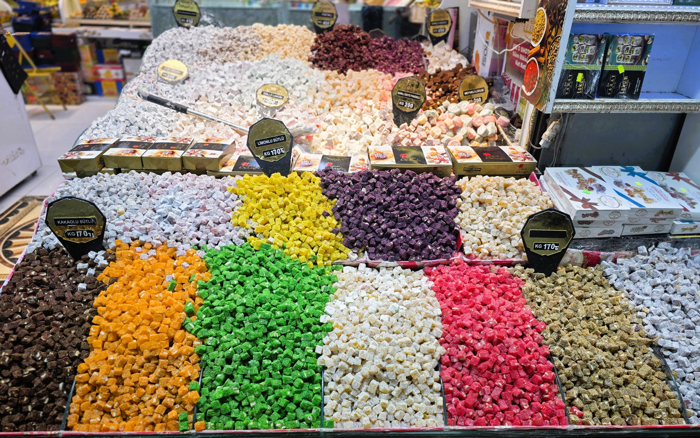
Delicious treats at the Grand Bazaar
The Grand Bazaar required an entirely different talent. I had ventured into its sprawling labyrinth alone the previous day and quickly learned that making eye contact with its charismatic vendors could result in being gracefully persuaded that your life was incomplete without whatever they happened to be selling. Bargaining, however, is an art form here; accepting the original price almost seems an insult. Perhaps channeling my grandfather, who is believed to have had Turkish blood, I engaged a textile vendor in the traditional marketplace choreography. I feigned indifference, sighed dramatically, and pretended to walk away. The theatrical dance triumphed: I emerged with a superb scarf of genuine Bursa silk at half the original price.

Yours truly in Ottoman attire
Returning with the tour group, I surrendered even more completely to the bazaar’s theatrical romance, dressing in an imperial costume to have my portrait taken as an Ottoman Sultana and living out my Magnificent Century fantasies for one brilliant, fleeting moment.
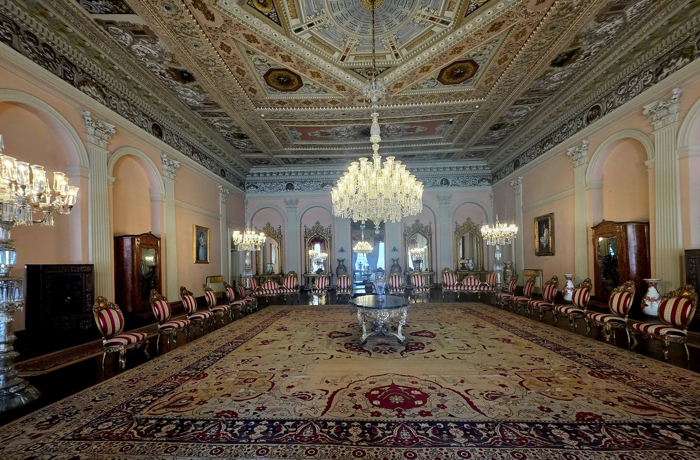
Interior at Dolmabahçe Palace
In the days that followed, architectural opulence alternated with sweetly moving street-level discoveries. Dolmabahçe Palace dazzled me with its extraordinary fusion of Ottoman grandeur and European Baroque, Rococo, and Neoclassical styles. Its interiors initially reminded me of the Gilded Age mansions of Rhode Island, though on a more grandiose imperial scale.
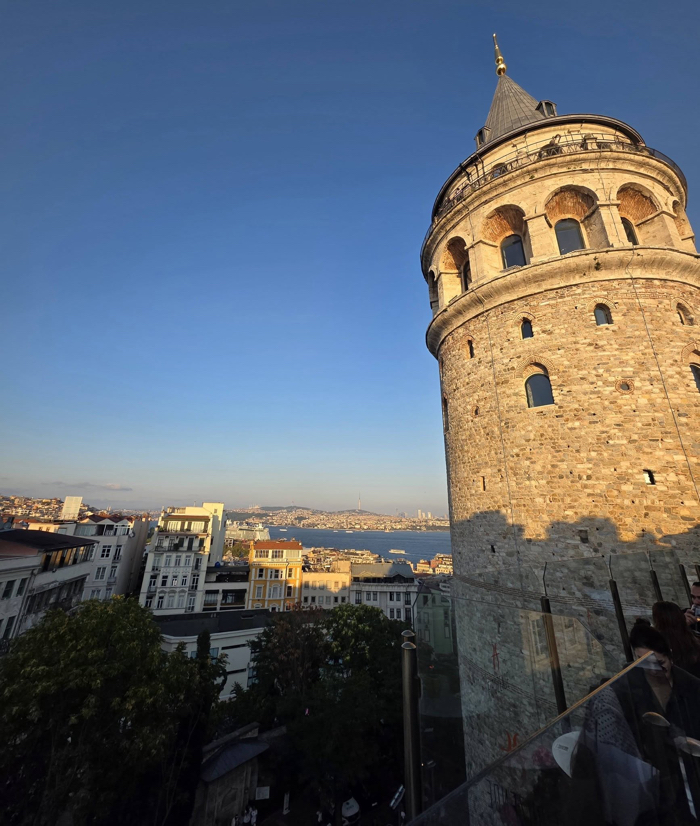
Sunset view of Galata Tower and Bosphorus from Firuzende Restaurant rooftop
Scaling the medieval Galata Tower offered an entirely different perspective: breathtaking panoramas over the city’s seemingly endless rooftops. That evening, I dined at Firuzende, where the tower itself, bathed in a rich golden glow, seemed to watch over our rooftop tables like a benevolent sentinel.
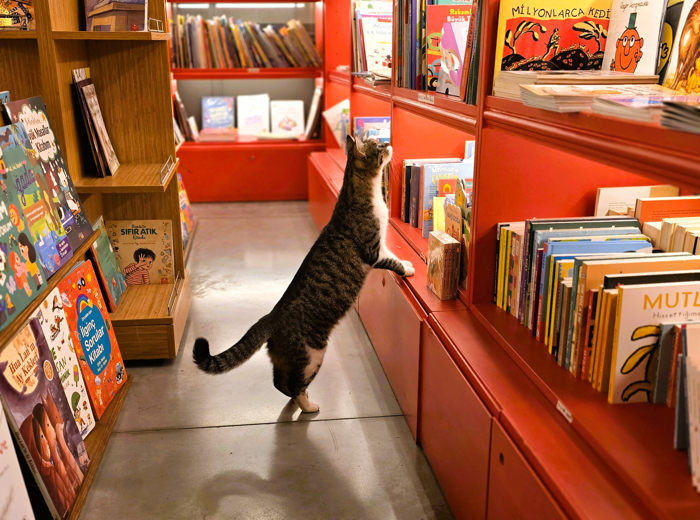
Famous cat book expert at the Minoa Bookstore
Some of my fondest memories were forged simply walking the steep, cobbled streets of Beyoglu. Istanbul is famously a city governed by its felines; the community loves, feeds, nurtures, and fiercely protects its street cats. They sleep on boutique doorsteps, stroll through museums, and occasionally insert themselves into the most official of proceedings. At Minoa Pera, a beloved bookstore and café, the resident cat became my silent tour guide. A city that loves cats so unconditionally is, without question, my kind of city.
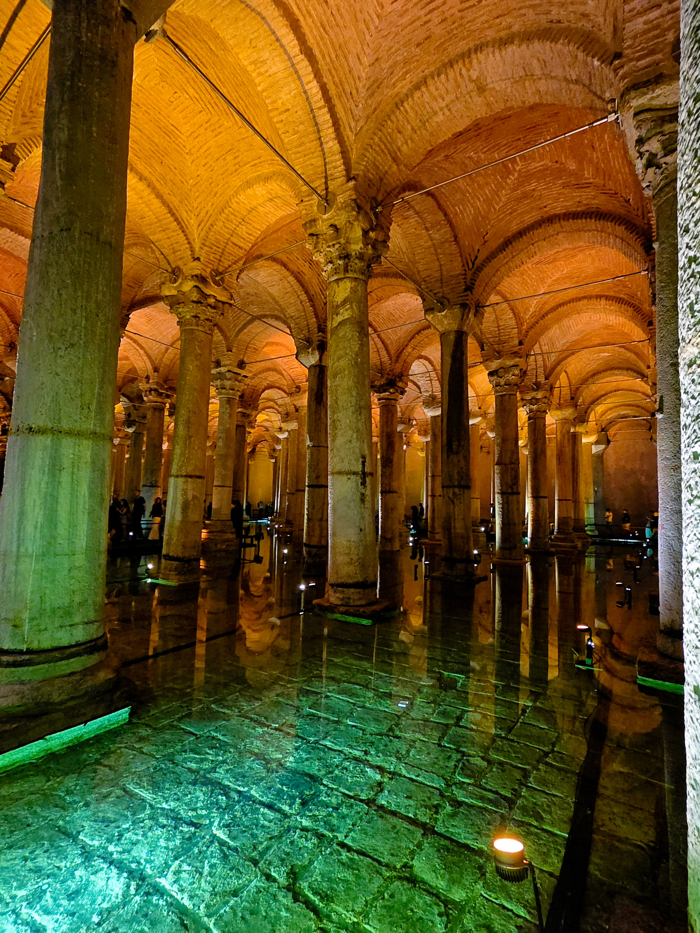
Inside Basilica Cistern
For sheer enigma, however, nothing matched the hypnotic subterranean depths of the Basilica Cistern. Built during the reign of Emperor Justinian in the 6th century, this ancient reservoir feels like stepping into a Gothic mystery. Walking among hundreds of columns while water ripples quietly below, one instantly understands why the cistern has inspired filmmakers and novelists. At the far end, monumental stone Medusa heads emerge from the darkness, one sideways and another upside down, frozen in time.
The true crown jewel of Istanbul is its people. Their hospitality is warm, conversational, and deeply knowledgeable. I felt instantly at home thanks to people like Nihat Akbay, the gracious restaurant and catering manager at the Pera Palace, and Ayham Souda at the Sirvani Lokum store near the bazaar, with whom I enjoyed hour-long conversations about Istanbul’s history and charms. At Serbethane Café and Restaurant, the owner and his lovely young daughter welcomed me like family and served me my first glass of traditional Turkish sherbet.
Being of Romanian origin offered an unexpected passport to their hearts. Whenever locals discovered my heritage, their faces would light up with recognition and one name would inevitably surface: Gheorghe Hagi, the legendary Romanian footballer who became an enduring Galatasaray hero, first as a player and later as a coach. Even in a city divided by the fierce rivalry between Galatasaray and Fenerbahçe, Hagi seemed capable of inspiring something close to universal affection.
These encounters awakened in me a sense of familiarity I had not expected. The trace of Turkish blood inherited through my grandfather had always seemed distant, more an intriguing strand of family history than a living part of me. Yet here, amid Turkish words that came at first tentatively and then more boldly to my lips, melodies that stirred an inexplicable longing, and strangers who responded to my Romanian identity with such immediate warmth, that distant thread suddenly felt closer.
As my journey approached its end, I realized that the tapestry of Istanbul is never static; it is woven and rewoven around you every day. The calls to prayer echo from minaret to minaret five times a day like an ancient, mystical round, bridging the progressive streets of Beyoglu with the historic spires of Sultanahmet. Below, on the bridges themselves, lines of patient fishermen cast their silhouettes against the water day and night.
And then there is the Bosphorus blue.
The light enchants the eyes, turning the water varying shades of deep, vivid, seemingly impossible blue, colors so particular to Istanbul that I wondered whether they existed anywhere else. Then I found them captured almost perfectly in the woven threads of a small bamboo-and-silk carpet I simply had to buy, after an extensive and spirited round of bargaining, of course. During this acquisition of my own woven piece of the Bosphorus, I heard a local refer to Istanbul by one of its historic Ottoman names: Der-i Saadet, often translated as the Abode of Felicity, or as some say, The Gate of Bliss.
Evocative names for a city that demands patience before yielding its pleasures.
Especially as Istanbul’s breathtaking beauty comes with infuriating, labyrinthine traffic. As one taxi driver told me, “In Istanbul, we don’t need psychologists—traffic is our therapy!” The steep, cobbled hills can turn a tour minivan into an unpredictable horse and cart, particularly if one has made the tactical error of eating a heavy meal beforehand. As drivers take shortcuts up impossibly steep inclines, there is little to do but relinquish control and flow with the ride.
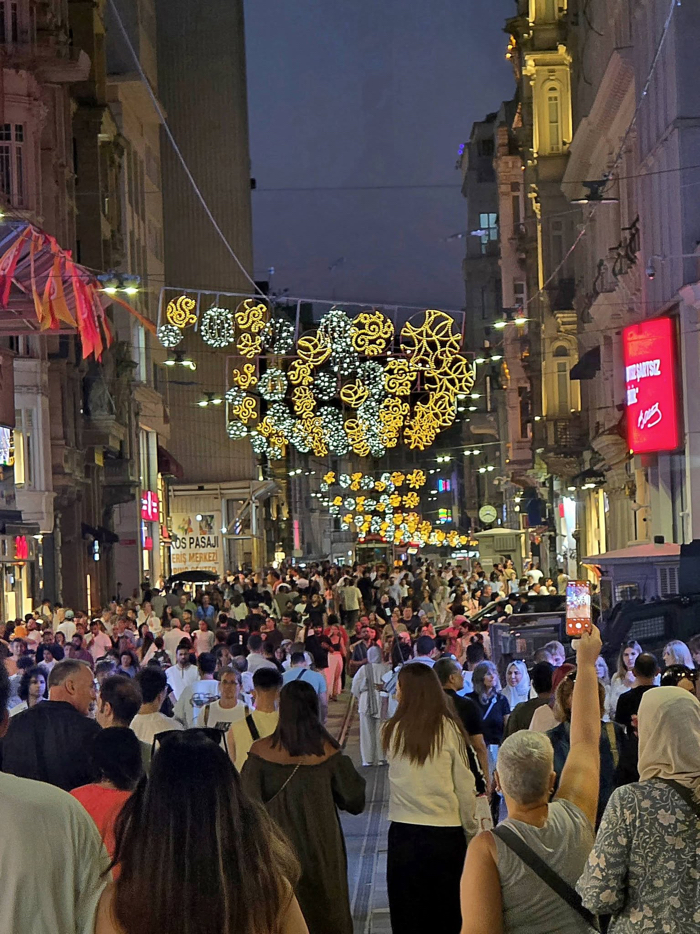
Evening walk on Istiklal Avenue
The same is true on foot. Istiklal Avenue, the historic pedestrian artery connecting Taksim Square and Tünel, surges with humanity well into the evening, not simply tourists, but Istanbul itself. Among the crowds, I witnessed public marriage proposals and declarations of love on rooftops and street corners, greeted by spontaneous applause from hundreds of strangers. The city can be chaotic, theatrical, exasperating, and unexpectedly intimate, sometimes within the same five minutes. But ultimately, the traffic and crowds blend naturally into the daily fabric and rhythm.
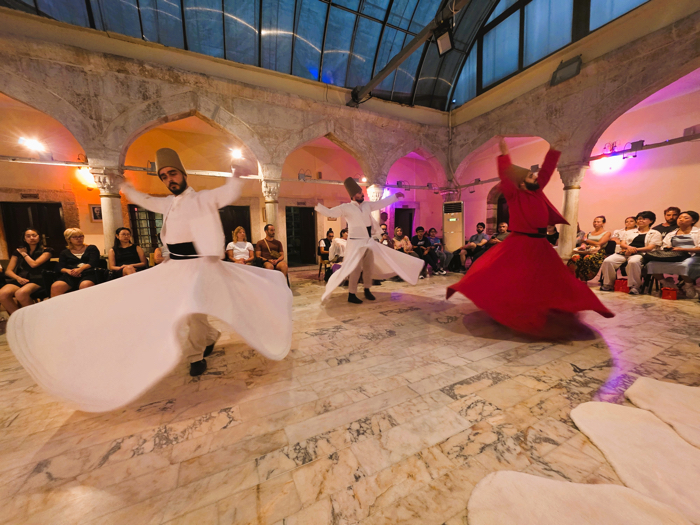
Whirling Dervishes at the Sufi Ceremony
Istanbul is as deeply spiritual as it is intensely sensory, and nowhere did I understand this duality more profoundly than at a Sufi ceremony. Sitting in the intimate space, I watched the Whirling Dervishes and found myself drawn into an almost shared state of trance. The ritualistic music was anchored by traditional instruments: the haunting, breathy whisper of the ney (reed flute), the warm, resonant plucking of the oud (lute), and the brilliant, cascading strings of the kanun (zither), accompanied by a singer—the oud player—whose voice seemed to rise from the deepest recesses of his soul. The music led me to the poetry of Rumi and to a philosophy that approaches the Divine through boundless love and the shedding of the human ego. Watching the Dervishes spin, their flowing skirts blossoming like roses, is to see that philosophy transformed into physical motion. They whirl toward a state beyond worldly identity, their faces bearing an extraordinary fusion of beatitude and surrender.
And perhaps that is exactly what Istanbul asks of anyone who passes through its ancient gates: To stop resisting or even defining its contradictions. To relinquish rigid expectations. To accept the noise with the silence, the crowds with the solitude, the ancient with the modern. To observe how ferry horns, gulls, calls to prayer, Turkish melodies, laughter, traffic, and the whisper of the ney become movements within the same vast composition.
And finally, to surrender to its ravishingly beautiful, at times unpredictable symphony, dissolving the contours of fixed identity to melt into the multifaceted allure of a city that belongs to eternity.
Photos by Maria-Cristina Necula
For more information
Topkapi Palace — National Palaces of Türkiye
Dolmabahçe Palace — National Palaces of Türkiye
Blue Mosque (Sultanahmet Mosque) — Visit Istanbul