A First Encounter
Two hours are hardly enough to spend in the historic Massachusetts coastal city of Salem. But when you’re only passing through, as I was, and time is limited, even a brief stay can prove historically and culturally illuminating and enriching. My visit began at the Salem Witch House. The museum’s two-part tour starts with a captivating presentation of the Salem witch trials where scenes depicting the events that led to the trials and the trials themselves are set up with mannequins and narrated, lit up one by one while the audience sits in a darkened circular auditorium as though a part of the courtroom. The narration brings to mind Arthur Miller’s powerful 1953 play The Crucible, a partially fictionalized story of the Salem witch trials that Miller intended as an allegory for McCarthyism.
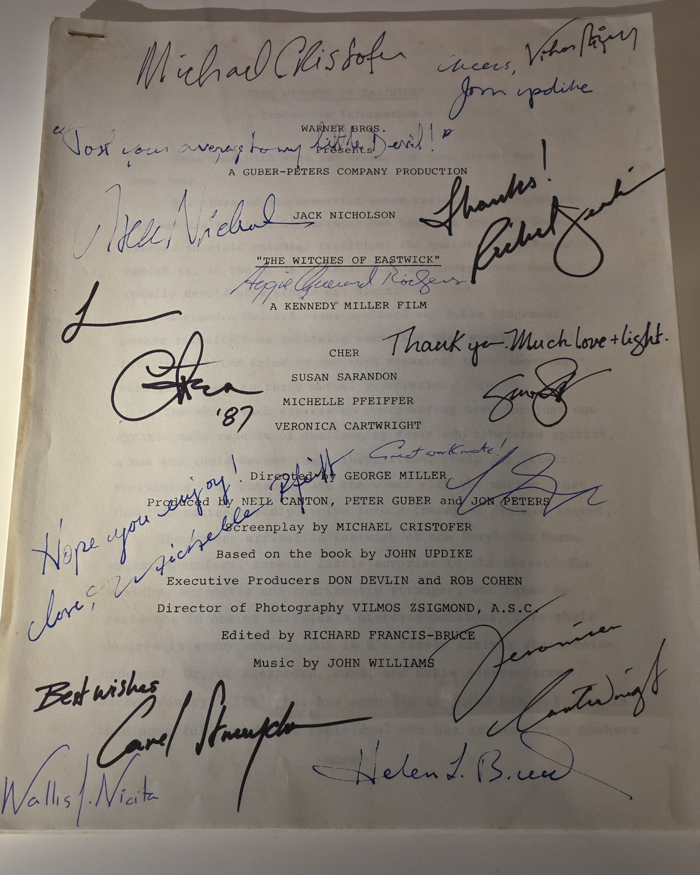
The Witches of Eastwick screenplay signed by its stars at the Salem Witch Museum
The presentation is followed by a guided tour of an exhibit and complemented by explanations of the history of witches in Europe. The museum’s treasures combine history with entertainment: from old manuals of spells to herbs and their bewitching properties to the first edition of Frank Baum’s The Wonderful Wizard of Oz from 1900 to the screenplay of The Witches of Eastwick movie signed by its stars Jack Nicholson, Cher, Michelle Pfeiffer, Susan Sarandon, and others.
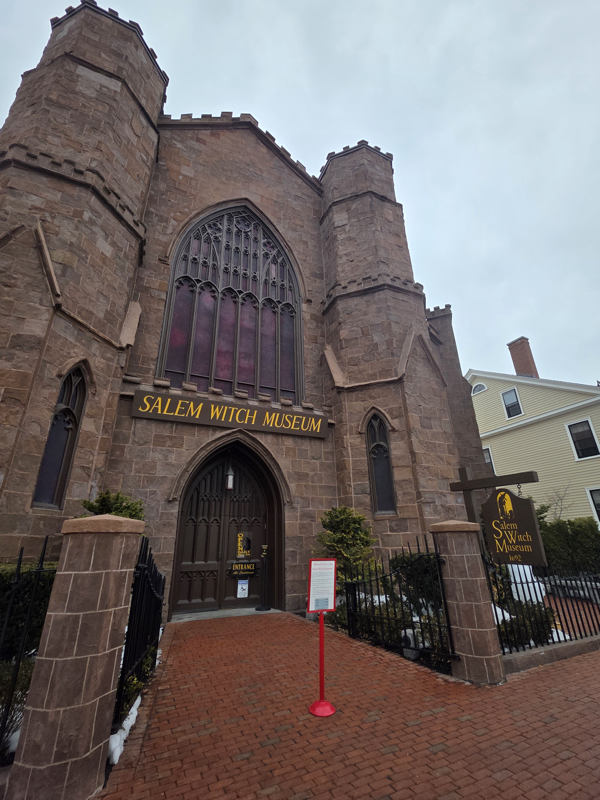
The Salem Witch Museum
Within walking distance from the Salem Witch Museum is the Salem Witch Board Museum, the world’s only museum dedicated to the history of the Ouija board. I was greeted by its owner John Kozik who regaled me with a fascinating tour and account of the history and mystery of the “talking board”. A wonderfully engaging speaker and entertaining narrator, John instantly draws you into the story so profoundly that you can actually sense a magic, enigmatic energy emanating from the displays of various Ouija boards, posters, artifacts and other enthralling items, and you want him to continue speaking for the entire day.

John Kozik, owner of the Salem Witch Board Museum
This enlightening visit inspired me to remember and reflect on what happened in Salem in 1692 and to share what I have learned at both museums. The emergence of mass hysteria is a universal phenomenon that repeats itself throughout history in avalanches of devastation, injustice, and anguish. Salem’s evolution is also a story of restoration and reclamation. And while, as is the case with astonishing historical circumstances and figures of most eras and locations, Salem’s past has been turned into a commercial success, these local educators take great care to unpack the details of what occurred with sensitivity and depth, and restore a belated, commemorative justice to the victims.
The Salem Witch Trials: When Fear Overpowered Justice
In 1692, the small Puritan community of Salem Village, Massachusetts, became the center of one of the most infamous episodes of mass hysteria in American history. The Salem witch trials were not born from clear evidence of wrongdoing but from fear, grief, superstition, and social strain.
The crisis began quietly. Personal tragedies, including the losses suffered by one of its inhabitants, Mrs. Putnam, fostered anxiety about unseen forces. In search of answers, her daughter Anne and other girls engaged in secret attempts to contact the dead. Reverend Samuel Parris’s enslaved Black servant, Tituba, told the girls stories that blurred folklore and imagination. When the girls later began exhibiting strange physical behaviors—fits, screams, and trance-like states—these episodes were interpreted as signs of demonic possession. What might today be understood as psychological distress quickly escalated into collective panic. The girls’ accusations spread, and suspicion rippled through the tightly knit religious community and launched the trials.
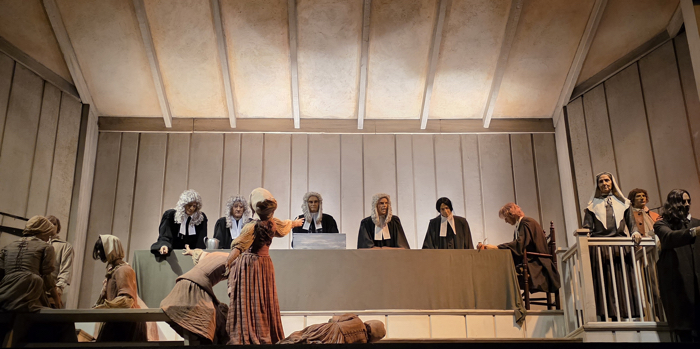
Scene from the Salem witch trials at the Salem Witch Museum
These trials revealed how fragile justice can be under pressure. Rebecca Nurse, a widely respected elderly woman, was accused of witchcraft. Though initially acquitted, the verdict was overturned amid public outcry. The court accepted “spectral evidence,” allowing dreams and visions to serve as proof of guilt. Under Chief Justice William Stoughton, legal standards eroded as the proceedings prioritized appeasing public fear rather than examining credible evidence. Approximately 250 people were jailed. They had to pay for their own upkeep in prison, and as a result, many became bankrupt. Nineteen were hanged and one died a horrific death of being pressed by heavy stones: the 81-year-old farmer Giles Corey who refused to enter a plea of either guilty or not guilty. Others died in prison due to illness or mistreatment.
Even outspoken critics were not safe. John Proctor publicly condemned the trials and was later accused and executed himself, proving the danger of dissent in a climate ruled by fear. There were small signs of restraint: pregnant women such as John’s wife Elizabeth Proctor received temporary stays of execution, but these exceptions could not undo the devastation.
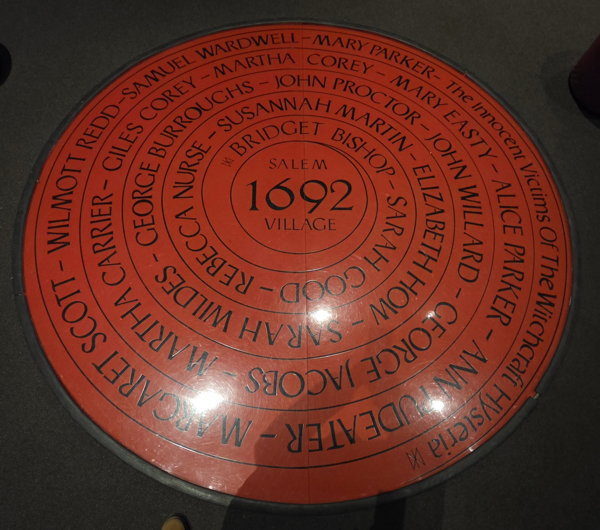
The names of the Salem witch trials victims at the Salem Witch Museum
In the years that followed, remorse replaced hysteria. In 1706, Anne Putnam publicly apologized for her accusations. Over time, the Salem witch trials came to symbolize the destructive power of mass panic and scapegoating. Today, they serve as a warning: when fear dominates reason, justice can quickly unravel.
European Witch Hunts and the Making of a Stereotype
Long before Salem, Europe experienced widespread witch hunts. Accusations often surged during times of war, plague, famine, and economic uncertainty. Communities searching for explanations and scapegoats frequently targeted society’s margins, such as widows, outspoken women, and the poor. The 1486 publication of Malleus Maleficarum—the best-known treatise about witchcraft written by the German Catholic clergyman Heinrich Kramer—reinforced the belief that women were especially susceptible to the devil’s influence. Such texts shaped enduring stereotypes about witches as dangerous, subversive figures. By the late 18th century, formal witch trials declined. Historians estimate that roughly 45,000 people, most of them women, were executed across Europe. In colonial America, execution typically meant hanging rather than burning, but the consequences were equally tragic.
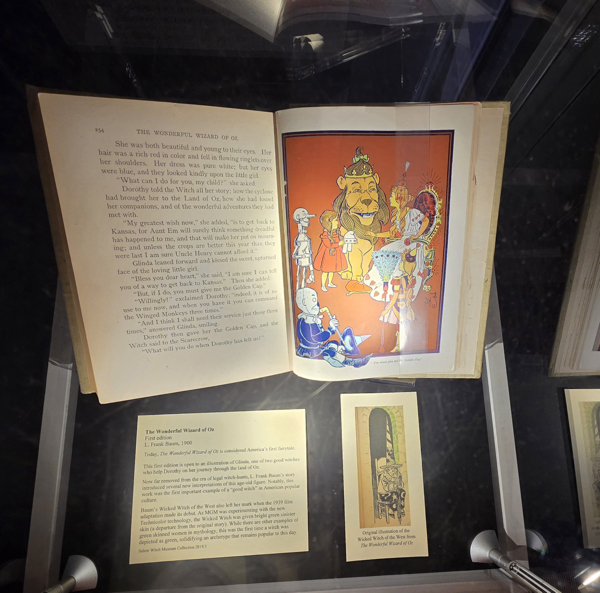
First edition of Frank Baum’s The Wonderful Wizard of Oz (1900) at the Salem Witch Museum
Over centuries, folklore and imagination added visual symbols: broomsticks, pointed hats, and animal companions such as black cats. These images entered mainstream culture most memorably in the 1939 film The Wizard of Oz, whose green-skinned Wicked Witch became an enduring icon.
Reclaiming the Witch: The Rise of Modern Spiritual Movements
In the 20th century, the meaning of “witch” began to shift dramatically. Rather than symbolizing evil, it became associated with spiritual exploration and empowerment. The emergence of Wicca in the 1950s marked a turning point.
Wicca, a modern nature-based religion, honors a Mother Goddess and a Horned God, figures distinct from the devil imagery of earlier centuries. Practitioners celebrate seasonal cycles, personal responsibility, and harmony with nature. For many, adopting the label “witch” is an act of reclamation, transforming a word once used to persecute into one that expresses identity and resilience. The witch thus became both a reminder of historical injustice and a symbol of spiritual renewal.
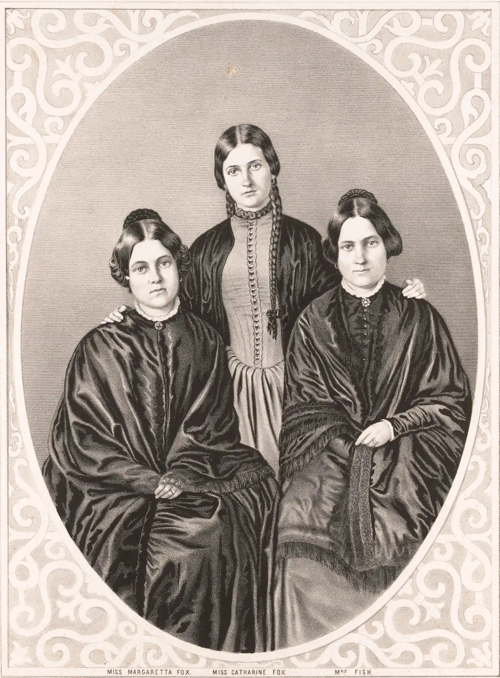
The Fox sisters (from left to right Margaret, Catherine, and Leah) – Lithograph after a daguerreotype by Appleby, Rochester, NY, 1852
The Ouija board: Comfort, Controversy, and Cultural Reinvention
The story of modern spiritualism also includes one of the most recognizable mystical objects in popular culture: the Ouija board. Its origins trace back to the 19th-century Spiritualist movement, inspired in part by the three mediums Kate, Maggie, and Leah, known as the Fox sisters, and their claims of communicating with spirits through knocking sounds. By 1890, Charles Kennard, the founder of Kennard Novelty Company, had commercially produced the first “witch board,” later named “Ouija.” The American businessman, inventor, and entrepreneur from Baltimore, William Fuld, expanded its production and marketing, presenting it as both mysterious and accessible.
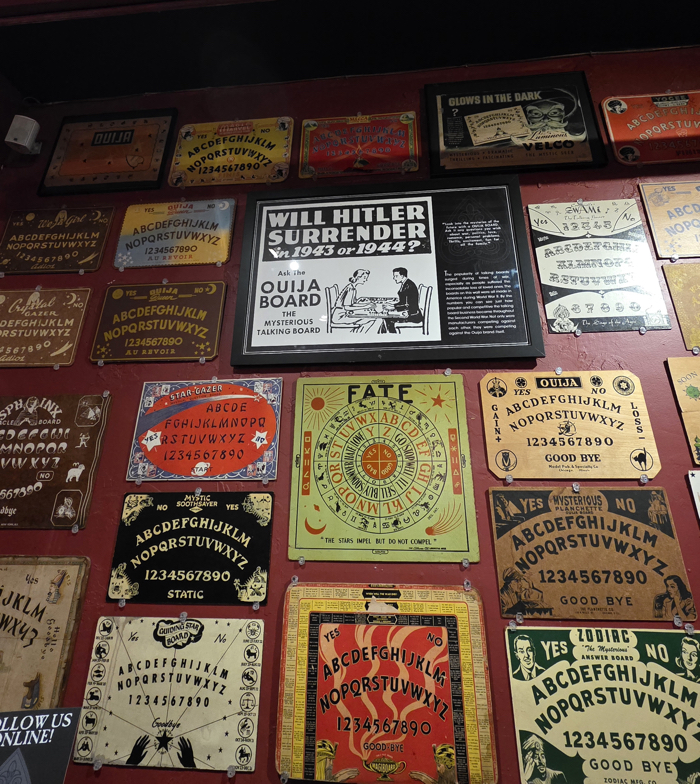
Ouija boards and a WWII poster at the Salem Witch Board Museum
Originally, the Ouija board offered emotional comfort, especially after the Civil War, when many families sought connection with lost loved ones. It was not inherently feared. During World War II, it remained popular, sometimes even used to speculate about wartime events. Public perception shifted dramatically after the 1973 horror film The Exorcist portrayed the board as a conduit for demonic forces. Despite the ominous portrayal, sales increased. The board evolved into a party novelty and cultural dare. Though occasional sensational stories have fueled suspicion, many argue that the Ouija board is simply a tool, its meaning shaped by the beliefs and intentions of those who use it.
Salem Today: Memory, Tourism, and Community
Modern Salem reflects a striking transformation. What was once the site of tragedy is now a center for education, tourism, and spiritual community. Various annual gatherings, such as Tarot conventions and more, and museum exhibits attract visitors from around the world.Local businesses preserve historical narratives while supporting heritage tourism. Exhibits emphasize nuance and depth, exploring the human stories behind accusations, the evolution of spiritual practices, and the distinction between folklore and documented history.Visitors engage not only with artifacts but with living traditions. Conversations, social media sharing, and cultural events keep the story evolving. Salem today balances remembrance with reinvention, blending history, myth, commerce, and community.
From 17th-century gallows to 21st-century spiritual festivals, the figure of the witch has undergone profound transformation. The Salem witch trials remain a cautionary tale about the dangers of mass hysteria and scapegoating. The European persecutions of those suspected to be witches revealed how social instability can foster suspicion and violence. Yet modern spiritual movements demonstrate resilience. The witch, once a symbol of terror, has become for many a symbol of empowerment and self-definition.
The story of witchcraft is ultimately a story about society itself, about how communities respond to fear, how justice can falter, and how identities can be reclaimed. It reminds everyone that while mass hysteria may pass, it can always take countless forms and its lessons endure.
The Crucible (1996 film) on Amazon
Top: The Jonathan Corwin House also known as The Witch House built in 1642, a Historic House Museum with direct ties to the Salem witch trials that Corwin was involved in as an investigator.
Photos by Maria-Cristina Necula