One never knows how a gift given in childhood may inspire a creative life. In this case, it was Jacob W. Frank’s first camera. His photo book, Parklands: America’s National Parks and Public Lands, is dedicated to his mom for passing down her digital camera, and for urging him to take pictures whenever he could.
That second-hand camera, he says, became the gateway to the outside world, and ignited an eagerness to travel and explore. Over the years, he found himself drawn to the country’s natural beauty and was chosen to be an intern at Grand Teton National Park in Wyoming. Next stop was another post, but this time at Glacier National Park (Montana), then to Canyonlands and Arches National Park (Utah). All the while, with camera in hand, he kept taking pictures of the surrounding beauty, panoramic vistas, the animals that inhabit the area, and nighttime skies.
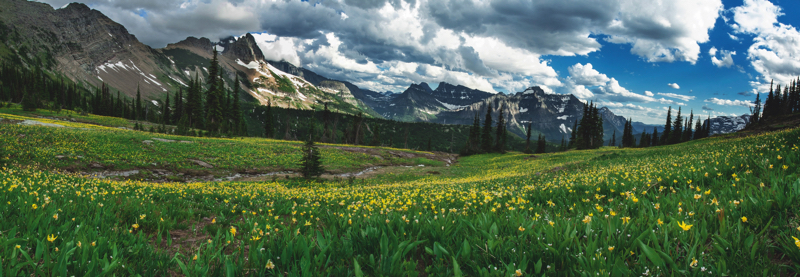
Vibrant Lillies in Glacier National Park
With these lush and artful photographs, it’s obvious Frank honed his eye for a stunning landscape, or an up-close peek inside a cave, and from his uphill hikes, we have dramatic aerials of snowcapped mountains, and crystal-clear lakes. In Arches National Park (Utah), we see “Swiss cheese rock,” where over time, a honeycomb appearance was created on the desert rock surface. In Denali National Park and Preserve (Alaska), Frank captured a fossilized dinosaur footprint. What? A dinosaur footprint!
Chapters are divided up based on themes. We see one on “Geology,” another on “Flora,” then “Dark Skies,” “History” and a few others. In each one, Frank provides insight into its ecological importance. In the “Dark Skies” chapter, he delves into the need for darkness for “physiological processes” of plants in how they flower; some plants bloom in the night for the nighttime pollinators like moths. Their life cycles depend on a certain amount of total darkness. Humans need it, too, he writes, for proper sleep and overall wellbeing.
In the chapter titled, “Charismatic Creatures,” we get to see a diverse collection of species and how these public lands provide undisturbed territories for them to “roam, hunt, and reproduce.” Plus, we see them feeding their babies. The photos in the “History” chapter will surely inspire awe at the Pueblo structures and bits of pottery found in the dirt, and century’s old drawings on the red cave walls.

His intention is not only to share his love affair with the beauty in these national parks but also a call to action to help promote the importance of public lands. He suggests finding hands-on restoration projects, cleanups and educational programs that may ignite a new passion.
Books of this kind with magnificent nature photographs that highlight our world’s beauty and mystery also have the power to spark an interest, but in in smaller way: to become more observant, go outdoors more, or if you’re an armchair traveler, learn about the parks in your area. Maybe even find a used digital camera and start recording the world around you.
With an impressive background including advanced degrees in Recreation, Parks and Tourism, Frank has worked at six of the National Parks. Before taking a position in the National Park Service, he was videographer and photographer for the Navajo Nation non-profit organization. His photography has been featured at the Smithsonian National Museum of Natural History.
Parklands: America’s National Parks and Public Lands
Jacob W. Frank
Top: A lone bull elk stands proudly in Yellowstone National Park
Photographs by Jacob W. Frank. Reprinted by permission of Gibbs Smith Books.
Our editors love to read and independently recommend these books. As an Amazon Affiliate, Woman Around Town may receive a small commission from the sale of any book. Thank you for supporting Woman Around Town.