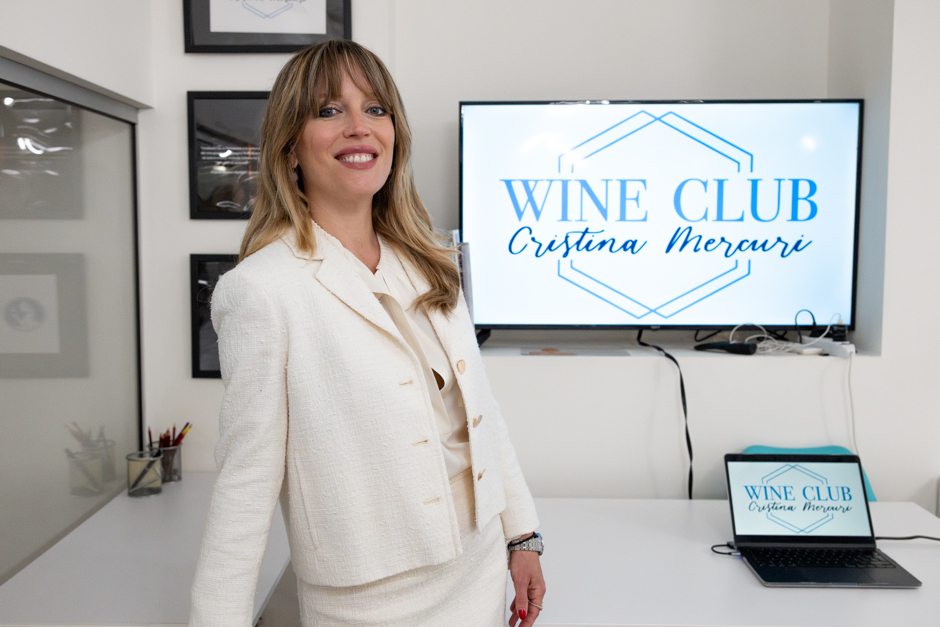
Cristina Mercuri is the Founder and CEO of Mercuri Wine Club, a consulting company and educational
academy where she develops training programs for both consumers and companies within the wine industry. Her teaching style stands out for its clear and engaging language, capable of reaching diverse audiences while maintaining academic rigor. She just became the first Italian woman to achieve the Master of Wine qualifications, one of the most rigorous and prestigious ones in the global wine industry.
Alongside her academic and consulting work, Cristina has led important training projects for wineries, wine consortia, distributors, and restaurants, with a particular focus on strengthening and promoting the brand reputation of Italian wines abroad. She is also active in the luxury sector, where she develops innovative wine-focused team-building formats.
Her narrative vision is summarized in the brand’s guiding statement: “We believe that wine education and communication can achieve the highest levels of excellence and authority while remaining accessible and enjoyable.”
Can you point to one event that triggered your interest in your career?
The turning point came when I realised that wine brought together several things that fascinated me: culture, science, geography and human connection. It felt like a field where intellectual curiosity could translate into a lifelong journey of learning.
What about this career choice did you find most appealing?
What appealed to me most was the possibility of working at the intersection between knowledge and impact. Wine is an industry where agriculture, craftsmanship, economics and culture meet, and that complexity creates an extraordinary space for analysis and strategic thinking.
Over time my work evolved toward helping producers and brands translate that complexity into clear positioning and communication. Through consulting and through Mercuri Wine Club, I work with wineries on product identity, market strategy and storytelling, helping them understand how their wines can be perceived and valued in different international markets. In a global industry, the ability to connect terroir, style and narrative in a coherent way can significantly influence how a wine succeeds commercially and culturally.
What I find most compelling is precisely this possibility of contributing to change. By improving how wine is understood and communicated, you can strengthen the entire ecosystem: producers gain clearer positioning, consumers gain better understanding, and the industry becomes more open, transparent and relevant. That potential to shape the conversation around wine is what makes this career so stimulating for me.
What steps did you take to begin your education or training?
My path into wine began after a previous career in law. I worked as an international lawyer before deciding in 2015 to redirect my professional life toward the wine industry. That background shaped the way I approached wine from the beginning: with a strong emphasis on method, discipline and analytical thinking.
The first step was structured education. I began studying through the WSET programmes, which provided a rigorous framework for understanding viticulture, winemaking, markets and tasting methodology from a global perspective. Alongside formal study, I dedicated an enormous amount of time to tasting practice, comparative analysis and reading in order to build both sensory memory and theoretical depth.
As my understanding grew, I wanted to challenge myself at the highest level of the profession. In 2019 I entered the Master of Wine programme, which allowed me to deepen my analytical approach and place my work within a truly international context. That journey required years of preparation, blind tasting practice and research, ultimately culminating in the completion of my Research Paper and the MW title.
Looking back, the transition from law to wine was demanding but coherent. The same discipline and intellectual rigor that guided my legal career became the foundation for my education and professional development in wine.

Along the way, were people encouraging or discouraging?
I encountered both. Some people encouraged the transition because they saw how committed I was. Others questioned the decision to leave a legal career for wine. In the end, what mattered most was remaining consistent with my own sense of direction.
Did you ever doubt your decision and attempt a career change?
Doubt is natural in any long journey, especially one that requires years of study and persistence. However, I never seriously considered returning to another career, or most of all, back to law. Wine had already become the field where my curiosity and professional energy felt most aligned.
When did your career reach a tipping point?
Entering the Master of Wine programme in 2019 was a defining moment. It placed my work within an international framework and accelerated both my learning and my professional visibility.
Can you describe a challenge you had to overcome?
One of the most demanding challenges was adapting to the very different phases of the Master of Wine programme. Stage Two is an intense technical test: blind tastings under pressure and written papers that require you to connect viticulture, winemaking, economics and markets with speed and precision. Preparation for that stage felt almost like athletic training. I worked through repeated exam simulations, structured tasting practice and a very disciplined routine in order to perform consistently under time pressure.
I passed Stage Two on my second attempt, which I consider a significant achievement given the very low pass rate at that level. Reaching that stage confirmed that the preparation, discipline and method I had developed were effective.
Stage Three presents a completely different kind of challenge. Once the exams are completed, the focus shifts to the Research Paper, which requires long-term intellectual work and a much more solitary form of discipline. Instead of performing in a few hours, you spend months — often years — refining ideas, methodology and argumentation. My research on Wine, Women and Fascism: Gender Representation in Enotria (1922–1943) required historical research, visual analysis and academic rigor beyond the usual wine discourse.
Learning to move from the high-intensity performance of Stage Two to the slower, reflective work of Stage Three was one of the most important challenges of the journey. It required patience, focus and the ability to sustain intellectual curiosity over a long period of time while continuing to work professionally.

What single skill has proven to be most useful?
Analytical thinking. Wine can be emotional and cultural, but clear reasoning allows you to interpret complexity, communicate effectively and make sound professional decisions.
What accomplishment are you most proud of?
Becoming the first Italian woman Master of Wine is certainly a meaningful milestone. It represents years of study, discipline and perseverance, and I am aware that it carries a symbolic value for the Italian wine community. At the same time, I see it less as a single achievement and more as the culmination of a long process of growth. I am equally proud of what has been built around that journey. Through Mercuri Wine Club I have been able to create a platform where education, communication and strategic thinking about wine come together. The goal has always been to help professionals and consumers approach wine with greater clarity and confidence, translating complex knowledge into something engaging and accessible. In that sense, the accomplishment I value most is contributing to a culture of wine that is both rigorous and open — where knowledge is shared, dialogue is encouraged and the next generation of professionals feels empowered to participate.
Any advice for others entering your profession?
Focus on knowledge and patience. Wine is an industry where credibility grows slowly through study, tasting and experience. Curiosity, discipline and intellectual honesty will carry you much further than speed.
Photos courtesy of Cristina Mercuri