Melina Gonzalez was 14 when she crossed the border from Mexico into the United States. Although her father had come to the U.S. in 1982 and obtained his green card four years later, bringing his entire family would take as long as 20 years. The decision was made that Melina, her mother, and her siblings would travel to the U.S. in different groups, even though they would not yet have legal status. Melina and her younger sister flew to Tijuana where they were met by an uncle. He was unable, however, to bring them into the U.S. without the necessary paperwork. Eventually, a so-called “crosser” helped the two young girls jump a flimsy border fence. They walked to a highway, were picked up by a van, and taken to a mall where they met their uncle. Two weeks later, Melina and her sister were on a plane to New York City to be with their father.
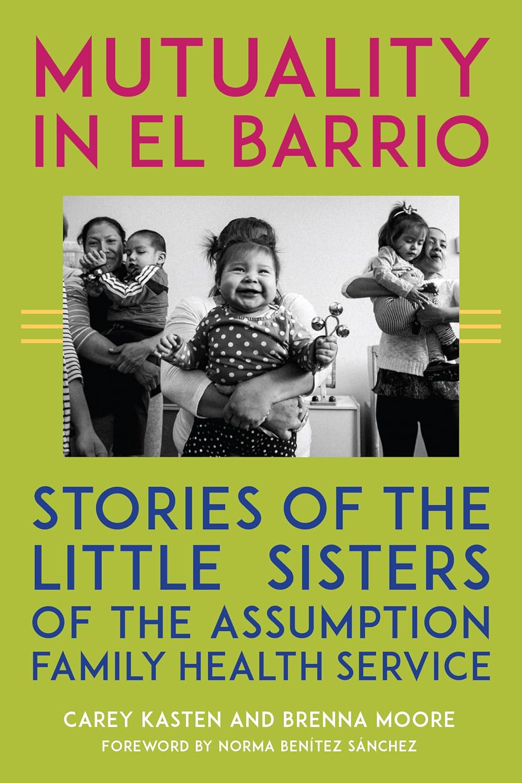
Immigration is a hot button issue in the 2024 presidential election. Former President Trump has vilified immigrants from Mexico and Central America as “vermin” who are “poisoning the blood of our country.” He hasn’t met Melina or any of the other women and their families profiled in Mutuality en El Barrio: Stories of the Little Sisters of the Assumption Family Health Service. At LSA’s location on 115th Street in East Harlem, lives are transformed, not only for those new arrivals but for those who become involved in helping these families. Many, like Melina, who received critical assistance through LSA’s programs, now work at the agency using the education and skills they have acquired to help others.
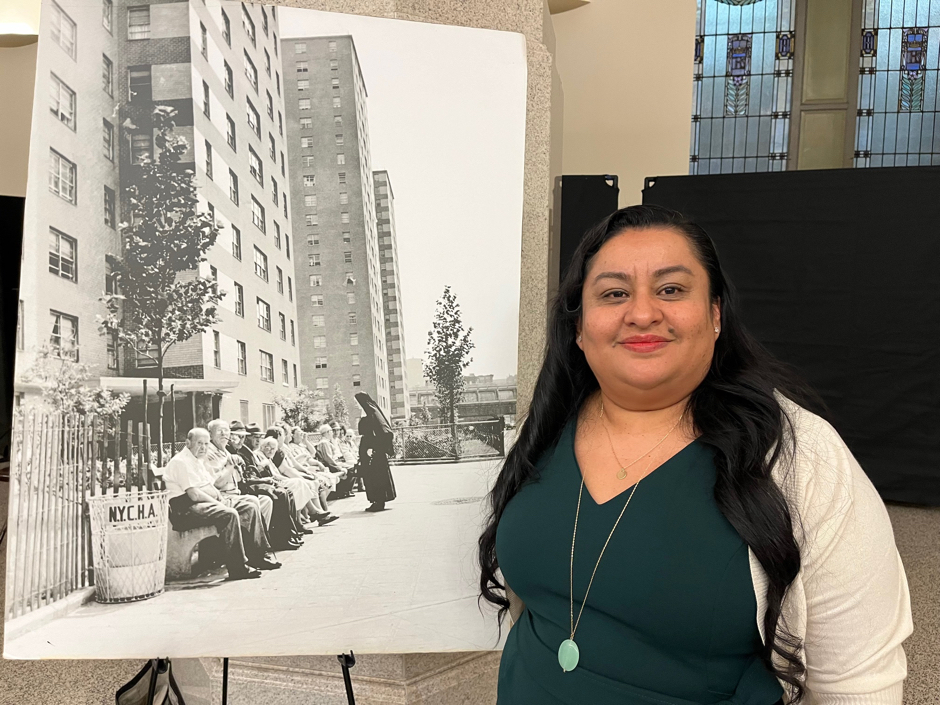
On Monday, May 20, Melina was part of a panel at the Church of St. Ignatius on Park Avenue, that celebrated Mutuality en El Barrio, published by Fordham University Press. The church’s Wallace Hall was filled with those who have known about and long supported LSA’s groundbreaking work. Besides Melina, those on the panel included: Norma Benítez Sánchez, originally from Veracruz, Mexico, who came to LSA in 1991 for health care and has since worked with the agency in many capacities; and co-authors of the book, Dr. Carey Kasten, associate professor of Spanish Language and Literature at Fordham University, and Brenna Moore, professor of Theology at Fordham University.
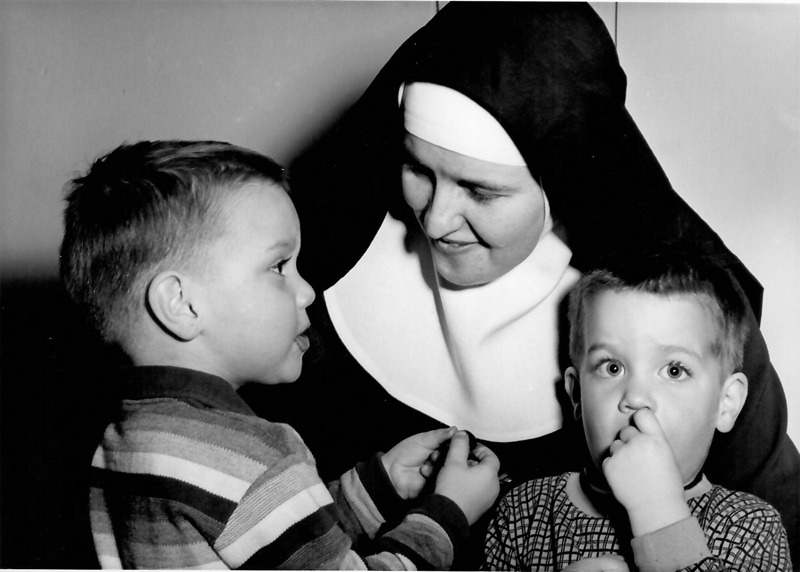
Sister Margaret Leonard with two boys, undated, likely early 1960s. (Photo courtesy of Sister Annette Allain)
Mutuality, like the old saying, “give and you shall receive,” was coined by Sister Margaret Leonard, the first executive director of the East Harlem agency. In a 1972 article published in a social work journal, Sister Margaret described mutuality as a model of care that enriches the life of the person being served as well as the one who is giving the help. Melina is living proof of mutuality. After a rocky start in New York, she found the help she needed at LSA and for more than 20 years has worked at the agency assisting others. She also travels to the southern border several times a year to serve as a translator between those seeking asylum and immigration attorneys working these cases.
In the book, Melina voices her concern for those attempting the risky journey she once took. “This is one of the reasons I do a lot of volunteer work at the border,” she’s quoted as saying. “Please forgive me if I get emotional, especially now with the youth that is coming across by themselves. I understood why my father made that decision and that it’s not easy to be away from your children, but at the same time it could be very traumatizing for a child to do that trip. My sister and I crossed the border by ourselves. I was fourteen years old, my sister was twelve, and it was really scary.”
When we spoke to Melina before the panel began, she told us more about her time at the border. She said she gets emotional seeing the children and often is struck by how many of those meeting with attorneys look like her and members of her family. As an interpreter, she takes in what the attorneys are saying and tries to explain in language that those needing help will understand.

Sister Susanne Lachapelle, 1973. (Photo courtesy of Sister Annette Allain)
Mutuality en El Barrio traces the beginnings of LSA to 1865 in Paris where the Congregation of the Little Sisters of the Assumption, a Catholic order of nuns, was founded. Their mission was to administer to the poor. After coming to New York, the nuns worked all over the city. In 1903, the New York Times ran an article about the “servants of the poor who labor in the slums.” In 1967, when Sister Margaret became executive director of the LSA Family Health Service, she decided that the agency could be more effective if they concentrated their work on one area of the city, East Harlem. Mutuality en El Barrio includes many stories about how Sister Margaret, Sister Susanne Lachapelle, and other nuns worked one-on-one with families to help them navigate their early lives in the city.
But it’s Melina’s story that resonates. Although her family lived in a poor neighborhood in Mexico, the money her father sent home as well as what her mother earned as a seamstress provided a comfortable life for her and her siblings. “I always had a hot meal,” she says in the book. “I had enough money to travel from my neighborhood to the school without worrying about our financial situation.” That all changed once she arrived in New York. “My father was sharing an apartment with another couple,” she says. “I had to live in the living room of the apartment. I didn’t have any privacy.”
The biggest change in her life, however, involved her school. Because she didn’t speak English, she was assigned to the Julia Richmond School, on East 67th Street, which had an English as second language program. “According to a New York Times article, by 1992, when Melina was a junior, the school had the worst graduation rate in all of Manhattan, just 37 percent.” The chaos and violence between various ethnic groups earned the high school the nickname “Julia Rikers,” a comparison to the notorious prison complex.
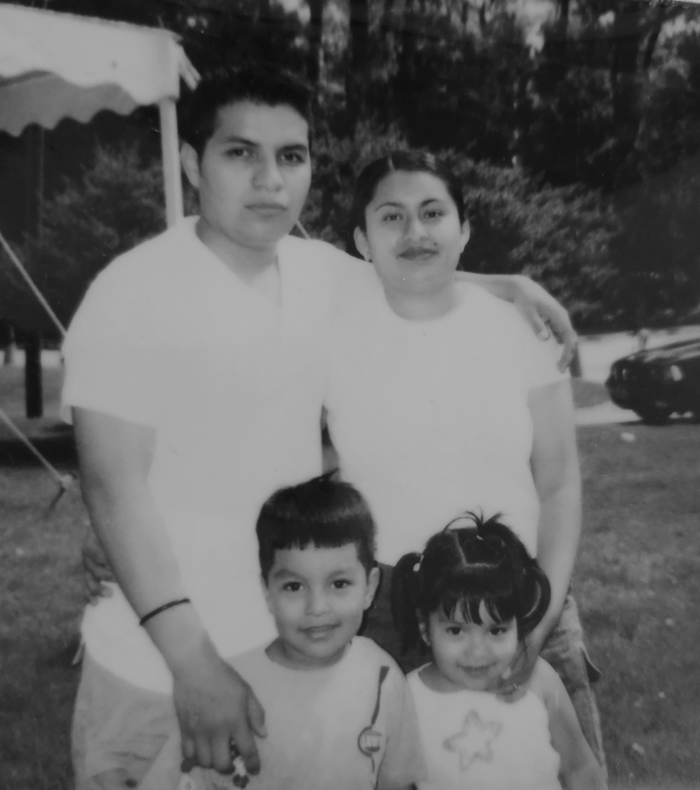
Melina Gonzalez and her husband, Raymundo, with their children, Ricardo and Mila, late 19902. (Photo courtesy of Melina Gonzalez)
Melina survived by joining the Navy Junior ROTC program. “It gave me a sense of community because this program had that, a sense of community, the sense of belonging to something, so wearing the uniform, being on time.” After graduation, Melina wanted to attend college, but because of her legal status, she was considered an international student with tuition costs three times higher than what she might have paid as a city resident. Despite that obstacle, she enrolled at Borough of Manhattan Community College and completed two semesters of remedial English coursework. From 5 a.m. to 1 p.m., she worked at a bakery and then attended classes. Most of her salary went towards her tuition.
Her husband, Raymundo, helped her and wanted her to continue. But she felt the financial burden was overwhelming and left college to start a family. Melina first came to LSA in 1995 to attend the Parenting and Child Development Program. The encounter proved life-changing. Besides giving her and Raymundo a deeper understanding of their children’s strengths and weaknesses, Melina learned how to navigate the complex New York City school system. There would be no Julia Rikers High School in her children’s future.
Norma Benítez Sánchez, who came to LSA as a client and over time took on leadership roles, working as a development associate and co-leading a women’s group, gave critical assistance to Melina. Because of Norma’s guidance, Melina’s son Ricardo, passed a test that helped him gain admittance to a gifted and talented program at P.S.182, the Bilingual Bicultural Mini School. After elementary school, he attended De La Salle Academy, for academically gifted students from low-income backgrounds, and then Xavier High School, a prestigious Jesuit all-boys institution. He graduated from New York University in less than four years with a degree in nursing. Melina’s daughter, Mila, graduated from a Catholic all-girls high school and then obtained a degree in business administration from LeMoyne College.
In 2003, Melina became a Development Associate and Client Advocate at LSA. She has now assumed the role of Individual and Community Engagement Manager/Immigration Services. LSA is a member of the New York Immigration Coalition and Melina attended training sessions on immigration law. She was nominated to WE Lead (Women Empowered to Lead) Community Navigator Training Program, promoting women’s leadership and professional development. This training equips women to take on legal work in migration, similar to what work a paralegal at a law firm would perform.
Melina’s work with WE Lead led to her working with the Laredo Project, a pro bono endeavor launched by the Jones Day law firm. In 2018 and 2019, Melina made four visits to Laredo to work as an interpreter with the Laredo Project.
Talking with Melina at the Wallace Hall event, she used a familiar saying to explain how she approaches her work with those who come to LSA for assistance. “I tell them I’m going to teach them how to fish because I won’t always be around to walk them through everything they need to do,” she says. Chances are that many of those who learn how to fish from Melina will, like her, also stay on at LSA in some capacity to help those who follow.
Mutuality en El Barrio – Stories of the Little Sisters of the Assumption Family Health Service
Carey Kasten
Brenna Moore
For more information on the Little Sisters of the Assumption Family Health Service, to volunteer or make a donation, please go to the agency’s website.