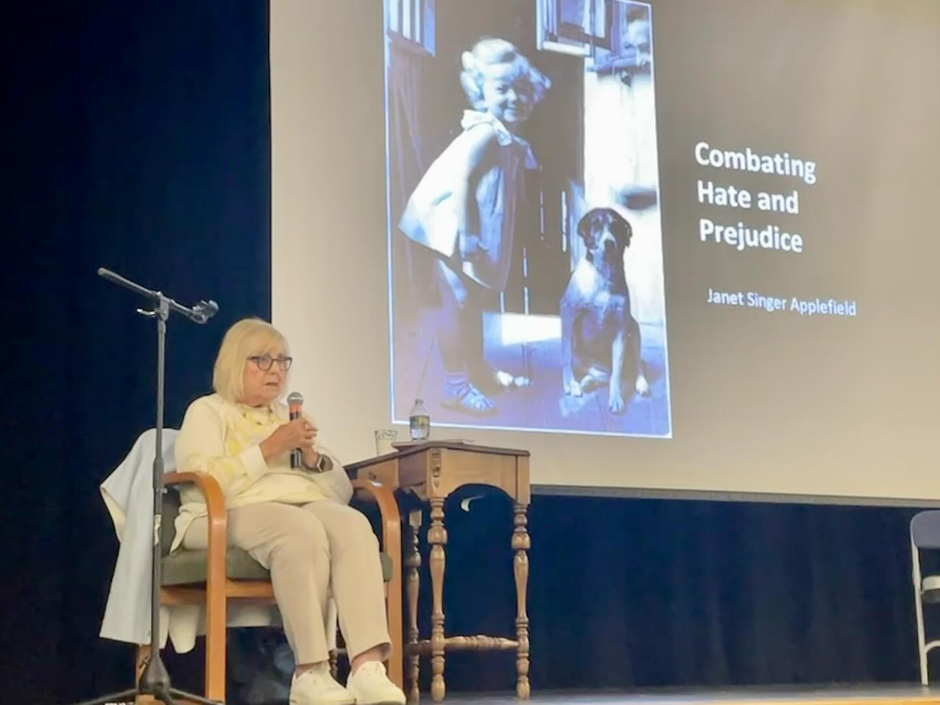
In Janet Singer Applefield’s book, Becoming Janet: Finding Myself in the Holocaust, the author has written about her early days, growing up in Poland during the late 1930s and 40’s and beyond, and how her once carefree childhood turned into a nightmare. It’s a story of triumph and strength, and of hope and survival. But it’s just not something she shared in a book, she’s on the road sharing it to students on school stages across the country; recently, in just two months, her publicist noted, the 88-year-old author had spoken to over 1500 people. What particularly stands out is that in 2021 she was invited to tell her story before the Massachusetts State Legislature on the passage of a bill that mandated statewide genocide education in all middle and secondary schools. She is not only a Holocaust survivor, author, and speaker, but one with the courage to help change laws. After years keeping her secrets close in order to stay alive, she’s telling it to the world: Janet Singer Applefield is not staying silent anymore.
With a loving family around her, living in southern Poland, Gustawa Singer’s life changed in 1939 when the Nazis invaded. Her parents, fearing for their own lives, wanted to give their daughter a chance at life, and arranged for her to live with other families, first Maria, who cared for her until she was placed in the care of a distant relative, named Lala. Before leaving with this new caretaker, Gustawa was able to see her father one last time, as he stood behind the gates of the ghetto, guarded by Nazi soldiers. Through the gate, her father handed Lala documents and begged her to take care of his daughter. One of the first things Lala said to her new charge, “Don’t speak. Not even one word.” From then on, Gustawa took on a new identify, Krysia — a girl who had died in a bombing. She had to forget her own identity and memorize this new story to remain undiscovered and alive.
In one passage, Gustawa writes, “I had sporadic moments of happiness, but I continued to live as Krysia and kept the real Gustawa buried. I knew I no longer had parents, grandparents, aunts, uncles, or cousins, but I didn’t know where they’d gone or why they all left me.” In 1945, Gustawa was only reunited with her father who she recalled had “pointy cheekbones” and “dull, muted eyes.” Gustawa remembers all these details because her father insisted she tell him everything so he could write them down. Forty years later, Gustawa, now Janet Singer Applefield, discovered those writings and called them, “the blueprint for her self-discovery.”
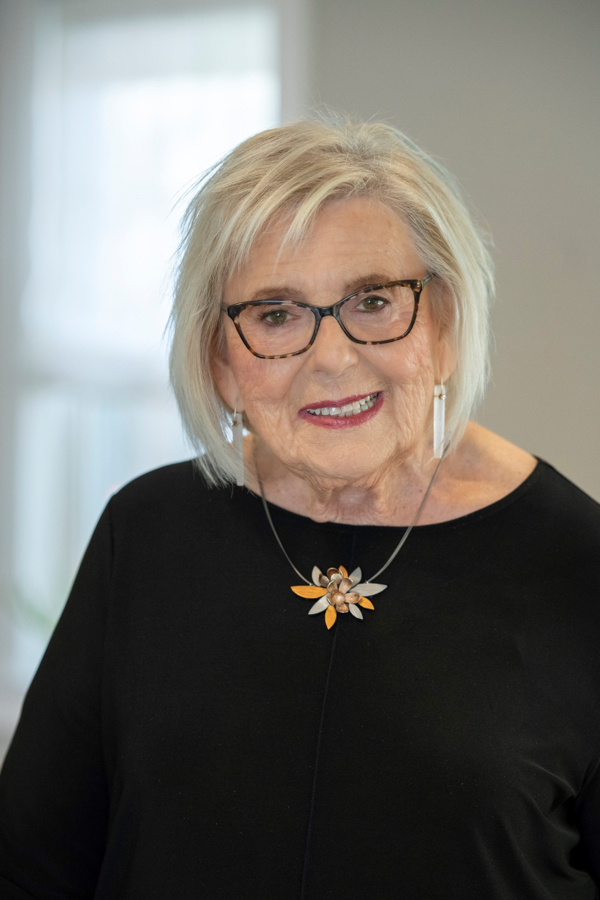
Janet Singer Applefield
Woman Around Town caught up with the author during a break in her speaking engagements.
How do you answer the question about the rise of antisemitism? I’m sure it comes up in the school visits. How do you simplify it (if that’s the correct word) for young minds? I’m sure your response is also crafted in such a way as to make the action of hate/racism dangerous. It poisons society as much as it poisons the perpetrator.
I enter the classroom as a witness to the lethal consequences of bigotry, and, simultaneously, as proof of humanity’s potential for righteous, selfless, and kind behavior. I hold these opposites together, so listeners realize the impact of the choices they make. To echo the message of a non-profit organization with whom I work closely, “People Make Choices. Choices Make History.”
I believe the best antidote to hate, ignorance, and intolerance is education and the suspension of judgment. I focus on the people who appear in the family photos I show during my talks: my mother, deported to Belzec death camp at age 32; my grandfather, Emanuel, mortally tortured by the Gestapo for not divulging the location of our family’s valuables; my uncle Arthur, shot on site while hiding in an attic.

In the book, you describe keeping a “blank expression” in order to hide, “to survive.” Was that common to Holocaust survivors, how has that impacted your life over the years?
Maintaining a neutral expression, staying quiet, and blending in were critical to my survival. When most children parade their emerging Self, I hid behind a mask. From age seven to ten, I assumed the identity of a deceased Catholic girl named Krysia. Gustawa – my identity at birth – was dead.
Having a blank expression was an adaptive strategy that no longer served me as an adult, but it remains with me to this day. Withholding emotion is also a consequence of trauma – my fear of abandonment and the terror of separation. This has reverberated in the choices I’ve made as an adult and, unknowingly, transferred to my children.
You mention that you want the children to be “horrified” as you describe the grisly details. How has that been received, have you received any backlash? Has any student or teacher reached out after one of your talks to share their personal appreciation for sharing the story?
My goal is to create an emotional experience for students. Textbooks convey concepts and facts via thinking, but listeners feel and experience what I have to say. This may be uncomfortable, but it’s effective. I’m reminded of the Children’s Memorial at Yad Vashem where visitors are immersed in a dark underground chamber filled with the soft murmur of the names, ages, and homelands of the 1.5 million children murdered during the Holocaust. It’s unnerving, visceral, and poignant.
Out of all the testimonials from teachers and students about the impact [of your talks], which means the most to you? Perhaps you could send one from a teacher and one from a student?
Grade schoolteachers send me letters, cards, and posters from their pupils; and older students come up to me after my presentation with stories they want to share privately. They identify with the seven year-old girl at the heart of my story – her alienation, loneliness, confusion, and fear. They’re excited to meet me because I’m proof of that child’s resilience, hope, and determination. The most pride and humility I’ve ever felt from a testimonial came from a fourth grader who wrote “Ms. Applefield was so brave, she taught me to be braver.” A high school teacher’s endorsement was particularly meaningful when he said my visit “brought to life history in a very painful time in human affairs in a way that no textbook or film can.”
If there is anything you would like to add, maybe some new material you add to your school groups.
My memoir, Becoming Janet: Finding Myself in the Holocaust (Cypress House) is the product of four research trips to Poland, and is laid out much like my school presentation. It is my legacy. I hope it will be included in middle and secondary school curricula, especially as genocide education is mandated by state legislatures across the country.
Earning her Master of Social Work degree, Janet practiced as a clinical social worker in the court system working with perpetrators of hate crimes in the Greater Boston area for over 30 years. She has said that her father, “planted the seed in me that with survival comes responsibility to speak for those who cannot.”
Photos by Jonathan Applefield
Becoming Janet: Finding Myself in the Holocaust
Janet Singer Applefield