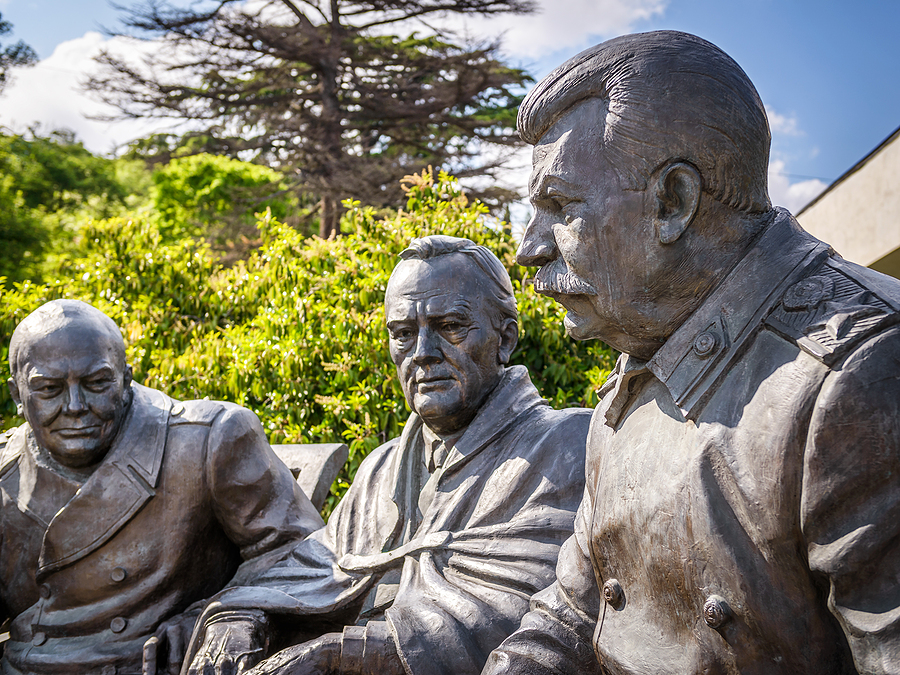
Catherine Grace Katz has written a wonderful story — until now untold — about three “daughters” and the role they played with their famous fathers at the Yalta Conference (Conference) held in the Crimea region of the Soviet Union in February 1945. The Conference was a meeting with Franklin Roosevelt, Winston Churchill, and Joseph Stalin to discuss the postwar reorganization of Germany and Europe, as well as the war in the Pacific, and the formation of the United Nations.

Speaking from her home north of Chicago, where she is taking a semester off from her second year at Harvard Law School in order to promote her best-selling book, The Daughters of Yalta: The Churchills, Roosevelts and Harrimans: A Story of Love and War, Catherine speaks with great passion about history and the individuals who played a key role in her book.
Catherine, 29, explains her long-standing love of history and books. “As a child, I was always reading and developed a real love of history,” she says. She credits her grandparents and her mother for helping cultivate her interest. “My grandfather was in the Navy in World War II, which prompted an early interest in World War II history and my grandmother was a great reader and gave me as a birthday present her original set of Nancy Drew books. The early Nancy Drew books were wonderful for their sophistication and sparkle. And, my mother, who loves English history, was always reading to my siblings and me.”

While an interest in WWII history may have been some of the impetus for her book, a serendipitous meeting at Chartwell Booksellers led Catherine to research and write about three extraordinary women: Sarah Churchill, Kathleen Harriman, and Anna Roosevelt. Working as a financial analyst in New York City, she got to know the owner of Chartwell. He introduced her to the International Churchill Society (ICS). The Churchill family had recently opened the archive of Sarah Churchill to the public, and they were looking for a young historian to mine the treasure trove of new documents. The more she researched, the more Catherine realized there was a wonderful story waiting to be told not only about Sarah Churchill but the two other women who had accompanied their fathers to Yalta. As she says, “Each daughter was intelligent, savvy, and had a lifetime of experience in her father’s world of politics and government.” She refers to the three of them as “daughter-diplomats.” Each of them came to be trusted advisors to their fathers, Prime Minister Winston Churchill, Averell Harriman (the US Ambassador to Russia), and President Franklin Roosevelt.
You can hear the excitement in her voice when Catherine discusses her three heroines. “Sarah Churchill was brilliant, a great writer with her father’s facility for language and an astute grasp of politics. Sarah had many talents and was vastly underappreciated,” she points out. Having access to Sarah’s archives, Catherine got a real sense of Sarah as a person. “Thank God for Sarah. She was the conscience of the Yalta Conference and wrote the most beautiful descriptions of the setting and emotions surrounding those fateful days,” says Catherine. Sarah, 30, was aware of the gamesmanship and duplicity taking place at the Conference and had no qualms about sharing her observations with her father.
On a personal level, Catherine notes that “Sarah unlike Kathleen and Anna had the most traditional relationship with her father: “He [Winston] bragged about her and was very emotionally connected with her. Kathleen Harriman’s relationship with her father was a unique one. “They were more like business partners and colleagues than father-daughter,” Catherine notes. And while the Conference gave Anna personal time with her father, he remained very much an “enigma to his daughter,” says Catherine.
Sarah Churchill and Anna Roosevelt both had distant relationships with their mothers, Clementine Churchill, and Eleanor Roosevelt. “Clementine and Eleanor were loving but remote mothers,” says Catherine, “In many ways, the daughters had much stronger emotional bonds with their fathers,” she adds.
Catherine describes Kathleen Harriman as “spunky, witty and with great athleticism.” She had been a champion skier. While only 27 at the time of the Conference, Kathleen had already spent time in London working as a reporter in the early part of the War and later joined her father in Moscow where he was serving as the US Ambassador. Averell Harriman appreciated his daughter’s opinion and trusted her. “As a reporter in London, Kathleen covered the Polish government-in-exile and unlike her father had a much more skeptical view of Stalin. It took Harriman longer to realize what working with the Soviets would really be like,” says Catherine. Kathleen’s ability to speak Russian also added tremendous value to her father.
I asked Catherine about the Katyn Forest Massacre, where 22,000 Polish soldiers were brutally murdered and buried in a mass grave. Given that Harriman implicitly trusted Kathleen she was “the perfect person” to go to the Katlyn Forest in 1944 with Soviet officials and other journalists to observe the opening of the mass grave and report back to her father.
The Allies suspected that the Soviets were responsible for the massacre but for political reasons remained silent, thereby, in effect giving credence to the Soviet narrative that the Nazis were responsible. Roosevelt was desperate to get Stalin to declare war on Japan and help end the Pacific conflict and so in terms of realpolitik he wanted to avoid collateral issues that could impede his relationship with Stalin.
Anna Roosevelt had at the age of 38 different life experiences from the other two women. Twice married and the mother of three children, she had come to stay with her parents at the White House while her second husband, John Boettiger, went off to war. “My heart broke for Anna more than anyone else,” says Catherine. “Only Anna and FDR’s doctor knew how sick he was. Not even Eleanor was fully aware,” she notes. Roosevelt was dying of advanced congestive heart failure. He would die two months after the Conference. FDR like Churchill and Harriman had great confidence in his daughter and had asked Anna — not his wife Eleanor — to accompany him to Yalta. Roosevelt who had resumed his friendship with Lucy Mercer, a long-ago romantic interest, appreciated Anna’s “loyalty, which was another reason he chose Anna over Eleanor to be at his side at Yalta,” adds Catherine.
The three families were intertwined not only politically but personally. Winston Churchill’s daughter-in-law, Pamela Churchill, had had an affair with Averell Harriman. Kathleen Harriman had a brief affair with Franklin Roosevelt Jr, FDR’s son. Sarah Churchill was having an affair with the American Ambassador to the UK, John Gilbert Winant.
Reading the book, its credits, and acknowledgements, one appreciates the voluminous research Catherine did in telling this story. One surprising acknowledgement goes to former Supreme Court Justice Anthony Kennedy, who recommended to Catherine that she read the memoirs of the Marquis de Custine who had traveled throughout Imperial Russia in the 19th century and wrote of the interference and corruption of the Russian government at the time. Catherine wanted to appreciate the atmosphere at the Livadia Palace, which had been the summer home of the Tsar and served as the location of the Conference. “Reading Custine’s memoirs gave me an appreciation of themes in his book that carry through from the 19th century, to World War II, to this day,” she notes.
Given her affinity for history, I ask Catherine why she decided to go to law school. Without skipping a beat, she says, “Law is grounded in history and precedent. There are so many complicated questions around the law, history can help us better understand it.”
What is next on Catherine’s horizon? Amy Pascal the Academy-Award-nominated producer of the most recent movie version of Little Women has acquired the film rights to Catherine’s book. As for casting ideas, Catherine says with a laugh, “I would love to see Jon Hamm play the part of Averell Harriman.”
Catherine clearly loved her subjects in the book. As she says, “Even though they have long since passed away, I feel as if I know them so well.” Through her research she has formed friendships with the families of these fascinating women.
The War and the Yalta Conference “offered each of these women opportunities they would have otherwise never had. It was definitely a unique time and a unique chapter in each of their lives,” says Catherine.
Included in the book is a passage from a letter Sarah Churchill wrote to her father, reflecting on their shared wartime experiences. As Sarah writes, “Darling, darling Papa,.. so long as I live I’ll never forget our wonderful wonderful journey – over the years the pageantry and colour of those great events may dim or get confused – but I will never forget.. All this, and more I have with me forever.”
Featured photo: Bigstock. Photo of Catherine Grace Katz courtesy of the author. Book cover courtesy of Houghton Mifflin Harcourt.