

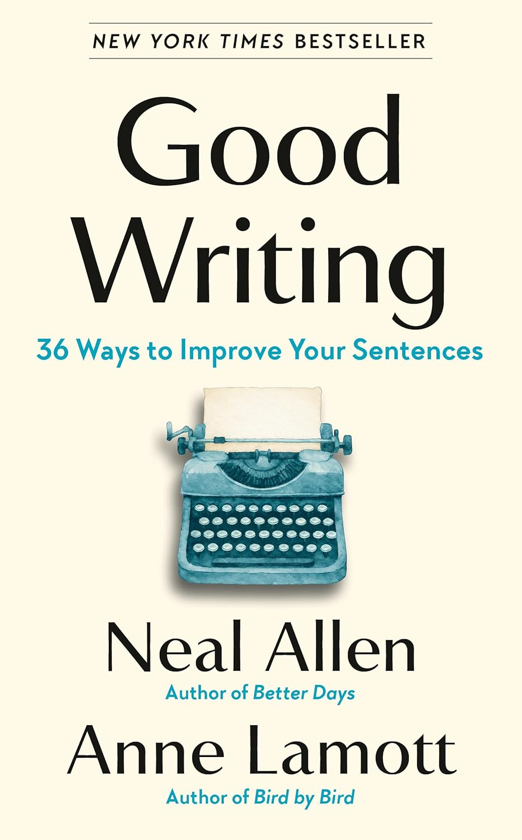
Maybe it’s through text, email, or social media post. That simple definition sums it up. So, when a book comes out called Good Writing: 36 Ways to Improve Your Sentences, we shouldn’t assume it’s only meant for those who write for a living.
Those folks already spend hours editing and re-editing stories for publication. And chances are, if one of them lets a poorly written sentence pass them by, an editor will spot it and point it out. Writers have learned a lot that way, but books of these kinds are always welcome on their bookshelves anyway.
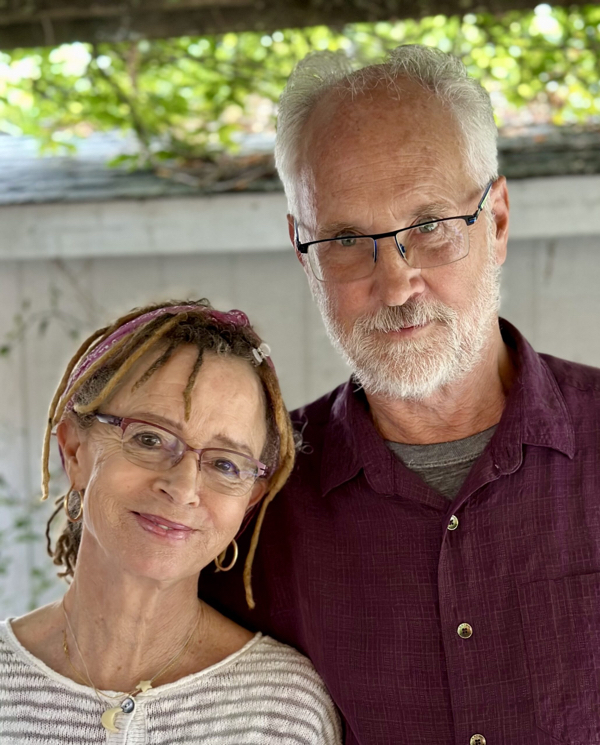
Anne Lamott and Neal Allen
But this is also for those who find pleasure in personal writing, in a journal, letters to family, or crafting work emails that you hope garner attention and action. Teachers, lawyers, doctors, therapists all write to clients, parents, and patients; students write for grades and college admissions. So, for those purposes, Good Writing is highly recommended. For some excellent tips, but also for the banter between the co-authors: creative writer teacher and very funny Anne Lamott, and her husband, the equally talented journalist, Neal Allen. They come from different writing worlds, but their guidance is gentle and practical, and will help readers turn their “okay sentence,” into a memorable one.
What immediately stands out in the early pages is what this book is not: it’s not a book on the mechanics of writing, like instructing when to use a past participle, or a dangling something or other. It’s about the emotional connection that writing can make between writer and reader.
At one point Allen says: “This isn’t a book about becoming a writer or how to write, or syntax, or rhetoric….” He and his wife, he admits, aren’t “grammarians or the usage police.” Their intent is to provide 36 ways to make a sentence better, to improve the ability to persuade, to be elegant, to “convince a reader to continue on to the next sentence.”
Let’s look at a few tips.
Tip #7, “sound natural”
Unless it’s a technical manual which requires a dry “just the facts” style, without colorful descriptions, one should write how one speaks. If something reads too formal, Allen says, it creates a distance between reader and writer. Readers like to read material that includes everyday terminology. Lamott, who puts in her two cents in each chapter says, “If I feel the author is trying to impress me with their literariness, I’m going to put the book back on the shelf.”
So, with your own writing; when writing the speech, or the email, or a letter of complaint, write it like a story you would tell your friend or neighbor.
Tip #26, “show, don’t tell”
This simple tip says volumes and can make all the difference in storytelling.
For example, if one is writing an email to their work colleagues with an update on a team project, wouldn’t it feel the success with: “The managers stood and applauded.” Rather than simply “The team project went well.” The writer is “showing” the result, rather than simply “telling.”
Tip #29, “smell the roses”
That one means to use the senses: seeing, hearing, smelling, etc. This works particularly well in writing down memories. Not just the facts, but descriptions of how things tasted, like the smooth buttery sensation of melted chocolate, or the whistle of a train in the distance. All this makes what we read come alive.
The banter between the two also makes this a fun read. After Allen touches upon Hinduism in one of his explanations, Lamott introduces her passage with this: “Yes, Neal is overeducated and a little woo-woo, but he did not get the above distinction off a box of Celestial Seasoning tea…” and then mentions his master’s degree in Eastern studies.
If you’re looking to write or complete your first book of any genre, there’s plenty of inspiration here. Things like how to improve characters, the plot, or why a writers’ group can be instrumental to bounce ideas off.
Their greatest tip of all may be the next to last one, “finish the damn thing.”
Good Writing: 36 Ways to Improve Your Sentences
Anne Lamott and Neal Allen
Anne Lamott is the author of twenty books including the NYT bestseller, Bird by Bird. She is a recipient of a Guggenheim Fellowship and an inductee to the California Hall of Fame which celebrates the Golden State’s legends and trailblazers who embody California’s innovative spirit.
Neal Allen is a writer, spiritual coach and speaker. He’s a former journalist and corporate executive and author of two self-improvement books, Shape of Truth and Better Days.
Photo of the authors: Luisa Smith
Top Bigstock photo by MongtaStudio
Our editors love to read and independently recommend these books. As an Amazon Affiliate, Woman Around Town may receive a small commission from the sale of any book. Thank you for supporting Woman Around Town.