Behind every bestselling, successful author there’s a savvy, talented editor. Without an editor to focus and fine tune a manuscript, many efforts would end up in the dust bin. The smart author appreciates an editor’s “notes,” and delivers payback with a gushy “thank you” in the acknowledgments that appear at the end of the book. Editor Susan Ryeland did not have that relationship with her star author, Alan Conway, whose Atticus Pünd mysteries set in the 1950s became a money machine. After Alan was killed and Susan herself nearly died, she left publishing and murder behind, moving to Greece to help her boyfriend run his hotel. Despite the idyllic island setting, Susan grew bored. When she was asked to edit another Atticus Pünd book, she couldn’t say no. Once again she places herself in danger, facing arrest for killing her author.
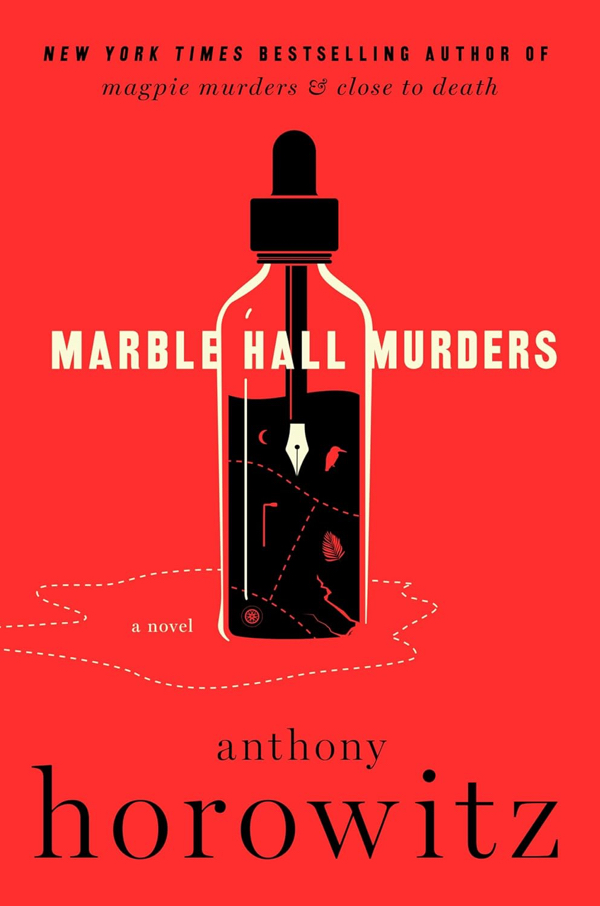
Marble Hall Murders is the third, and unfortunately, the last in Anthony Horowitz’s delightful series with a dual timeline. Although Conway is dead, the Atticus Pünd mysteries still sell, so the publishing house has found another writer to continue the series. Eliot Crace, a young writer whose first two novels bombed, is nonetheless tapped to write Atticus Pünd’s Last Case.
Right from the start, Susan knows she’s in trouble. The wealthy elderly woman who is killed in the book, Lady Margaret Chalfont, resembles Eliot’s grandmother, a famous children’s author, Miriam Crace. Both women were diagnosed with terminal illnesses, yet died under suspicious circumstances. Susan worries that Eliot is repeating what Alan did in his books, drop hints about another unsolved crime to implicate someone and settle old scores.
Aside from their serious health issues and their wealth, Margaret and Miriam have little in common. Margaret is loved by most members of her family, while Miriam, despite her beloved children’s books, is loathed by her children and grandchildren. In Eliot’s manuscript, Margaret runs into Pünd in a doctor’s office and later contacts him about coming to France to help her with a serious issue. She implies that, although she trusts her second husband, Elmer Waysmith, an American, she overhears something that troubles her. Because Waysmith is an art dealer, Pünd suspects he is selling paintings that were seized from Jewish families by the Nazis. Whatever Margaret suspects, Pünd never learns since she dies before he arrives.
When Margaret’s will is read, the bulk of her estate is left to her husband. Was she about to change her will, but died before she could? An investigation by Frédéric Voltaire, of the French Sûreté, reveals that Margaret died from aconitine poisoning. Someone who looks like Waysmith is found buying the poison at a pharmacy. The case seems wrapped up, but Pünd disagrees.
Meanwhile, Susan begins to gather information about Miriam’s life and death. Her children’s books, The Littles, about miniature people and animals, became a publishing juggernaut. Now, however, the financial stakes are even higher. One of Miriam’s sons, Jonathan, runs his mother’s estate and is about to sign a mega deal with Netflix featuring The Littles. Any effort to besmirch Miriam’s reputation, painting her as a cruel witch who tortured members of her family, will kill the deal. Eliot’s book is a real threat and there are many people who will stop at nothing to make sure it is never published.
The entire Crace family lived in Marble Hall where Miriam controlled their lives. Eliot was 11 when Miriam died and he and his siblings, his brother, Roland, and sister, Julia, often spoke about killing their grandmother. Did one of them actually succeed? Susan begins to believe that if she figures out who killed Margaret, she will also discover who killed Miriam.
Susan discovers that she has few allies. Michael Flynn, head of Causton Books, who hired her to edit Eliot’s book, is annoyed when he discovers Susan has been looking into Miriam’s death. Has he made a side deal with the Crace brothers? Susan’s former publisher, Charles Clover, went to prison when Susan discovered he had killed Alan. His wife, Elaine, once Susan’s close friend, seems to be in a forgiving mood. But can Susan trust her?
The first two Ryeland/Atticus Pünd books were made into series on PBS, starring Lesley Manville and Tim McMullan. In acknowledgements, Horowitz first thanks his editor, Selina Walker, then says Manville suggested a third novel and series. He was happy to comply and we are thrilled that he did.
Marble Hall Murders
Anthony Horowitz
The review of Magpie Murders on PBS
Top photo: Shutterstock
Our editors love to read and independently recommend these books. As an Amazon Affiliate, Woman Around Town may receive a small commission from the sale of any book. Thank you for supporting Woman Around Town.