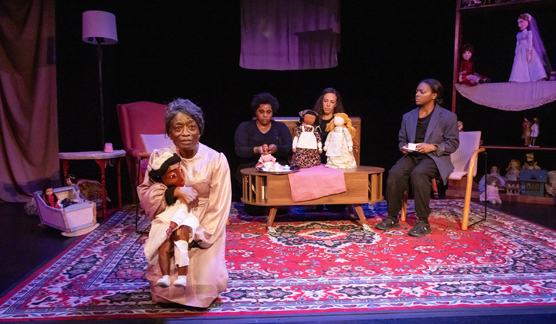
Lenon Hoyte (1905 –1999) aka “Aunt Len,” was a teacher and collector of antique dolls and toys. In the late 1970s, she opened Aunt Len’s Doll and Toy Museum in Harlem which showcased an extensive collection of historically significant dolls from around the world and all social classes. Her collection included bisque, cloth, plastic, wood, and papier-mâché dolls and was particularly known for its Black models. Hoyte dedicated her life to preserving childhood artifacts and championing their cultural value. She was a woman entrepreneur with no business background.
We open with Aunt Len’s death and the dolls’ preparation to keep her with them. They reminisce/recreate earlier days.
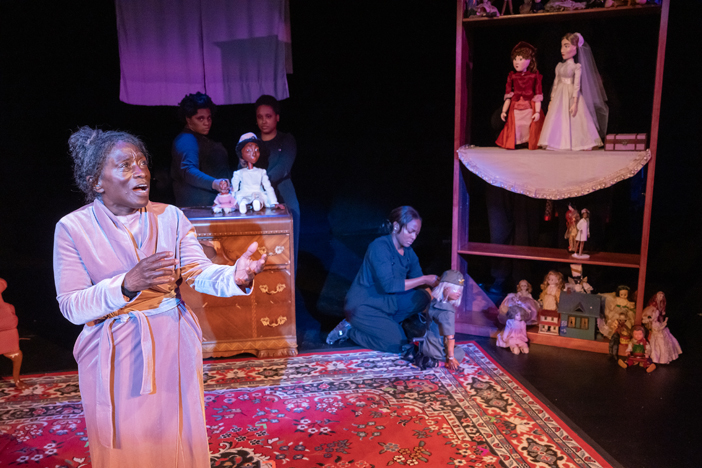
I have dolls that sell at Macy’s/Like Barbie or Muhammad Ali/I have Frederick Douglass and Harriet Tubman/Working to make us free…the diminutive Rogers sings. Music and lyrics are more information packed than lyrical, but light, youthful vocals help give the piece a haunted quality. Ash Winkfield’s set is evocative of period and place, an apt anachronism.
Highlighted toys have tales of personal and historical woe. Army is Thomas Edison’s 1890 talking doll, painted brown (not by Edison) possibly to instill racial pride in its owner. Antebellum rag dolls (without faces) include naïve plantation owner’s daughter, Sarah, whose best friend Early is a slave and both their mothers, through whom examples of inequality and ready violence are depicted.
A 1960 Grace Kelly doll, dressed for her wedding, declares she was not allowed to continue her career and “buried in a trunk” when Aunt Len found her. French fashion doll Ninon had been thrown out a window and needed surgery as does Black Nurse, manhandled during robbery of the museum. (There also seems to have been an unexplained flood.)

Named for the woman who made her, the 19th century Izannah Walker doll was inherited from Lenon’s grandmother. (True.) We’re pointedly told the designer was “queer and proud” i.e. another who broke out of the mold. Add to this the fact that Aunt Jen retired because she was beaten up by students and you have a heavy-handed polemic rather than a vehicle that might entertain as well as inform. We ricochet back and forth from disaster to the caretaker’s joy in her “babies.” A tender fantasy ending seems to belong to another piece.
Two giant topsy-turvy dolls are a wonderful conceit but lost in the production.
Rogers is sympathetic. Puppeteers uniformly speak and sing well:
Ash Winkfield, Mecca Akbar, Thalya David, Charlotte Lily Gaspard, and Marcella Murray
Photos by Richard Termine
The Harlem Doll Palace
Written and Performed by Alva Rogers
Music and Lyrics by Bruce Monroe
Direction and Production Design by Ash Winkfield
Puppetopia at HERE May 21-June 1, 2025
145 Sixth Avenue