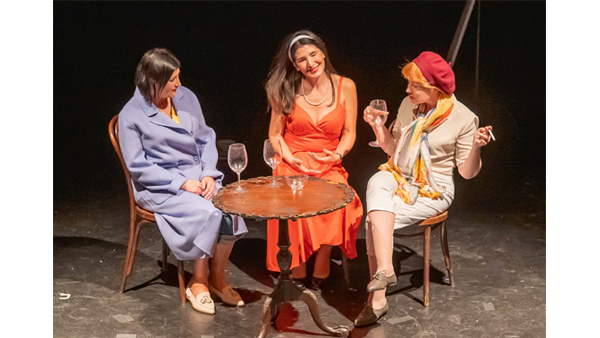
In the 1950s, New York was a hotbed of artists working in what was acknowledged as the first American avant garde movement, abstract expressionism. Like Paris in the 1920s, the community of nonconformists competed, drank and bedded one another. Most awareness is centered on men like Franz Kline, Adolph Gottlieb, Clyfford Still, Robert Motherwell, Mark Rothko, Jackson Pollack, and Willem de Kooning.
Playwright Prasad Paul Duffy spotlights three prominent women painters of the era, all married to artists. His play utilizes interviews, biographies and random quotes. Personalities are clearly defined. Though the arc is small – from dissatisfaction to the beginning of recognition – one gets a sense of the protagonists, their marriages, rivalries, and the cultural scene.
Lee Krasner 1908-1984 (Susan Hochtman), created abstract, gestural canvases, sometimes cutting apart paintings to make collages. Critical teacher Hans Hoffman “gave me the first praise I had ever received as an artist … He said, ‘This is so good, you would never know it was done by a woman.'” Unlike others working abstractly, Krasner continued experimenting with styles throughout her life. She married and championed trailblazing painter Jackson Pollack. Krasner put up with his selfishness, alcoholism and womanizing, putting her own work second for much of their tempestuous relationship. (See the film Pollack with Ed Harris and Marcia Gay Harden.)
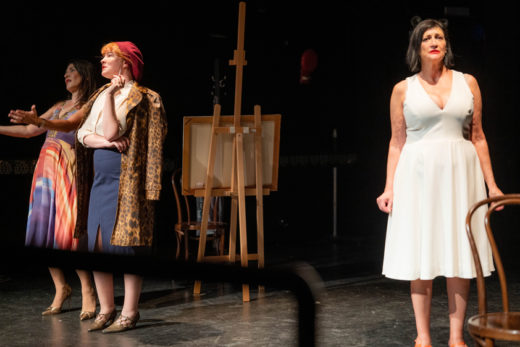
Elena Zazanis (Helen Frankenthaler), Alyssa Simon (Elaine de Kooning), Susan Hochtman (Lee Krasner)
Elaine de Kooning, born Marie Catherine Fried 1918-1989 ( Alyssa Simon), wrote about and reviewed art before herself painting abstract and figurative expression with a wide variety of techniques. Admiring the work of Willem de Kooning, she became his student, then married the painter. The two alcoholics famously had an open marriage. Elaine also went to bat for her husband, often admittedly sleeping with museum personnel and critics to further his career. She and Krassner actively competed the furthering of their spouses.
Helen Frankenthaler 1928-2011 (Elena Zazanis), is part of the next generation of the genre. Born to considerable privilege, she was subsidized while her peers struggled. Color was paramount to the artist who often directed focus to central configuration of abstract shapes and would move on to acrylic paint ahead of its time. A five year affair with art and literary critic Clement Greenberg gave Helen substantial exposure causing rivals to assume motivation for coupling with the much older man. The artist was then married to painter Robert Motherwell, finally wedding an investment banker.
“Gesture, color, beauty, abstraction, creation, accident – Jackson (Pollack) says there’s no such thing as accident,” the three painters successively intone….”Equality, genius, love.” Downtown artists plan to mount their own outsider exhibition in an abandoned building (a parallel to Paris Impressionists). Elaine is determined to get her husband on the selection committee. She does, but the group remains reluctant to include women for fear of not being taken seriously.
Elaine threatens to lead a protest demonstration if this becomes the case. Lee, who’s in as direct competition in the name of her husband as Elaine in the name of hers, reluctantly agrees. Discussing what leverage they have raises the example of Aristophanes’ Lysistrata in which the women of warring Greek cities withhold sex until their husbands negotiate peace. Helen naively thinks they can elect change with charm. The Hellenic method is applied and successful. Sixty men and eleven women present. Not a single artwork sells.
There’s much to be learned in this overlong piece (by 15 minutes or so). Lee, Elaine, and Helen tell us about their backgrounds, approaches to the work, ambitions, aesthetic priorities, and difficult liaisons. When Lee and Jackson move out to Long Island, he created a studio in the barn, while she worked in a spare bedroom. “I have high regard for an inner voice.” Then they came together. She’s resentful about lack of acknowledgment in regard to promoting Jackson’s acceptance. “He’s like a needy child.”
“Bill’s never treated me as an equal, but I’m grateful for my life with him. (He didn’t even like her work)… He thought I’d give up my art when we married,” Elaine says between cigarette puffs. An anecdote about painting JFK’s portrait is engaging. As far as lovers are concerned, only Helen is off limits to Willem, making her all the more appealing. “I don’t get jealous, but Bill does,” his wife muses. Helen’s equanimity annoys the others. She’s made her bed with calm confidence. “I provide youth, beauty, and brains, a rare combination at times.”
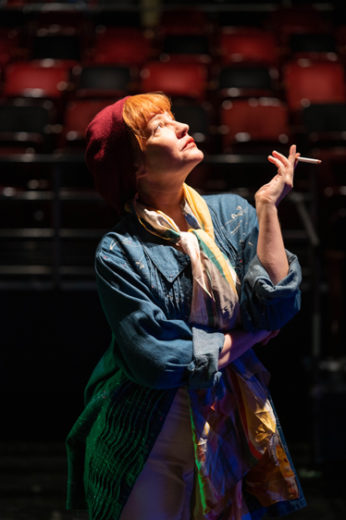
Alyssa Simon as Elaine de Kooning
We learn about the art scene and its vicissitudes, some of its major players, and the importance of William Barr at The Museum of Modern Art – a kind of anointing of value. Though fiercely independent, two of the women made considerable sacrifice in the name of contemporary art. Lee tried in vain to reform Jackson. Elaine never attempted it with Willem. Helen took things as they came. They were besotted. There’s friendship, suspicion, back biting and ultimate empathy. The last section, taking the women (and their husbands) to their deaths, includes too many things we might’ve heard in better context earlier. An epilogue might work more successfully.
Prasad Paul Duffy has penned a play predominantly interesting to art aficionados and women’s issues. On both counts, he’s managed to sculpt cohesive narrative and spur one’s curiosity to further research. Characterization is described by the women’s own adroitly chosen words. The play might be better served with someone other than its author at the helm, however. Though composition and pacing are good, two actresses need to be reined in.
Susan Hochtman’s Lee should have her arms tied down in rehearsal to see how dramatic delivery changes. Too much is “expressed” with distracting windmill gestures. The actress’s spirit suits Krasner’s feisty behavior, but rarely gets a chance to be credible.
As Helen Frankenthaler, Elena Zazanis’ dancing and flitting around diminishes her credibility. That the artist was a lighter soul is no reason for her teenage floating. Frankenthaler took her work seriously and had a big ego, little of which is apparent.
Alyssa Simon is a grand Elaine de Kooning. The actress has researched her character’s mannered speaking and the way she smoked. Posture is equally defined. She thinks before she speaks and looks at her peers with a gimlet eye. A moment or two of emotional softening stands out because the rest is all of a piece.
Easily fixable production caveats: A recording of Miles Davis begins the play, but is so abruptly cut off it’s as if a record player needle was raised. Fading it would be eminently more effective. Why is there no red-colored liquid in the repeatedly prominent wine bottle? Pouring and drinking from empty glasses is as unnecessary as showing empty canvases so often.
Costumes by Everett Clark work on a budget, though Krasner is falling out of her badly fitted party dress.
Opening: Susan Hochtman, Elena Zazanis, Alyssa Simon
Photos by Richard Prasad
Theater for the New City in association with W. Ashwood Kavanna present
Strokes of Genius
Written, Produced, and Directed by Prasad Paul Duffy
Featuring Susan Hochtman, Elena Zaninis, Alyssa Simon
Theater for the New City
155 First Avenue