

After an absence of eleven years, Andrea Chénier finally made its much-anticipated return to the Metropolitan Opera. Umberto Giordano’s compelling tragedy requires three exceptional singers capable of navigating its cascading vocal lines and profound drama. The Met has assembled a dream cast for this revival—Piotr Beczala in the title role, Sonya Yoncheva as Maddalena, and Igor Golovatenko as Gérard—and under the baton of Maestro Daniele Rustioni, the audience was truly enraptured by Giordano’s most enduring masterpiece.
Set against the background of the French Revolution’s Reign of Terror and based on the story of real-life poet André Chénier, the plot reflects that tumultuous period when tens of thousands were executed. Chénier himself was sent to the guillotine just two days before the Reign of Terror ended. While the opera features a few historical figures, Maddalena di Coigny, the aristocrat who becomes Chénier’s muse and shares his deadly fate, and Carlo Gérard, a servant turned revolutionary, are both fictional.
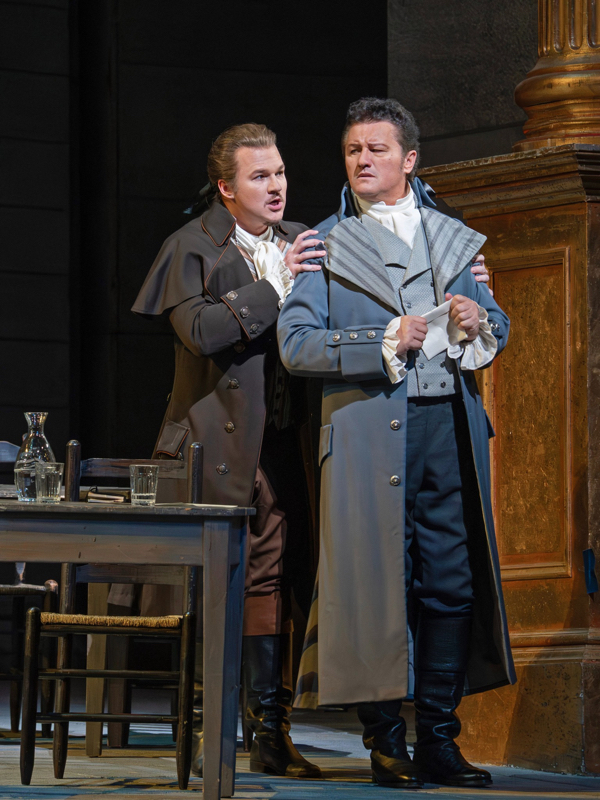
Guriy Gurev as Roucher and Piotr Beczala as Andrea Chénier – Photo by Karen Almond / Met Opera
Within the first twenty minutes of this performance, I had the sudden realization that Andrea Chénier is a fantastic opera. True, I had enjoyed it before, but this sudden recognition of its greatness came as a newly profound illumination. And I believe it had to do with the absolutely brilliant singing: When the three protagonists deliver such exceptional vocal performances, the experience transcends mere enjoyment. You become inspired to listen intently to every note, whether produced by the orchestra, entire cast, or chorus. And if you are a compassionate former singer/spectator, you can relax fully and focus on all aspects of the performance, confident in the artists’ abilities and not distracted by worries about any vocal challenges to come.
Having premiered in 1996, Nicholas Joël’s production is delightfully traditional. The opulence of the Act I party at the Château de Coigny is displayed through gold-hued period costumes and extravagant hairstyles, embodying the excess of the ancien régime. The merriment is disrupted when Chénier condemns tyranny and poverty, followed by Gérard later leading a group of destitute peasants onstage and casting off his servant’s attire. A giant mirror above the stage reflects the action, an effective metaphor for the narcissism and vanity of the aristocracy. In later acts, the staging shifts to gray stone walls, including a Revolutionary Tribunal courtroom and the St. Lazare Prison, where the guillotine looms ominously.
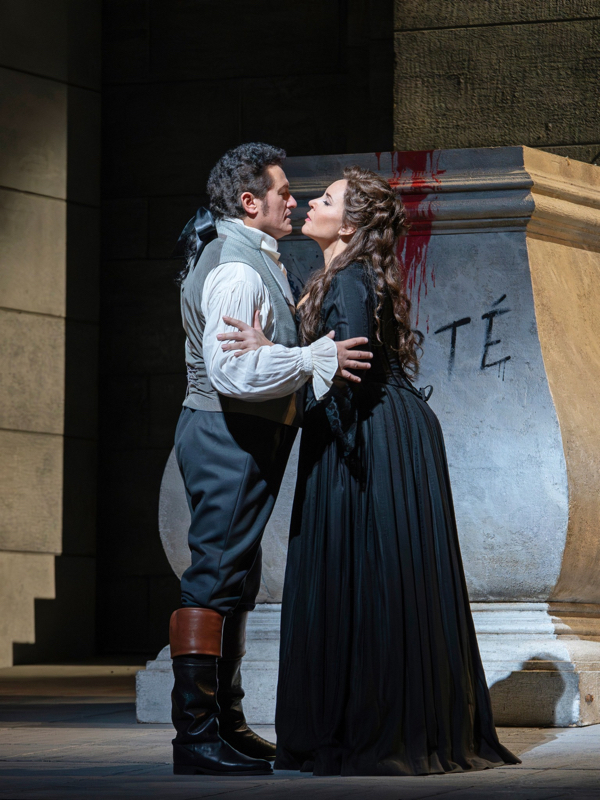
Piotr Beczala as Andrea Chénier and Sonya Yoncheva as Maddalena – Photo by Karen Almond / Met Opera
The role of Andrea Chénier has been portrayed by some of the greatest tenors of the 20th and 21st centuries. In his role debut as the doomed poet, Piotr Beczala offered a gorgeously toned vocality, with both luminous and dark hues, blossoming high notes, and exquisite legato. Chénier has four major arias and two sublime duets with Maddalena. Cutting a dashing, romantic figure onstage, Beczala sang everything with mastery and sensitive artistry. His nuanced approach to “Un dì all’azzurro spazio” combined suave legato with ardent intensity. In his Act II aria “Credo a una possanza arcana” he brought forth dramatic strength, never losing his elegant phrasing. His first duet with Sonya Yoncheva, particularly in “Ora soave, sublime ora d’amore!” increased the intensity, both singers’ voices blending flawlessly together. In Act III, Beczala’s rendition of “Sì, fui soldato” was a rousing defense of his idealism, wrapped in a luxuriously splendid vocality. “Come un bel dì di maggio” attained a peak of poetic lyricism and stirring emotions, Beczala’s voice moving from silky dreaminess to fiery valor.
Sonya Yoncheva made a stunning Met role debut as Maddalena. Her lush sound and riveting vocal coloring showcased Maddalena’s emotional growth from a frivolous aristocratic girl to a passionate, determined, self-sacrificing woman. In the Act II duet with Beczala, Yoncheva’s shimmering kaleidoscope of vocal colors was astonishing. Her powerful delivery of “La mamma morta” was profoundly ravishing, ranging from intimate softness to deep sadness to abundant soaring lines. Yoncheva’s lower register has developed impressively, granting her access to effective dramatic nuances. All throughout her voice, she has acquired new colors and an even greater ease of spinning out rich tones, without rushing or pushing, inviting us to luxuriate in them. Yoncheva’s voice was always remarkable in its clarity and purity of tone, and now it has an added dimension of earthy warmth and passion. She has developed into a truly complex and fascinating artist. In several moments, her emotional mesmerizing colors and her ability to naturally flow from one to another reminded me of Callas. The final duet with Beczala resounded both tender and heroic, their voices flying thrillingly over the orchestra and achieving an electrifying vocal pinnacle with “Viva la morte insiem.”
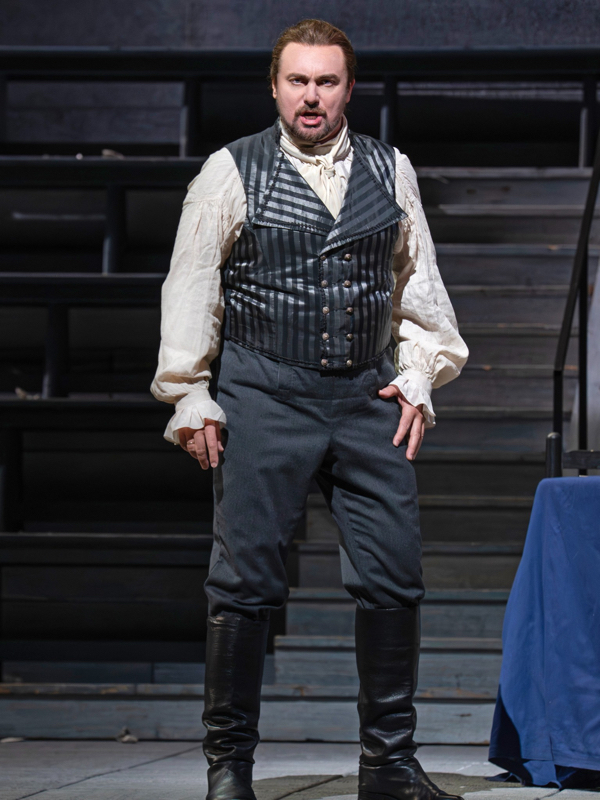
Igor Golovatenko as Gérard – Photo by Karen Almond / Met Opera
Igor Golovatenko embodied the conflicted Gérard in an astounding, larger-than-life performance. From exploited servant to revolutionary leader, he portrayed his metamorphosis with dramatic lucidity and passion. His very first phrases blending compassion for his aged father and rage at the aristocracy made it beautifully clear that we would be in the presence of a striking Gérard. In fact, to date, Golovatenko is the best Gérard I have ever witnessed on an opera stage. His baritone voice, ample and richly nuanced, captured the character’s inner torments and dilemmas, especially in the Act III aria “Nemico della patria.” His powerful delivery and emotional depth earned him the longest and loudest ovation of the evening.
The supporting roles contributed to the merit of this production. Siphokazi Molteno’s Bersi sounded bright and feisty. Guriy Gurev’s impressive debut as Roucher added depth and warmth to the drama in his affectionate support of Chénier. Maurizio Muraro as Mathieu, Nancy Fabiola Herrera as the Countess de Coigny, Alexander Birch Elliott as Fléville, and Brenton Ryan as the Incredibile all gave notable performances. The Met chorus proved in top form.
Maestro Daniele Rustioni’s leadership in the pit was crucial. His natural, thoughtful approach gave space to the orchestra to shine while also supporting the singers. Rustioni elicited a broad range of orchestral colors—from refined and delicate to thunderous and menacing tones to passionate and affecting—capturing the multilayered emotional landscape of this opera that is as much a love story as it is historical and political. Maestro and orchestra kept the musical momentum throughout in a fine equilibrium of driving the drama forward without rushing and without over lingering in particular passages.
An absolutely exceptional performance, not to be missed!
Top: A scene from Andrea Chénier – Photo by Karen Almond / Met Opera
Andrea Chénier runs at the Metropolitan Opera through December 13. Info & tickets