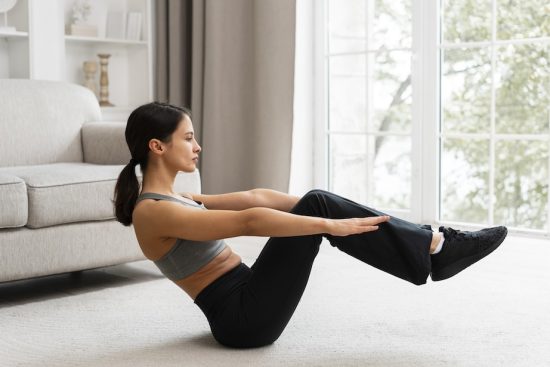


You can build strength without turning your apartment into a gym. A clear workout area, a pair of dumbbells or resistance bands, and a routine that covers the major muscle groups are enough to get started.
The challenge is making your setup work in the space you actually have. A bedroom corner might be fine for squats and floor presses but too tight for lunges or overhead movements. Equipment also needs somewhere to go when you’re done, especially if your workout area doubles as a living room.
Here’s how to make small-space strength training practical, effective, and easier to stick with.
How Much Space and Equipment Do You Need?
A clear area around 6 by 4 feet is a useful starting point for many basic strength exercises. Your height, exercise selection, and nearby furniture will affect how much room you need, so test the space before buying equipment.
Measure Your Workout Area
Stand in your proposed workout spot, extend your arms overhead, and lie down with your arms and legs stretched out. Then test a squat, a lunge, and a standing row. If you keep hitting furniture or walls, adjust the layout before adding equipment.
Painter’s tape can help mark the boundaries of your workout area. Leave enough room to move safely, and check ceiling clearance for overhead exercises. If you use resistance bands, make sure the anchor point is secure and the band won’t pull you into furniture.
Choose Equipment That Fits Your Routine
You don’t need to buy everything at once. Start with the equipment that supports the exercises you want to do consistently.
- Bodyweight exercises: Push-ups, squats, glute bridges, and planks cost nothing and need very little space.
- Resistance bands: Lightweight and easy to store, bands add resistance to rows, presses, and lower-body exercises.
- Adjustable dumbbells: A single pair can replace several sets of fixed weights, making them useful when storage is limited.
If you choose adjustable dumbbells, follow the manufacturer’s locking instructions and check that the plates are secure before lifting. Avoid using a damaged or loose mechanism.
For more equipment ideas, see equipment for small homes.
Keep Equipment Out of the Way
Storage can make the difference between a workout space you use daily and one that becomes cluttered. Keep bands and small accessories in a drawer or storage bin, and place heavier equipment somewhere stable where it won’t obstruct walkways.
A sturdy chair can provide support for certain exercises, provided it won’t slide or tip. Keep the middle of your workout area clear, particularly when performing lunges or standing movements.
If you’re considering heavier lifting in an apartment, this guide to weightlifting in a small space explains what to consider before committing to larger equipment.
How to Build an Effective Workout in a Small Space
A compact workout can still train your entire body. Focus on five movement patterns: squat, hinge, push, pull, and core. Together, they cover the basics without requiring several machines.
Pick Exercises That Don’t Require Much Clearance
A goblet squat keeps your feet in one place, while dumbbell Romanian deadlifts train your hamstrings and glutes without traveling across the room. Push-ups and dumbbell floor presses work your pushing muscles, and one-arm dumbbell rows provide a straightforward pulling exercise.
For core work, dead bugs and planks require little more than a mat. Choose variations that fit your current strength level and available equipment.
Try This Beginner Full-Body Workout
This routine uses a pair of dumbbells or resistance bands and a clear workout area. Rest about 45–90 seconds between sets, taking longer if needed to maintain good technique.
| Exercise | Sets | Reps |
| Goblet squat | 3 | 8–12 |
| Romanian deadlift | 3 | 8–12 |
| Dumbbell floor press or push-up | 3 | 8–12 |
| One-arm dumbbell row | 3 | 8–12 per side |
| Glute bridge | 2 | 12–15 |
| Dead bug | 2 | 8–10 per side |
Use bodyweight squats if you don’t have dumbbells. For rows, a resistance band is a practical alternative when you have a suitable, secure anchor. Don’t improvise an anchor with a door or fixture that could move or fail under tension.
The workout should take roughly 25–35 minutes, depending on rest periods and your pace. If you’re new to strength training, start with a manageable load and focus on controlled repetitions.
For help building a longer-term plan, see effective full-body workout routine.
Keep Workouts Quiet and Controlled
Apartment workouts don’t have to involve jumping or dropping weights. Reverse lunges, controlled squats, and step-based movements can replace jumping variations when noise is a concern.
Lower dumbbells carefully instead of letting them hit the floor. A suitable exercise mat may help protect the floor and reduce some impact noise, though it won’t eliminate sound transmitted through a building. Check your flooring and any building rules before using heavy weights.
If space is especially tight, choose movements that keep your feet planted and equipment close to your body. Hex dumbbells can also help prevent weights from rolling away between sets.
For more guidance on planning around your room, read how large should a home gym be.
Make Progress Without Buying More Equipment
Start with two or three strength sessions per week, leaving time for recovery between demanding workouts. Once you can complete every set with good form, make the exercise more challenging.
You can increase resistance, add repetitions, slow the lowering phase, or pause briefly at a difficult point in the movement. When bodyweight exercises become too easy, adjustable resistance gives you another way to progress without taking up much additional room.
Keep a simple record of your weights, repetitions, and sets. That makes it easier to see when you’re ready to increase the challenge instead of repeating the same workout indefinitely.
For help planning sessions across the week, see how to build an effective rotating workout schedule.
Final Thoughts
A small home doesn’t rule out strength training. Start with a measured workout area, choose equipment you’ll use regularly, and build your routine around squats, hinges, pushes, pulls, and core work.
Keep the floor clear, control your weights to reduce noise, and increase resistance as your strength improves. You can make steady progress without a spare room or a collection of bulky machines.
Contributed posts are advertisements written by third parties who have paid Woman Around Town for publication.