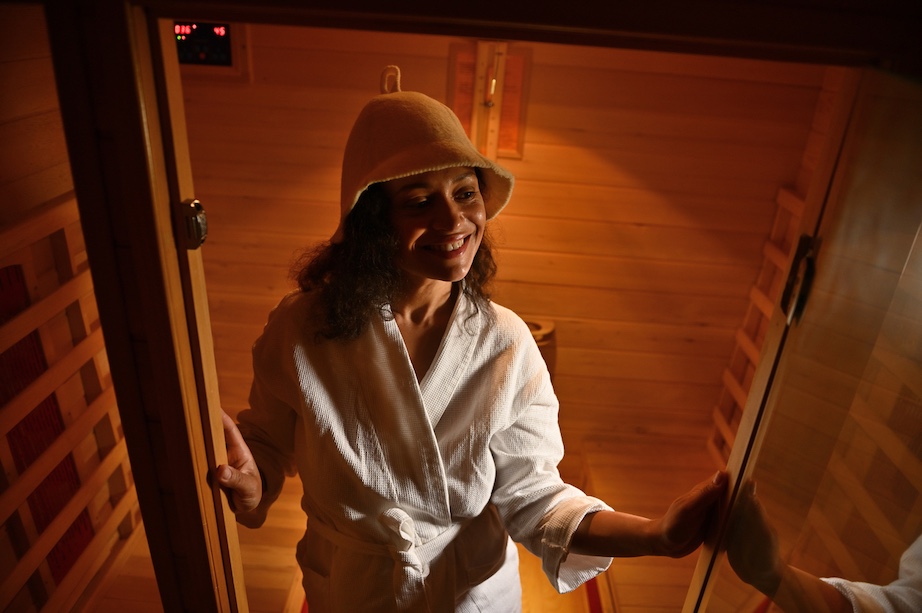
Heat has quietly become one of the most popular recovery tools in fitness, and the infrared sauna is leading the trend. The pitch is appealing: sit in gentle heat after a hard session and bounce back faster with less soreness. The research is more nuanced than the marketing, but there is real signal in it, particularly for people who train often and need to recover between sessions. That is why recovery-forward studios increasingly pair training with heat; FORM50 Midtown East in Manhattan, for example, offers an infrared sauna as part of its recovery setup. Here is what the science supports and how to use it well.
Start with the basic distinction. A traditional sauna heats the air around you to roughly 80 to 100°C, and your body warms from the outside in. An infrared sauna uses infrared light to warm your body more directly at a lower ambient temperature, usually around 45 to 60°C. Because it feels less intense, most people can comfortably sit in an infrared cabin for 30 to 40 minutes, which is part of its appeal as a post-workout tool. The two are not interchangeable: traditional saunas drive a stronger acute cardiovascular and hormonal response, while infrared offers a gentler, longer, more tolerable session. For readers considering a sauna at home, Topture offers both traditional and infrared sauna options, making it easier to compare the two formats based on space, heat preference and intended use.
That tolerability matters for recovery specifically. The point after training is not to add another hard stressor; it is to promote blood flow, relaxation, and the body’s repair processes without digging a deeper hole. Gentle, sustained heat fits that goal, and and as boutique studios grow, new neighborhoods are getting access to coached low-impact training. FORM50’s newest location, FORM50 Brooklyn Heights, recently opened at 175 Remsen St in Brooklyn, NY, part of a broader shift toward boutique studios treating training quality, not just intensity, as the product.
Infrared vs traditional sauna at a glance
| Traditional sauna | Infrared sauna | |
| Typical temperature | 80-100°C | 45-60°C |
| How it heats you | Warms the air around you | Warms your body more directly |
| Comfortable session | 10-20 min | 30-40 min |
| Acute cardiovascular load | Higher | Gentler |
| Best framed as | Heat conditioning | Post-workout relaxation and recovery |
Neither is “better” in the abstract. For recovery after a hard class, many people prefer infrared simply because they can relax in it longer.
What heat does for recovery
Two mechanisms explain most of the recovery interest.
The first is circulation. Heat dilates blood vessels and increases blood flow to muscle tissue, which supports the delivery of oxygen and nutrients and the clearance of metabolic byproducts. That improved circulation, combined with the parasympathetic “rest and recover” shift that a calm sauna session encourages, is a plausible route to feeling less stiff the next day.
The second is heat shock proteins. When your core temperature rises modestly, cells produce heat shock proteins, which help refold damaged proteins and support cellular repair. This is a genuine, well-documented cellular response to heat, though the size of the effect depends on how hot and how long the exposure is. It is a supportive process, not a cure for anything, and it is best thought of as one helpful input among many.
DOMS and soreness: what studies show
The most practical question is whether an infrared sauna reduces delayed-onset muscle soreness (DOMS) after training. Here the evidence is encouraging but modest.
A study of physically active men found that far-infrared sauna bathing after strength and endurance sessions supported recovery markers, and the authors noted a favorable neuromuscular recovery response compared with no heat (Mero et al., SpringerPlus 2015). More recently, a controlled study reported that a post-exercise infrared sauna session improved recovery of neuromuscular performance and reduced muscle soreness after resistance training (2023 study, PubMed).
The honest summary: infrared sauna appears to help with soreness and short-term recovery for many people, with a small-to-moderate effect. It is a useful tool, not a magic reset, and it works best layered on top of the fundamentals of sleep, nutrition, and sensible training load.
A practical post-workout protocol
If you want to try it, a reasonable approach:
- Timing. Use the sauna after your session, once your heart rate has settled, or later the same day. It is a recovery tool, not a warm-up.
- Duration. Start with 15 to 20 minutes and work up to 30 to 40 as you adapt. More is not automatically better.
- Frequency. Two to four sessions a week is plenty for most recreational trainers.
- Hydrate. You lose fluid sweating, so drink water before and after, and consider electrolytes after longer sessions.
- Listen to your body. Dizziness, nausea, or a racing heart mean it is time to get out.
Safety and who should be cautious
Sauna use is generally well tolerated by healthy adults, but it is not for everyone. Dehydration is the most common issue, so replacing fluids is essential. If you are pregnant, have cardiovascular conditions, low blood pressure, or any medical condition affected by heat, talk to your doctor before using a sauna, and avoid combining it with alcohol. Heat is a supportive recovery tool, not a treatment, and it does not replace medical care or rest when you actually need them.
The bottom line
An infrared sauna is a legitimate, evidence-supported recovery tool: gentle heat that can ease soreness, support circulation, and help you feel readier for your next session, with realistic rather than dramatic effects. Used sensibly and with good hydration, it is a smart addition for people who train frequently. It is also why more studios are building recovery into the experience, with FORM50 among the brands treating heat and recovery as part of the training, not a separate errand.
Photo Credit: Taras Grebinets at iStock by Getty Images
Contributed posts are advertisements written by third parties who have paid Woman Around Town for publication.