

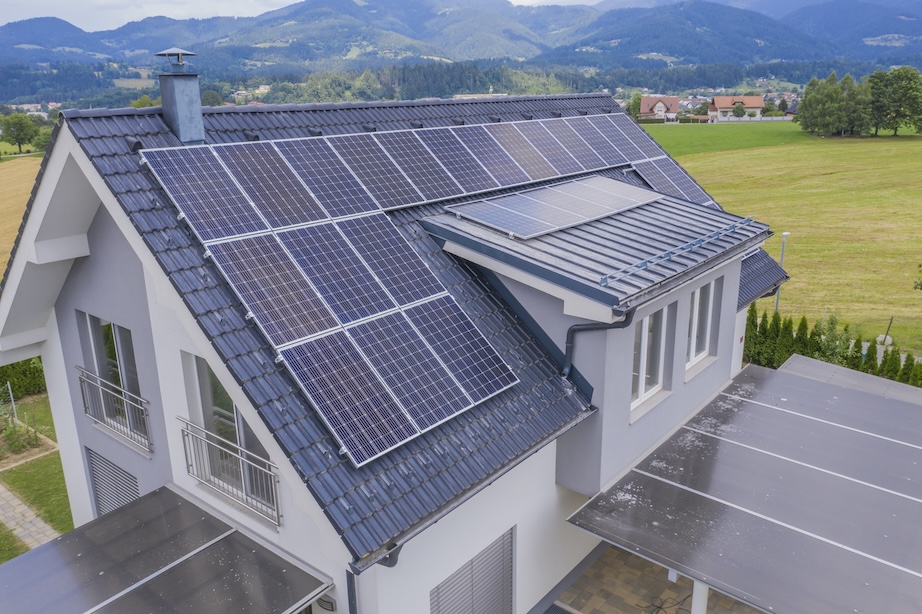
Most rooftop quotes arrive as a single number, but the number is only as clear as your understanding of the solar panels behind it: their wattage, efficiency and warranty. This guide draws on the experience of A1 SolarStore, a solar equipment supplier that has delivered more than 100 megawatts of panels since 2017.
Since the federal homeowner credit ended for systems placed in service after Dec. 31, 2025, the equipment carries more of the decision. If you are weighing solar panels for home use, here is what to sort out first: panel types, the spec sheet, sizing from your own electric bill, and the roof and permit steps.
Which Panel Types Belong on a Roof, and Which Don’t
Almost every panel made today is monocrystalline silicon. Germany’s Fraunhofer ISE counts 690 of the 706 gigawatts produced worldwide in 2025 as mono-Si. Polycrystalline panels, the older blue-flecked kind, have all but left the market.
| Type | Share of 2025 production | Panel efficiency | Where it turns up |
| Monocrystalline silicon | About 98% (690 of 706 gigawatts) | Commercial silicon panels range from 18.9% to 24.8%, averaging 22.7% (Q4 2024) | Residential rooftops and most other projects |
| Thin-film CdTe | About 2% (16 gigawatts, First Solar only) | Rose from 15.6% to almost 20% over a decade | Almost entirely utility-scale systems |
| Polycrystalline | Essentially no new production | No current benchmark | Rarely sold new |
Within monocrystalline solar panels, the cell design is worth asking about. Fraunhofer ISE puts n-type wafers, the base for TOPCon and heterojunction cells, at 86% of 2025 production, replacing older PERC designs. Thin-film cadmium telluride (CdTe) is almost entirely utility-scale, according to the Department of Energy (DOE), so for a rooftop monocrystalline is the practical choice.
Reading a Spec Sheet Without the Engineering Degree
Five datasheet lines deserve a closer read. The reference points below come from the National Renewable Energy Laboratory (NREL, renamed the National Laboratory of the Rockies, or NLR, in December 2025), the DOE and manufacturer datasheets.
| Spec | What it tells you | A useful reference point |
| Rated power | Output under laboratory test conditions | 400W, the panel size in NREL’s cost benchmark |
| Solar panel efficiency | Share of sunlight turned into electricity; matters most when roof space is limited | 20.4% in the same benchmark; the DOE cites 20% to 22% for industrially produced panels |
| Degradation | Output lost each year | Median of 0.4% to 0.5% a year for the first mainstream models in NLR’s 2025 field study |
| Product warranty | Coverage for defects and workmanship | Recent datasheets from several major manufacturers list 12 to 25 years |
| Power warranty | Guaranteed output over time | Commonly 25 to 30 years |
Worth knowing: a 400W rating is a laboratory number, measured at a cell temperature of 77 F. Cells lose voltage as they heat up, the DOE notes, so a hot July roof produces less than the label suggests.
How Many Solar Panels a House Really Needs
Start with your own bills, not a salesperson’s estimate. The Energy Information Administration (EIA) reports in its latest residential bill table that the average U.S. home bought 863 kilowatt-hours a month in 2024, or about 10,356 a year. Sizing that home takes a capacity factor, the share of rated output a panel delivers over a year; the table uses NREL’s 2025 range.
| Step | What to do | Worked example |
| 1 | Total 12 months of usage from your bills | 10,356 kWh a year (EIA’s 863 a month in 2024, times 12) |
| 2 | Choose a capacity factor for your region | NREL’s range is 11.7% to 18.3%; 15% as a middle case |
| 3 | Divide usage by capacity factor × 8,760, the hours in a year | 10,356 kWh ÷ (0.15 × 8,760 h) = about 7.9 kW |
| 4 | Divide by the panel rating | 7.9 kW ÷ 400 W = about 20 panels |
Sunshine moves the answer. At the sunniest end of NREL’s range (18.3%), the same home needs about 6.5kW, or 16 panels. At the dimmest end (11.7%), it needs about 10.1kW, or 25. If an electric vehicle is on the horizon, the DOE advises building that in before you settle on a size.
What Still Moves Solar Panel Cost After the 30% Credit Ended
The IRS describes the residential clean energy credit as 30% of qualified costs for property installed from 2022 through 2025, and says it is “not available for any property placed in service after December 31, 2025.” If you buy a system, outright or financed, that discount is no longer part of the math.
For scale, NREL’s Q1 2025 benchmark for an 8kW rooftop system with 400W panels at 20.4% efficiency is $2.78 per watt at its minimum sustainable price and $2.95 at its modeled market price, in 2024 dollars and before storage. On 8kW, that is roughly $22,200 to $23,600 installed.
Four things still move what a household pays:
- Equipment price per watt, the one cost a buyer can compare line by line across quotes.
- State and local incentives and utility programs, which vary by address and are worth confirming with a tax professional before signing.
- Net metering and interconnection rules, which set what exported power is worth.
- Financing terms, if a home solar system is not paid for in cash.
Roof, Permits, and Paperwork: The Part Nobody Photographs
By the DOE’s account, installation itself takes a few days. Permits and inspections can take weeks to months, and the roof decides whether the job can start at all.
| Stage | What to know |
| Roof | Age and structure matter. Whoever inspects it, whether installer, roofer or structural engineer, has to confirm it can carry the load. If the roof is near the end of its life, replacing it and adding panels in one project can cost less. |
| Sun exposure | Orientation and shading set how much the roof can produce. Online tools use satellite imagery for a first estimate; an installer’s visit gives the detailed one. |
| Permits and inspections | Local rules decide which permits and inspections apply. Expect weeks to months. |
| Installation | A few days. |
Your installer assembles the permit package, so ask early which equipment documents the local office wants to see.
What to Settle Before Signing Anything
Incentives come and go, but two things hold up under any rule. Price per watt cancels out differences in panel size, so a 400W panel and a 450W panel can be compared fairly. And documentation matters because installers and permit offices need the specs on paper.
Suppliers differ on that second point. A1 SolarStore, for example, ships full documentation with every order, so the paperwork is in hand before anyone touches a roof.
Before the next quote, know your annual kilowatt-hours, your region’s capacity factor, the panel’s efficiency and power warranty, and the installed price per watt.
A Second Opinion on System Size
Whoever supplies the equipment, ask for the datasheet, the warranty terms and a production estimate before you pay anything.A1 SolarStore also has an in-house engineer who helps first-time buyers check a system size before they order, so the panel count comes from an engineer’s review, not a rough estimate.
Questions Homeowners Ask Most Often
Are Solar Panels Still Worth It Without the Federal Credit?
It depends on your usage, local electricity rates, how much sun the roof gets and what the system costs. NREL’s PVWatts calculator estimates the production of a grid-connected system; set that figure against your bills and the quoted price per watt. NREL’s Annual Technology Baseline assumes a 30-year life for a residential system.
How Long Do Solar Panels Last?
Output fades slowly rather than stopping, though not equally for every model: in NLR’s 2025 study of 16 module types, four lost more than 1% a year. Take 25 years, the shorter end of today’s solar panel warranty periods. Two benchmark rates work out like this:
| Annual degradation | Source | Output remaining after 25 years |
| 0.5% | NLR field data, upper end for mainstream models | About 88% |
| 0.7% | NREL 2025 baseline | About 84% |
Can a House With an HOA Still Have Solar Panels?
In most cases, yes. The DOE says you can install panels on a home governed by a homeowners association (HOA), though you will likely have to submit a request. Many states have solar access laws that stop HOAs from unreasonably restricting solar, and those laws vary, so check yours and read the HOA’s guidelines before you order equipment.
Does Solar Make a House Harder to Sell?
Usually not for a system you own. The DOE’s homeowner guide says buying a solar system will likely increase a home’s value. Systems owned by a third party, such as leased ones, are different: the guide calls their overall impact on sale price and time on market mostly neutral, though they add some complexity to the transaction.
Image by wirestock on Magnific
Contributed posts are advertisements written by third parties who have paid Woman Around Town for publication.