Your 30s are often the decade when your skin starts asking for a better plan.
Maybe your old routine does not work the same way anymore. Maybe your skin feels dull even when you sleep well. Maybe you are seeing fine lines around your eyes, sun spots that were not there before, or breakouts along your jawline that feel different from the acne you had as a teenager.
This does not mean your skin is “going bad.” It means your skin is changing.
The good news is that skincare in your 30s does not need to be complicated. You do not need a shelf full of products. You need the right basics, the right ingredients, and a plan that fits your skin instead of copying someone else’s routine.
For women in Missouri City, Sugar Land, and Houston who want a more guided starting point, The Derm Project offers physician-led medical aesthetics and wellness care focused on safe, personalized treatments for different skin types and tones.
The clinic is led by Dr. Analysa Gallegos, a board-certified physician, and provides services such as VISIA skin analysis, injectables, microneedling, chemical peels, and other skin and wellness treatments.
This guide explains how to take care of your skin in your 30s in a simple, practical way.
Why Skincare in Your 30s Starts to Change
Your 30s are not a sudden turning point, but they are often when small skin changes become easier to notice.
Collagen production naturally declines from early adulthood, and research has linked aging skin with reduced collagen production. Collagen is one of the main proteins that helps skin look firm and smooth. When collagen support slows down, fine lines, texture changes, and early laxity can become more visible. (PMC)
Sun damage also becomes more noticeable during this stage. Years of UV exposure can show up as brown spots, uneven tone, redness, and early lines. The American Academy of Dermatology says sunscreen is one of the key steps for reducing premature skin aging, and it recommends broad-spectrum, water-resistant SPF 30 or higher for exposed skin. (American Academy of Dermatology)
Hormones, stress, sleep, pregnancy, postpartum changes, and lifestyle can also affect the skin. Some women in their 30s deal with adult acne. Others notice more dryness, sensitivity, or pigmentation. This is why the best skincare for 30s is not one fixed routine. It should match what your skin is actually doing now.
The goal is simple: protect what is healthy, repair what is stressed, and prevent small issues from becoming harder to treat later.
What Is the Best Skincare for Your 30s?
The best skincare for your 30s is usually built around five things:
- Sun protection
- Gentle cleansing
- Barrier support
- Targeted active ingredients
- Professional guidance when needed
That may sound basic, but basic is not the same as weak. Most skin problems get worse when the routine becomes too aggressive. Too many acids, too many actives, strong scrubs, skipping moisturizer, and changing products every week can make skin more irritated.
A good routine in your 30s should help your skin feel steady. It should not burn, peel constantly, or leave you guessing.
A helpful way to think about it:
Your morning routine should protect your skin from the day.
Your night routine should repair and support your skin while you sleep.
Your professional care should help when home skincare is not enough.
Morning Skincare Routine for Your 30s
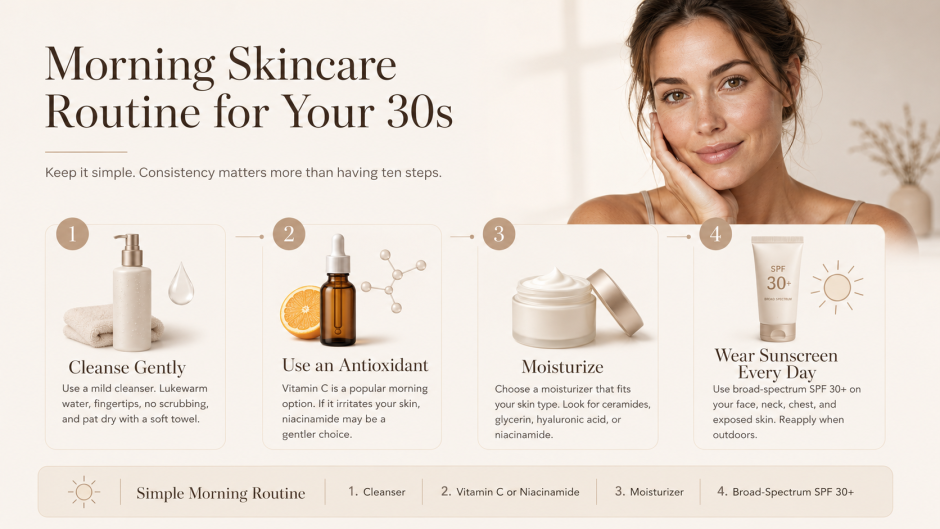
A morning routine should be simple enough that you can do it every day. Consistency matters more than having ten steps.
Cleanse gently
Use a mild cleanser in the morning, especially if your skin is oily or you used active ingredients the night before. If your skin is very dry or sensitive, some people do well with just rinsing with lukewarm water, but that depends on your skin.
The AAD recommends using lukewarm water, applying cleanser with your fingertips, avoiding scrubbing, rinsing, and patting the skin dry with a soft towel. (American Academy of Dermatology)
Use an antioxidant if your skin tolerates it
Vitamin C is a common morning ingredient because it helps with dullness, uneven tone, and environmental stress. Mayo Clinic lists vitamin C as an antioxidant used in wrinkle creams and notes that it may help protect skin from sun damage and reduce fine lines and wrinkles. (Mayo Clinic)
Not everyone can tolerate vitamin C, especially stronger forms. If it stings or causes irritation, niacinamide may be a gentler option.
Moisturize based on your skin type
Moisturizer is not only for dry skin. Oily skin can still have a weak barrier or low water content. A lightweight moisturizer can support the barrier without feeling heavy.
Look for ingredients like ceramides, glycerin, hyaluronic acid, or niacinamide. Ceramides, cholesterol, and fatty acids are part of the skin’s lipid structure and support barrier function.
Wear sunscreen every day
This is the step that matters most.
Use broad-spectrum SPF 30 or higher on your face, neck, chest, and any exposed skin. Reapply when outdoors, sweating, or swimming. Sunscreen is not only for beach days. UVA rays contribute to premature aging and can pass through windows, so daily use matters.
No serum can make up for years of skipped sunscreen.
A simple morning routine can look like this:
- Cleanser
- Vitamin C or niacinamide
- Moisturizer
- Broad-spectrum SPF 30+
Night Skincare Routine for Your 30s

Nighttime is where repair and treatment fit best. This is also where many people overdo it.
You do not need retinol, acids, exfoliating toner, acne treatment, and brightening serum all in the same night. That is how many routines become irritating.
Remove sunscreen and makeup properly
If you wear makeup or water-resistant sunscreen, cleanse well at night. Some people prefer a cleansing balm or micellar water followed by a gentle cleanser. The point is to clean the skin without stripping it.
Your skin should feel clean, not tight.
Use a retinoid slowly
Retinoids are among the most useful ingredients for skincare in your 30s. They can help with fine lines, uneven tone, acne, texture, and pigmentation. The AAD notes that retinoids may be a good option for mild acne, mild pigmentation irregularities, and mild fine lines and wrinkles, but they should be introduced slowly. (American Academy of Dermatology)
A smart approach is to start two or three nights per week. Use a pea-sized amount for the whole face. Apply moisturizer before or after if your skin is sensitive.
Do not use retinoids if you are pregnant or trying to become pregnant unless your clinician says it is safe. Mayo Clinic also notes that retinoids, including retinol, should not be used during pregnancy. (Mayo Clinic)
Repair the barrier
On nights when you are not using a retinoid, focus on barrier repair. A moisturizer with ceramides, glycerin, or hyaluronic acid can help reduce dryness and sensitivity.
Your 30s are a good time to stop thinking of moisturizer as optional. A healthy barrier helps you tolerate active ingredients better.
A simple night routine can look like this:
- Cleanser
- Retinoid or treatment serum
- Moisturizer
On non-retinoid nights:
- Cleanser
- Hydrating serum, if needed
- Barrier-supporting moisturizer
Ingredients That Work Well in Your 30s
The skincare aisle is crowded, but only a few ingredients deserve regular attention.
Retinoids
Retinoids are vitamin A derivatives used for acne, texture, discoloration, and fine lines. Over-the-counter retinol is usually milder. Prescription retinoids are stronger and should be used with medical guidance. Cleveland Clinic notes that retinol is used in creams, lotions, and serums and may help with acne and anti-aging concerns. (Cleveland Clinic)
Best for: fine lines, texture, acne, pores, early aging, uneven tone.
Vitamin C
Vitamin C is often used for brightness, antioxidant support, and uneven tone. It works well in a morning routine under sunscreen, but it can irritate some skin types.
Best for: dullness, discoloration, early photoaging.
Niacinamide
Niacinamide is a form of vitamin B3. Mayo Clinic notes that niacinamide may help reduce signs of aging, improve skin tone, and calm the skin. Cleveland Clinic also notes its use for brightening skin tone and dark spots. (Mayo Clinic)
Best for: redness, oiliness, barrier support, uneven tone, sensitive skin.
Hyaluronic acid
Hyaluronic acid is a hydrating ingredient. It does not replace moisturizer, but it can help skin feel plumper and more comfortable when layered under a cream or lotion.
Best for: dehydration, dullness, tightness.
Ceramides
Ceramides support the skin barrier. They are useful if your skin feels dry, irritated, flaky, or sensitive from active ingredients.
Best for: dry skin, sensitive skin, barrier repair.
Salicylic acid
Salicylic acid can help acne-prone or oily skin by working inside pores. It should be used carefully, especially if you already use a retinoid.
Best for: blackheads, clogged pores, oily skin.
Azelaic acid
Azelaic acid can be useful for acne, redness, and dark spots. It is often considered a good option for people who cannot tolerate harsher actives, though personal tolerance still matters.
Best for: acne, redness, post-acne marks, uneven tone.
What to Avoid in Your 30s Skincare Routine

Taking care of your skin in your 30s is not only about what you add. It is also about what you stop doing.
Avoid skipping sunscreen
This is the biggest mistake. If you use retinoids, exfoliants, peels, or brightening products but skip sunscreen, you are working against yourself.
Avoid harsh scrubs
Scrubs can feel satisfying, but rough exfoliation can irritate the skin barrier. The AAD recommends avoiding scrubbing because it can irritate skin. (American Academy of Dermatology)
Avoid changing products too often
Most ingredients need time. If you change your routine every week, you will not know what is helping or hurting.
Avoid using too many actives at once
Retinoids, exfoliating acids, benzoyl peroxide, vitamin C, and peels can all have a place, but not all at once. Too many active products can cause dryness, burning, peeling, breakouts, and redness.
Avoid copying someone else’s routine
Your best friend’s routine may not work for your skin. Your skin tone, oil production, sensitivity, acne history, hormones, and sun exposure all matter.
Avoid waiting too long to ask for help
If you have persistent acne, melasma, rosacea-like redness, changing spots, or irritation that does not improve, a professional assessment is better than months of guessing.
When Professional Treatments Can Help
Home skincare is the foundation. Professional treatments are useful when you want to target concerns that products cannot fully correct.
Skin analysis
A professional skin assessment can help you understand what is happening below the surface. VISIA skin analysis uses imaging to look at features such as pigmentation, pores, texture, and UV damage. The Derm Project offers VISIA skin analysis as part of its physician-led approach to personalized skin planning. (The Derm Project)
This can be helpful if you feel stuck or if your skin issues are not matching what you see in the mirror.
Chemical peels
Chemical peels can help with texture, uneven tone, acne, discoloration, and signs of aging. The AAD states that dermatologists use chemical peels to improve signs of aging and some skin conditions, including certain types of acne and discoloration. (American Academy of Dermatology)
Microneedling
Microneedling is often used for texture, acne scars, and collagen support. It should be done by a trained provider, especially for deeper treatments.
BBL and laser-based treatments
Light and laser treatments may help concerns like sun damage, redness, and brown spots. The right device and settings matter, especially for different skin tones.
Injectables
Neuromodulators such as BOTOX can soften expression lines. Dermal fillers can help with volume changes. These should be done with a plan, not pressure. Natural-looking results depend on anatomy, dose, placement, and provider skill.
Professional treatments work best when they support your daily routine. They should not replace sunscreen, moisturizer, or good habits.
The Derm Project in Missouri City, TX
If you are near Missouri City, Sugar Land, or Houston and want guidance instead of trial-and-error skincare, The Derm Project provides physician-led medical aesthetics and wellness care in a calm, personalized setting. The clinic focuses on medically supervised treatments for different skin types and tones. (The Derm Project)
Name: The Derm Project
Address: 9010 Sienna Crossing Dr., Ste. 100, Missouri City, TX 77459
Phone: (346) 724-4041
Service areas: Missouri City, Sugar Land, Houston, and nearby Texas communities
Care focus: Medical aesthetics, skin analysis, injectables, skin rejuvenation, and wellness care for women at different stages of life (The Derm Project)
A local clinic matters because skin care is personal. Climate, sun exposure, skin tone, lifestyle, age, and treatment history all affect the plan.
Build a Skin Plan That Fits Your Skin
The best skincare for 30s is not about doing more. It is about doing the right things consistently.
Start with sunscreen every morning. Cleanse gently. Use a moisturizer that supports your barrier. Add active ingredients slowly. Do not overload your face. Give products time to work. Ask for help when your skin is not improving.
Your 30s are a good time to build habits your future skin will thank you for.
A good plan should answer these questions:
- What is my main skin concern right now?
- Is my barrier healthy enough for active ingredients?
- Am I using sunscreen daily?
- Do I need a retinoid, vitamin C, niacinamide, or acne treatment?
- Am I treating the real issue or just buying more products?
- Would a professional skin assessment help me make better choices?
When your routine is built around your actual skin, skincare becomes much easier. You stop chasing trends. You stop buying random products. You start making decisions that make sense.
FAQs About Skincare in Your 30s
What is the best skincare routine for your 30s?
The best routine includes a gentle cleanser, moisturizer, daily broad-spectrum SPF 30 or higher, and a few targeted ingredients such as retinoids, vitamin C, niacinamide, or azelaic acid depending on your skin. Keep the routine simple and consistent.
Should I start using retinol in my 30s?
Many people start retinol or another retinoid in their 30s because it can help with early fine lines, texture, acne, and uneven tone. Start slowly, use sunscreen daily, and avoid retinoids during pregnancy unless your clinician approves it. (American Academy of Dermatology)
Is vitamin C good for skin in your 30s?
Vitamin C can be useful for dullness, uneven tone, and antioxidant support. It is often used in the morning before sunscreen. If your skin is sensitive, start with a gentle formula or ask a skincare provider for guidance. (Mayo Clinic)
Do I need professional treatments in my 30s?
Not everyone needs professional treatments, but they can help when home skincare is not giving you the results you want. Chemical peels, microneedling, light-based treatments, and injectables can support concerns like texture, pigmentation, redness, early lines, and acne scarring when used as part of a personalized plan.
How long does it take to see results from a new skincare routine?
Hydration can improve quickly, sometimes within days. Acne, pigmentation, texture, and fine lines usually take longer. Many active ingredients need several weeks of consistent use before changes are noticeable. Retinoids often require patience.
What should I stop doing to my skin in my 30s?
Stop skipping sunscreen, scrubbing your face, layering too many active ingredients, and changing products too often. These habits can irritate the skin and make it harder to know what is working.
Is oily skin in your 30s still dehydrated?
Yes. Oily skin can still be dehydrated or have a weakened barrier. A lightweight moisturizer with ingredients like niacinamide, glycerin, or hyaluronic acid can help without feeling heavy.
Photos by the The Derm Project
Contributed posts are advertisements written by third parties who have paid Woman Around Town for publication.