

Not all natural stones possess the structural density required to withstand daily impacts and liquid spills. Quartzite offers exceptional durability, but the physical quality varies depending on where the stone is sourced. Identifying premium slabs requires expertise in geology and strict material testing protocols.
To get premium materials, you must eliminate weak or porous stone slabs immediately. This blog examines how a professional supplier verifies high-density quartzite.
Geological Sourcing and Extraction
The physical density of quartzite depends entirely on the geological conditions under which it originally formed. True quartzite forms when sandstone undergoes intense tectonic pressure and extreme heat deep within the earth. This process fuses the quartz grains, creating a non-porous structure harder than standard granite.
Stone Supplier guarantees the stone originates from these verified, high-pressure extraction sites. They deploy procurement teams to inspect the raw stone blocks before they leave the quarry. This initial screening process rejects blocks containing structural fissures or high concentrations of soft mineral impurities.
Verifying Mineral Composition
Many stones sold as quartzite in the market are actually mislabelled as marble or soft dolomite. These softer stones etch instantly when exposed to acidic liquids like lemon juice or household vinegar.
Suppliers verify the structural integrity of quartzite slabs using these specific testing protocols:
- Hardness Testing: Uses the Mohs scale to confirm the stone resists scratching from steel blades and glass
- Acid Resistance: Applies hydrochloric acid drops to ensure the surface does not effervesce or etch chemically
- Porosity Checks: Measures water absorption rates to confirm the crystalline structure is tightly fused and sealed
- Impact Resistance: Tests the structural limits to ensure the stone withstands blunt force without fracturing
Precision Cutting and Resin Processing
Once the raw block passes inspection, it undergoes a precision cutting process to create individual slabs. Industrial diamond-wire saws slice the dense quartzite slowly to prevent heat fractures from damaging the material. The raw slabs then enter a vacuum resin chamber to reinforce their natural structural integrity.
Stone’s appearance and hardness are unaffected by resin treatment. It simply acts as a preventative measure to seal microscopic pores against future liquid absorption. This processing stage ensures the final slab provides a hygienic, non-porous surface for kitchen and bathroom installations.
Surface Polishing and Calibration
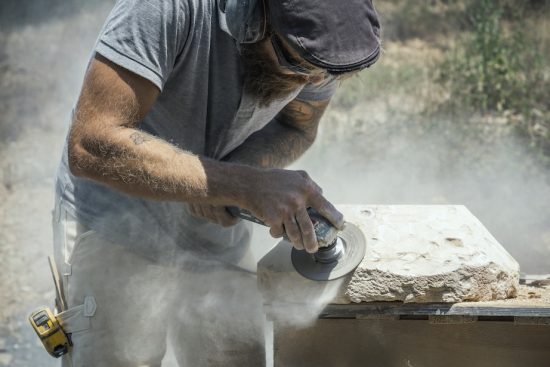
High-density quartzite requires specialised polishing equipment to achieve a smooth, reflective surface finish. Due to their extreme hardness, quartz grains quickly wear down standard polishing pads during fabrication. Suppliers use graded diamond abrasives to hone the surface, preventing burning or discolouration of the natural stone.
The final calibration process ensures the quartzite slab meets strict dimensional tolerances for installation:
- Thickness Uniformity: Grinds the back of the slab to ensure a consistent thickness across the entire surface area
- Edge Squaring: Trims the perimeter to exact right angles to facilitate seamless joining during benchtop installation
- Surface Flatness: Uses laser levelling to detect and remove minor undulations that complicate the mounting process
- Visual Inspection: Checks the final polished surface for resin pooling or uneven abrasive scratch marks
Managing Logistics and Transport
To avoid catastrophic transit fractures, heavy, rigid quartzite slabs need specialised handling equipment. High-density stone lacks flexibility, meaning it snaps if the transport vehicle subjects it to bending forces. Suppliers load the slabs onto reinforced steel A-frames designed to hold the stone perfectly vertical during transit.
This vertical positioning transfers the weight downward, eliminating the lateral tension that causes cracking. They use enclosed transport vehicles and secure the A-frames using heavy-duty industrial ratchet straps. Proper handling protects the financial investment made in these premium natural stone slabs.
Secure Premium Stone for Your Project
Sourcing high-density quartzite requires strict quality control measures at every stage of the supply chain. Relying on unverified suppliers exposes your project to the risks of mislabelled or structurally weak stone slabs.
Construction materials must meet strict durability and visual consistency standards. Avoid spending money on soft stones that etch and stain in the home. Contact a trusted stone supplier today to get premium quartzite for your structural investment.
Image by KamranAydinov on Magnific
Contributed posts are advertisements written by third parties who have paid Woman Around Town for publication.