Music director Leon Botstein led the American Symphony Orchestra (ASO) in a commemorative concert on January 30 at Carnegie Hall to celebrate the 250th anniversary of the Declaration of Independence. The program highlighted the evolution of an American musical identity during the 19th and 20th centuries, featuring a diverse selection of rarely performed works.
As an article on the Center for Arts & Culture website states: “Culture is a national resource, the accumulated capital of America’s ingenuity and creativity. It is the store of human achievement and memory as well as the font of creativity and innovation.” It acts as a crucial social source that aids in maintaining identity and understanding others. Vast admiration and high praise go to Maestro Leon Botstein and the ASO for doing exactly that by bringing these works to the attention of the public. And while Maestro Botstein’s pre-performance opening remarks rang painfully true—“No one could have predicted this is an ironic moment for traditional patriotism… I worry about the direction of the country”—it is precisely at this moment, more than ever, that American composers like Dudley Buck, Harry T. Burleigh, George Frederick Bristow, and many others must be recognized, revealed, and held in high esteem to value, promote, and preserve this country’s cultural wealth, all created here on American soil from the diversity that inspires the bold forging of novel and fascinating paths.
The program began with American composer Dudley Buck’s Festival Overture, a seven-minute orchestral work composed in 1879 to mark Independence Day. This piece is based on the melody of The Star-Spangled Banner, which Buck referred to as the “American National Air.” The iconic melody emerged subtly, transitioning from playful to somber tones to evoke the memory of the Civil War. Buck, known for his role as organist, choirmaster, and assistant conductor of the Theodore Thomas Orchestra in New York, skillfully blended this theme with orchestral grandeur, and ASO under the baton of Maestro Botstein captured beautifully the theme’s flow through the musical texture as well as the entire work’s majestic feel. The piece ended with the Bard Festival Chorale rousingly singing The Star-Spangled Banner melody.
From Buck’s vibrant finale, the audience was drawn into soulful and poignant reflection through three spirituals arranged as art songs by African American composer Harry T. Burleigh, and sung by J’Nai Bridges. In “Go down, Moses,” Bridges captured the anguish of Moses’ people and his powerful call for freedom, her rich and rounded voice lending both gravity and passion on an evocative orchestral backdrop. In Burleigh’s arrangement of the Christmas song “Behold that Star!” Bridge’s voice acquired a dreamy quality punctuated with resonant deep tones, floating from meditative to blues inflections. In “Swing Low, Sweet Chariot” Bridges’ flexibility of tone and dynamics created moving, subtle nuances that drew in the listener. The only flaw in Bridges’ enchanting artistry was her lack of clarity in diction.
Richard Wagner’s Großer Festmarsch / American Centennial March premiered at the 1876 centennial celebration of the Declaration of Independence in Philadelphia and was attended by President and Mrs. Ulysses S. Grant. It began symphonically, establishing a magisterial presence, followed by sweet interventions from strings and winds, then returning to its imposing motifs. But too much repetition and a lack of musical variety made for a piece that was a bit uninspiring. ASO did its best to maintain momentum, yet by its grandiose end, the work seemed to have lost its authority.
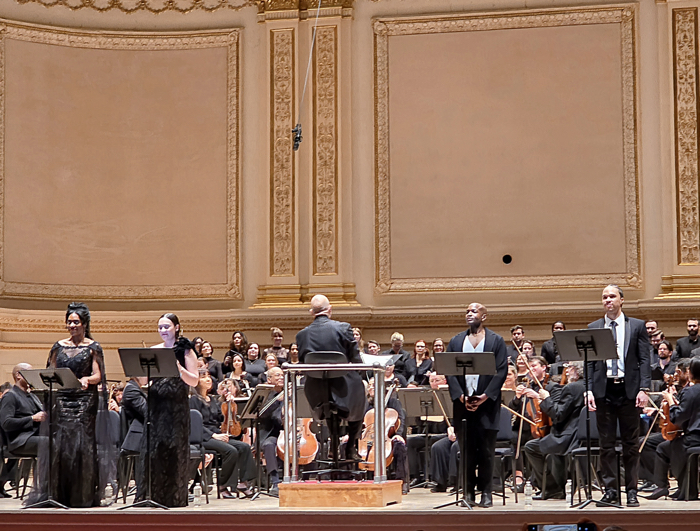
The ASO and Bard Festival Chorale conducted by Maestro Leon Botstein with soloists, l. to r.: J’Nai Bridges, Anna Thompson, Freddy Ballentine, Alan Williams.
The second part of the concert featured George Frederick Bristow’s lush Niagara Symphony (Symphony No. 5), a stunningly beautiful work inspired by Charles Walker Lord’s poetry about Niagara Falls, performed here for the first time since its 1898 world premiere at Carnegie Hall. In composing his Symphony No. 5, Bristow drew inspiration from Beethoven’s Ninth, and crafted a four-movement masterpiece with a choral finale, a fitting ode to wondrous Niagara Falls. Bristow is considered by some to be the “Father of the American Symphony”, although others would argue that his mentor, William Henry Fry, is more deserving of the title as he was actually the first American-born composer to write a symphony.
Texturally rich, infused with sublime melodies, imaginative passages, ardent late-Romantic pathos, and a musical wink to Handel’s “Hallelujah” in the chorus part, this is indeed a significant and magnificent work. The opening movement, “Allegro”, conveyed the grandeur of Niagara Falls with vigorous figures and rhythmic motifs. Warm violas masterfully accentuated and supported the violins undulating, shimmering like sunshine reflecting at the top of Niagara before the force of nature unleashes its full power, while a haunting bass theme evoked strong undercurrents. On occasion, the movement sounded Mahler-ish in its sweeping emotional power with touches of dark tumult, other times it brought to mind Liszt’s Préludes in an intoxicating blend of beauty, lyricism, and poetic passion. Maestro Botstein and the ASO clearly brought forth all of these various instrumental contributions while maintaining the unity and flow of the entire score.
The Andante offered, among many delights, a soaring, charmingly performed violin solo, brilliant brass, and a solemn passage impressively played by the horns. It brought to mind fragments from the opera Der Freischütz, an essential German Romantic opera by Carl Maria von Weber. The Scherzo wove in an old American melody through the Liszt, Mahler, Brahms influences, perhaps Bristow’s nod to America emerging from the European canon and putting its own unique stamp on classical music, surrounded by sounds of nature, like bird trills, and scintillating with piccolo gleam and triangle sparkle.
The finale invoked various aspects of the waterfall in homage to its divine creator, through the soloists and chorus. Freddie Ballentine’s gorgeous, seamless, bel canto-perfect tenor voice expressed wonder and illumination at the sight of Niagara. Bass Alan Williams offered a prayer in his abundant voice with superb high notes and laudable diction. J’Nai Bridges and Anna Thompson gave voices to the waters in search of the sea, while the orchestra aptly conveyed the increasing force of the bubbling cataract. Thompson’s fresh and bright soprano voice with clarion high notes blended pleasantly with Bridges’ creamy deep mezzo. The chorus expertly depicted the torrents of rapids and whirlpools, culminating in Thompson’s luminous, at times effectively straight-toned, serene benediction, followed by an epic finale.
It was a very special evening of long overdue appreciation for great composers of this country, who faced challenges in establishing a classical music tradition here while fighting to dismantle the possible and superficial perception that they might be mere imitators of European composers. True, the European master composers’ influences are evident in the works of Bristow and Buck, but the tradition merely provided their initial inspirational cauldron. Both Bristow and Buck left their own distinctively American musical signature on their pieces, and the encounter with their works is truly awe inspiring. Bristow’s Niagara Symphony belongs among the top greatest symphonies of all time, and it would be a crime not to perform it again and record it.
Top: Maestro Leon Botstein with J’Nai Bridges and the ASO
Photos by Maria-Cristina Necula