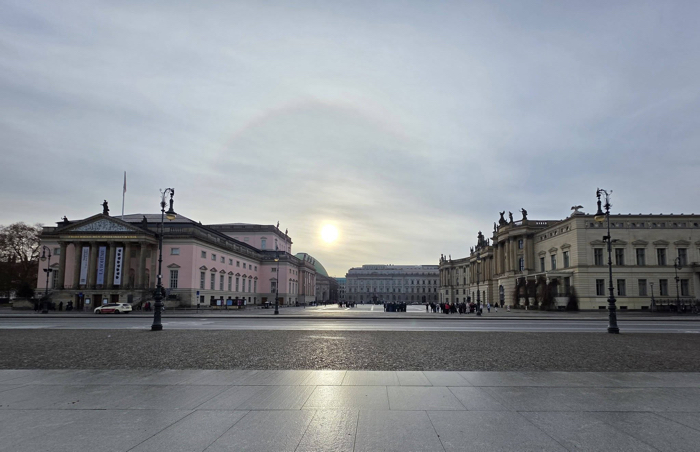
The promise of roasted goose animates my steps along the Spree River. Wrapped in its gray mantle, the day stretches slowly across the leaden water, indifferent to the fast-paced beings making their way to various destinations in Berlin. Tourists and locals sport thick coats and puffer jackets up and down the riverbanks, seemingly stoic in the face of the occasional gusts of bone-chilling wind.
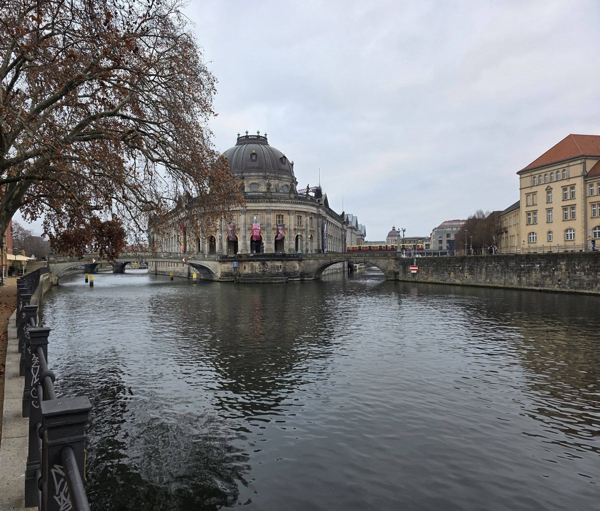
Walking along the Spree River in Berlin and admiring the Bode Museum
I pass the Bode museum, and despite my frozen fingers and goose-seeking urgency, I have to stop, struck by its grandeur and such unquestionable authority that it actually splits the river in two. I hurriedly grasp its image in a photo, then goaded by hunger and my phone’s annoying direction-giving voice, I refocus on my purpose: getting to the Brasserie Ganymed to taste goose for the first time in my life. It is Berlin’s Christmas menu specialty, and since my hotel restaurant listed it but did not have it, the elusive meal taunts me. By the grace of the internet gods, I discovered Brasserie Ganymed, a much-lauded French restaurant that serves goose, without reservations.
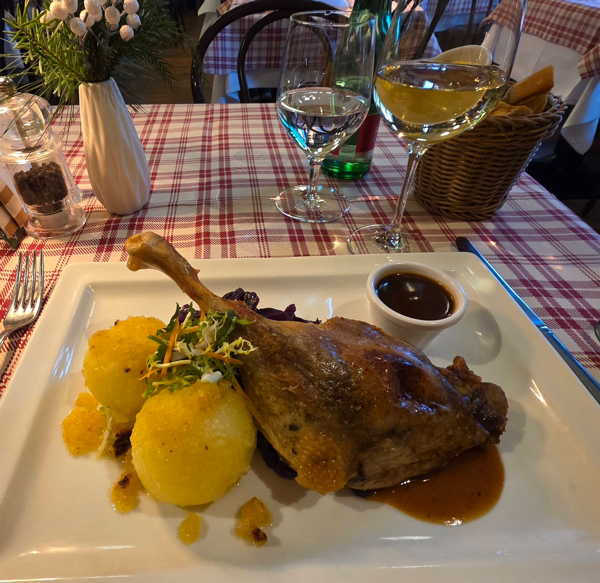
Roasted goose leg at Brasserie Ganymed in Berlin
So, I find myself seated at a simple table covered by the emblematic French bistro gingham checked tablecloth, facing an enormous goose leg on top of sweet cassis red cabbage, gently bordered by two potato dumplings and surrounded by goose jus. To the side stands its golden perfect accompaniment, the waiter’s recommendation: dry German Riesling. At the initial touch of my fork and knife, I meet with no resistance. The meat slides off the bone, graceful and tender. At first taste, my senses are instantly thrust into a heavenly realm, as the meat, simultaneously crunchy and soft, gamey and light, dissolves with little effort. I instantly know that this would be one of those meals where, despite my hunger, I would not devour it but instead stretch out the delight for as long as possible, as though every bite were its own universe worthy of detailed attention. I feel like a child in that state of stunned bliss I knew so well whenever I wanted something and I got it and it turned out to be even more extraordinary than I’d imagined.
Yet that state was a rarity in my childhood. I grew up on the Eastern Bloc where many wishes went unfulfilled. Longings for what we glimpsed on Romanian television in the American movies or series occasionally broadcasted, blossomed in children’s hearts only to wither on the stores’ empty shelves. Sometimes, miracles materialized, like Toblerone chocolate. Once in a while, it would be gifted to me. I lived for those moments and never forgot my first taste of Toblerone and that state of bliss that followed. I could proudly own the fact that I had at last tasted Toblerone. As a child, I knew how to own everything I encountered, including the places I traveled to with my parents. I felt that they were fully mine.
Except Berlin.
I was eight years old when Berlin split me in two. My parents and I, still living in communist Romania, were permitted, like all regular Romanian citizens, to take vacations only through Eastern Europe. We visited Hungary, Czechoslovakia, and Germany. I liked to say Germany and Berlin, but I was harshly corrected at school before my departure when I’d boasted of the places we would see. “It is the DDR. East Germany. East Berlin. Why are you using unified names for the country and its capital? Is your little mind already conceiving of visiting decadent, capitalist West Germany?” I was asked. The Berlin Wall had an essential, albeit deceptive, purpose in the eyes of iron-fisted Eastern European dictators: Propaganda presented it as keeping the corrupting elements of the West out, but in reality, it served as yet another prison wall, and those living in the East who dared to venture over it were shot.
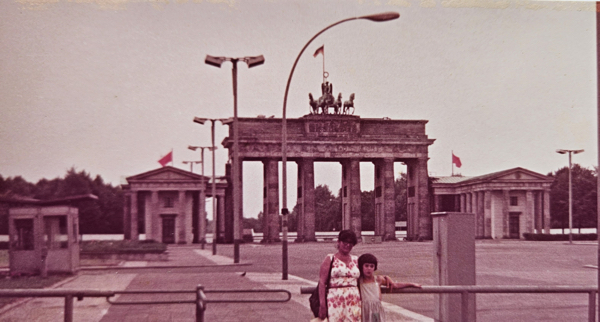
At the Brandenburg Gate with my mother in 1983 Berlin
Distance from the Wall had to be respected fiercely. I never saw the Wall as a child. But on a hot July day in 1983, I stood at a distance from the Brandenburg Gate, snuggling against my mother, posing for a photo that my father took. The photo shows me with my arm on the metal bar of the barrier blocking access to approaching the Gate. I am not smiling. I look perplexed because, as with all the extraordinary encounters of my little life, I want to own this one too. I want to walk to that Gate, touch it and step through it to the other side. It makes me think of the temples of my Olympian legends book, and I imagine gods and goddesses floating around the columns, and mortals worshiping them and gaining formidable powers. I’m here too, so close, and yet I can’t touch the Gate, and I can’t hold the moment. I can’t own it. I am in East Berlin and West Berlin lies impossibly beyond my reach. I am Eastern European, and suddenly, that feels like a life sentence. While Budapest and Prague belonged to me because my steps could cross them freely, it dawns on me that Berlin would not be mine. For the first time in my young life, I feel confined and split in two; my mind already flies beyond the Gate, yet my body remains pressed against cold metal, my mother’s arm protecting and consoling me.

At the Brandenburg Gate in 2025 Berlin
Over 42 years after that photo at the Brandenburg Gate, I feel as though I am dancing through my first day in unified Berlin. The memory of the goose meal coils pleasantly around my senses as I walk toward the Gate and my body dissolves into a giant rhythmic pulse. There it is, the elusive temple, no more metal barriers in front of it, but a Christmas tree and a menorah, and tourists posing and walking everywhere. I long to recreate the photo from 1983, and I show it to a kind passerby. We both search for an angle similar to the one in the old photo. My mother stands next to me in spirit. I finally approach the Gate and touch one of its columns. I look up. And then I take my first steps through it.
Berlin is mine.
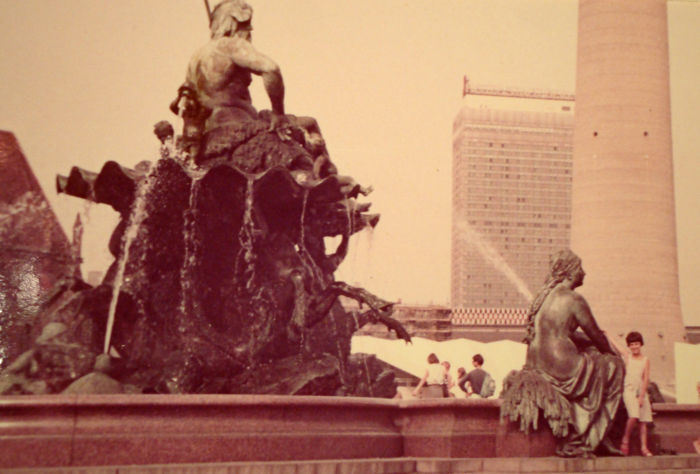
At the Neptune Fountain in 1983 Berlin
In exhilaration, I almost run toward the Neptune Fountain where I want to recreate another photo from 1983, of me sitting on the edge of the fountain, Neptune watching over me and the Television Tower looming nearby. I arrive to a surprising sight: a donut-shaped ice rink encircles the fountain and so do squeals of laughter from children and adults alike. I realize that the only way to get close to the fountain is to rent skates, and I count the number of times I have ice skated in my entire life. Five. Nonetheless, the past is calling me, and I force myself on the ice, looking as graceful as a scarecrow in high winds.
I know that I need help to cross the rink to the fountain, and I explain my purpose to a fellow skater. An American expat, in Berlin for 14 years, he patiently holds me by the elbows and guides me across the ice after which he tries to capture the angle of the 1983 picture in the new photo. There ensues such a back-and-forth commotion between us comparing the old photo to the new one while I strive not to fall and he takes more photos, that eventually, other people gather. By the end of the adventure, a small group surrounds me staring in awe at the 1983 photo and asking me to talk about it. While waltz music soars around us, while other skaters attempt to pass by us, while the light show from the Ferris wheel makes me feel like I am onstage, I tell my story.
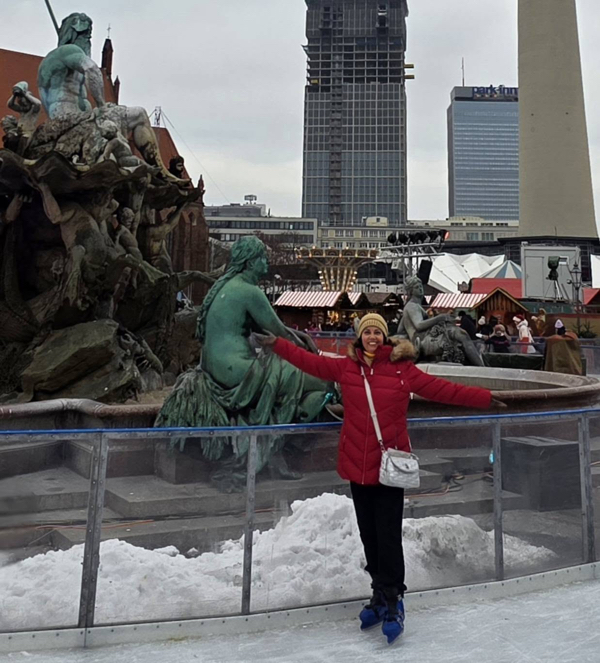
At the Neptune Fountain, on ice, in 2025 Berlin
I speak of growing up in communist Romania, of immigrating to the United States, of never—as life would have it—having been able to return to Berlin until now. I speak of the Brandenburg Gate and of a child’s dream to cross the Gate come true 42 years later. I speak of how living in Eastern Europe meant always carrying inside a feeling of threat. My heart shatters as someone asks: “And does it mean any different today? And only in Eastern Europe?” The questions hang heavy and sharp between all of us, and further words drop into silence.
A skating rink guard suggests with firm gentleness that we either keep skating or get off the ice because blocking a portion of the rink is unacceptable behavior. I say goodbye and let my story drift away on the winter wind. Fragrances of mulled wine, sausages, and other culinary wonders waft to me and glide me off the ice smoothly, as though I have skated all my life. I walk through the Christmas market by the Red City Hall, nostrils flaring and anticipation rising. I have been reinventing myself as an American for almost four decades, but here, I feel unfathomably Eastern European. In this Berlin, the West has come, at last, to meet me halfway. Yet it isn’t to the me of today that it grants a long overdue welcome. It is to the eight-year-old who has just taken her first steps through the Brandenburg Gate. And that eight-year-old, giddy with enthusiasm, breathes in the alluring aromas and wonders softly: What else shall I taste today in my Berlin?
Top: Berlin 2025: View of Bebelplatz from Boulevard Unter den Linden with the Berlin State Opera on the left
Photos by Maria-Cristina Necula