Recently, WAT editor Charlene Giannetti’s piece about the late food writer Marian Burros and her iconic plum torte (see the story) got me thinking about the food writers who, over the years, have had the greatest influence on me.
First to come to mind are Erma Rombauer and Marian Rombauer Becker, the friendly, encouraging mother-daughter duo who created The Joy of Cooking. You don’t know how to boil an egg? No problem, they seemed to say. We’ll teach you. Yet in and among the starchy casseroles and canned fruit suspended in translucent aspics, you could actually find a few gems, like a saffron-y, garlicky bouillabaisse that was, alas, simplified in later editions.
What to say of Julia Child, who brought us out of the dark ages of canned and frozen vegetables while enriching our sauces and teaching us the very real benefits of cooking with tarragon, cream, and white wine? Unlike the other Julia in Julia and Julia, I never tackled Mastering the Art of French Cooking page by page. And while I gravitated toward easier, more iconic recipes like onion soup, pommes dauphinoise, and tarte tatin, much that I learned from Julia stays with me to this day.
I have no recall of how I came across French Chef Raymond Oliver’s La Cuisine, whose twenty ingredient (and as many steps) recipes I could barely contemplate, much less attempt. Today, I keep the book around mainly for comic relief. In his preface, Oliver offers detailed advice on communicating with kitchen staff, the proper way to address the ambassador, where to seat the Commander of the Legion of Honor, and rules of engagement around hand-kissing. In short, your husband may kiss the hands of married women “but not the single gals.” Still, score one for Oliver’s chicken with forty cloves of garlic— a staple of my very first sit-down dinner parties.
Add to the shortlist New York Times food editor Craig Claiborne, whose cookbook was a must for any literate American home cook. With a deep understanding and vast cross-cultural knowledge of foods from across the globe, Claiborne entered our kitchens not as a friend, but rather a resident expert. A longtime favorite: his Moussaka—ground lamb and creamy eggplant redolent with cinnamon and red wine under a delightful ricotta bechamel.
I’m grateful to them all and others, including uncredited test kitchen cooks whose recipes I’d clip from magazines like Gourmet and Food and Wine. But the writer I hold most dear of all is Marcella Hazan.
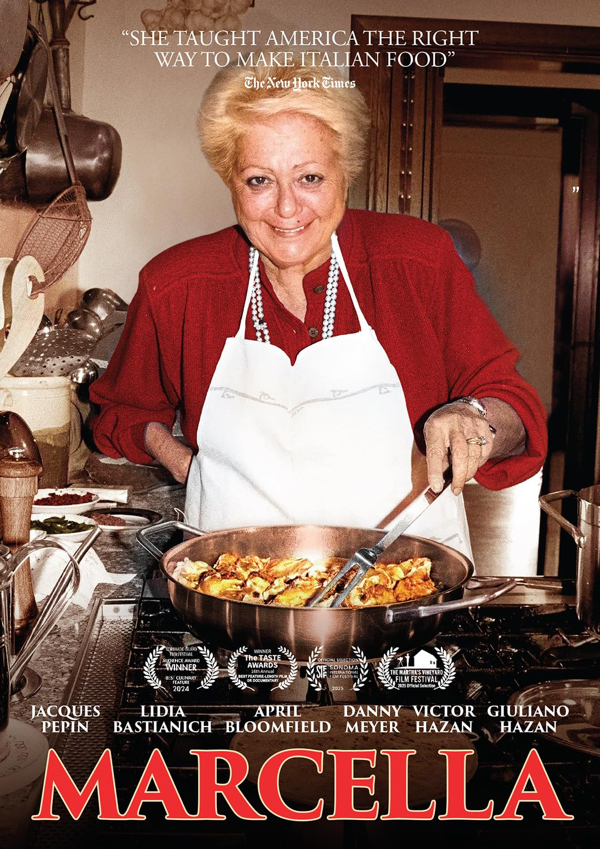
Born just over a century ago in Emilia-Romagna, Marcella began her reluctant climb to fame in the 1960s through Italian cooking classes she held in the Upper East Side apartment she shared with her husband Victor.
Marcella’s recipes offered us an extension of the flavorful, unfussy dishes found in the trattoria— working men’s lunch spots (as opposed to white-table cloth ristorante) in cities like Milan, Venice, and Parma. Most of her recipes called for four, six and eight ingredients (and hold the heavy cream).
From ingredients I had on hand or could easily find at the market, I could prepare the main dish for a dinner party in well under an hour. (No need to first make the brown stock required for the sauce espagnole needed for the sauce bearnaise.) Marcella provided reads with instructions on making pasta, but assigned no shame to using what was factory-made.
Marcella’s writing about food was friendly, relatable and even funny. About the “delectable bits” of garlicky potatoes stuck to the bottom of a roasting pan, she advised the reader to “save them yourself or someone you like nearly as well.”
Some of the pages of my Marcella Hazan cookbooks are stained and buckling from careless placement on countertops. All have been with me and— more importantly— in use through several marriages (hey, who’s counting?) at least three major moves, and more weeknight dinners and dinner dinners than I could count. And even with learn-everything-about-everything internet, I continue to turn to Marcella for inspiration, and to brush up on recipes I still don’t know by heart.
With Marcella, there was brilliance in simplicity. As a northern Italian, she used, in addition to olive oil, butter— the ingredient that makes her most classic tomato sauce to so silken and delicious.
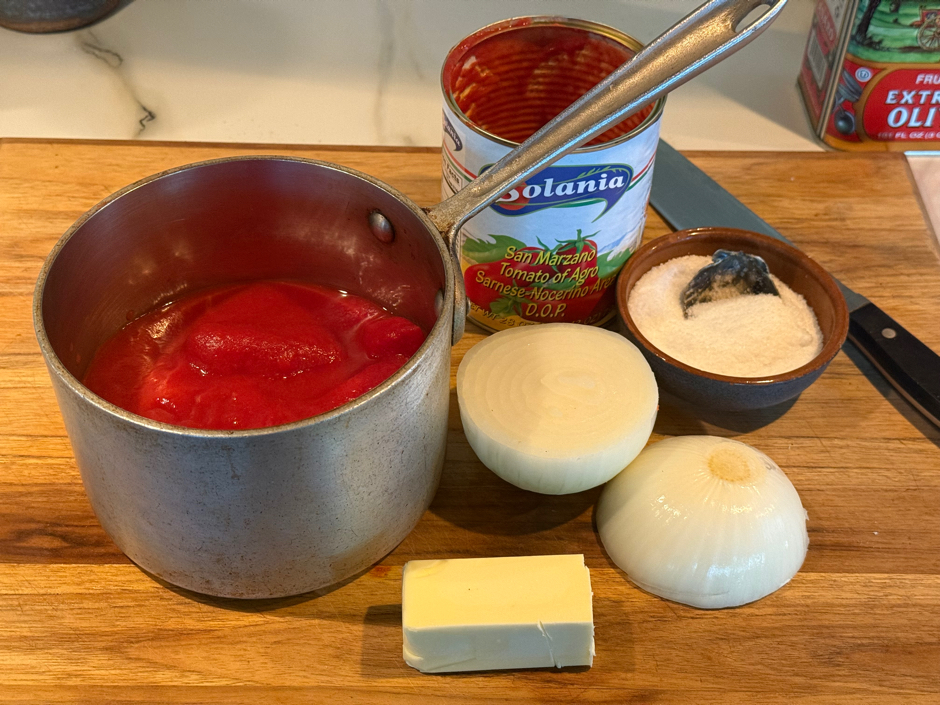
You can find the recipe on the Food and Wine and New York Times Cooking websites. But I don’t think Marcella would have minded my saying: a 28 oz. can of San Marzano tomatoes, 5 tablespoons of butter, a medium-sized onion, halved, and a “pinch or two” of kosher salt. (Photo above.) Basta. Bring everything to a simmer, reduce the heat, and cook slowly for 45 minutes. Discard the onion and ecce sugo. Add a few grindings of black pepper, some grated parmesan and you’re done.
There is, by the way, a terrific new documentary about Marcella Hazan on PBS. Watching, I was saddened to realize that her lifelong chain-smoking habit had surely contributed to her death. But mostly, I was grateful to learn more about this wonderful cook who shunned the spotlight and bombed on TV appearances – pretty much preferring to make— and write about – good food. Even though I’m not in Marcella’s league, somehow, I can relate to that, too.
Top photo by Carolyn Swartz