Aruba is called “one happy island.” Happiness lies in the constancy of the weather, the friendly people, the soothing breeze, the welcoming, serene, perfect-temperature water. About 19.6 miles long and six miles wide, bordered by beaches and the almost waveless green-blue Caribbean, Aruba is an easily traversable island with much activity packed into the tourist-filled beach areas, but also, inland, stunning natural landscapes with cacti-dotted desserts and natural pools preserved untouched. Located outside of Hurricane Alley, its weather is the top jewel in its crown of happiness. Sunshine abounds while a constant breeze prevents the air from feeling too hot.
These happy islanders must have made a deal with their gods: Wrap our island in soothing winds that placate the sun and keep our tourists beach-addicted and coming back for more. I had been here before and got to know the beauty of this island a bit. This time, though, I leave for Aruba alone with two main goals in mind: first, to enjoy a mini-escape from the everyday hustle-and-bustle, and second, on a request from a translator friend, to reread Dante’s Inferno—a particularly apt choice for this side of paradise—and write to him my thoughts on a particular translation. Quite an agenda for five days. I also travel light, determined that I would not be going out, but just move my body between the beach and the hotel, Inferno in my bag next to the sunscreen.
But Aruba has other plans for me.
Sunset colors
It starts with the locals, who are quick to offer words of wisdom. “Everybody needs to learn to be in the now. Even here in this paradise, we still have to remind ourselves to be present.” That seems so easy on this island, I’m thinking. Nothing is required except presence. The lure of activities: parasailing, jet-skiing, snorkeling, and horseback riding can induce a mild frenzy, if you’re not careful to remember that you have come here to escape scheduling and to reduce “doing” to a minimum. You’ve left your stressful world behind for the basics—the Aruban basics, that is: eating, sleeping, lying on the beach, floating in water, and if you drink, imbibing liquids, mostly of the cocktail variety.
It doesn’t matter if you come to Aruba alone since, should you wish, socializing is always at your fingertips. Or toes. Locals want to talk. Fellow tourists want to talk. The island must be surrounded by an uninterrupted, multilingual field of words. The breeze doesn’t mind the roaming gregariousness. It does its own whispering while palm trees wave their hands-of-many-fingers leaves in agreement or rejection of the stories told by the Aruban wind. Aruba whispers loudly all the time, sharing secrets in its own language. It’s not the native language—Papiamento—with Portuguese, Spanish, Dutch, Slavic influences and inflections. The language of the Aruban breeze is influence-free and open to interpretation.
Enter the teal water, and you find peace. When you swim far out, the talking stops. Few venture to the buoys, although you can still stand there and the water will embrace you up to your neck, if you’re 5’7. The surface turns from blue to green with splashes of amethyst in the concave cradles between the tiny waves. Swimming the breaststroke is like parting liquid spring grass and sky in pursuit of elusive lilac blossoms.
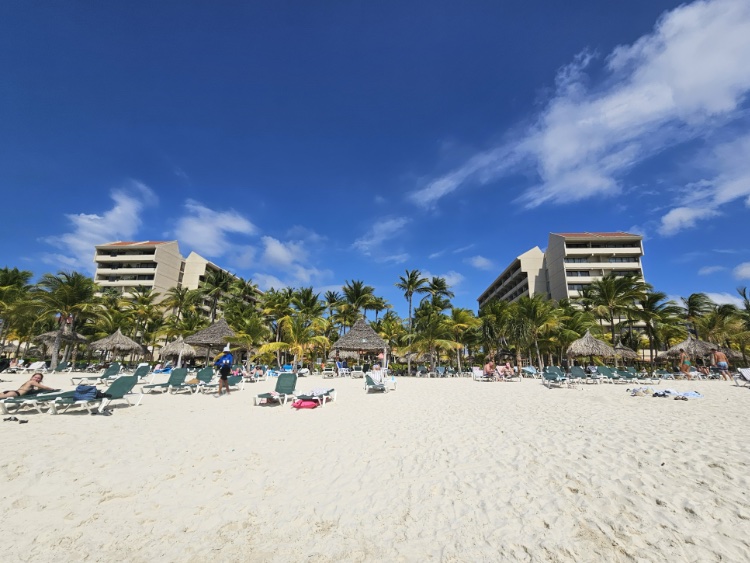
The beach at Barcelò
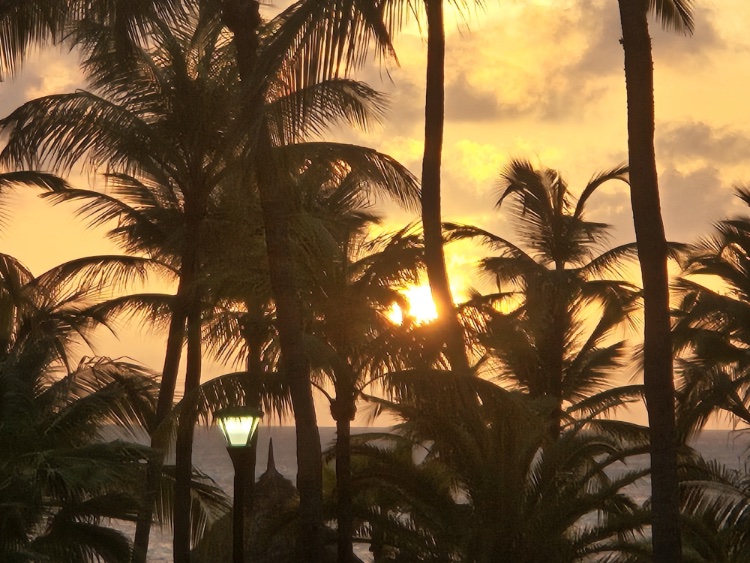
Securing your place in the shade is crucial. Some hotels, like the Marriott Stellaris, will let you reserve a palapa—the dried-palm-leaf umbrella encircled by a table—for a few days at a time, while others, like the all-inclusive Barcelò, leave you to your own devices. That translates to: You need to wake up every morning at 6:00 AM, go down to the beach and ask the beach attendant to set up beach chairs under the palm tree of your choice. By 7:00, there isn’t much choice. Some hotel guests present themselves on the beach at 5:30 to secure the best of the palm trees. The Barcelò all-inclusive hotel has immense potential, but sadly, I hear, it has declined in the past year in quality and service: the buffet food is not the best, attention to details both in the main restaurant and the room is shabby, and only the Mexican and Italian restaurants on its premises are a notch above. Barcelò’s special gift is that shade on the beach is provided mostly by palm trees rather than palapas, and once you lie down and look up at the blue sky between those swaying, whispering leaves, it makes no difference whether you slept only until five or six; the sweetest slumber comes upon you and after a nap, the day can unfold in an uninterrupted flow between hotel, room, and beach.
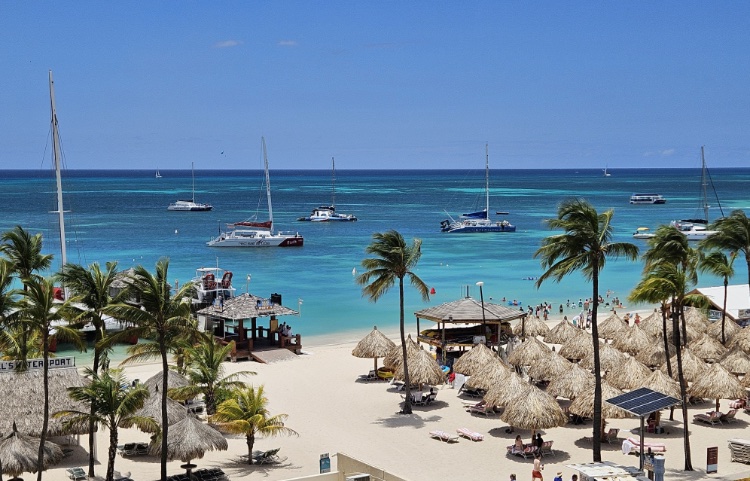
A Palm Beach view
Well… and restaurants. Because once your senses open to the sun and the water, your every cell loses the ability for restraint. In Noord town’s Palm Beach, there is an immense diversity of restaurants of which I tried a few. There is Atardi whose terrace reigns on the Marriott Stellaris beach and whose exquisite fish tacos and signature Aruban beer, Balashi, make for the perfect late lunch. There is Piet’s Pier Bar where the ceviche melts in your mouth like silk tasting of sea, and exploding into particles of cilantro, ginger, and lime, and where tanned Dutch bartenders lure you with Aruba Ariba, the signature cocktail of vodka, rum, orange liqueur, banana crème, Grand Marnier, grenadine and other wonders whose magic make their occasional karaoke singers sound like Eurovision winners.
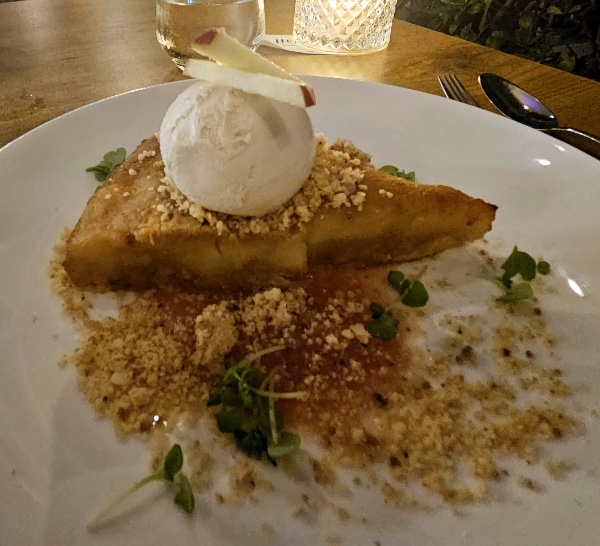
Apple tarte at L’Avenue
And there is the main discovery, a new culinary oasis added to Palm Beach’s array of restaurants: the enchanting Belgian Bistro L’Avenue, opened less than a year ago, located between Holiday Inn and Radisson Blu in The Cove Mall. They welcome you with smiles as you walk by, and they explain the menu. Once the eyes feast on their diversity of dishes’ names and you hear the descriptions, it is impossible to walk away. And staying for dinner is all worth it. For instance, the escargot appetizer’s buttery, garlic-and-green-herb-infused smoothness can pave a mesmerizing way for the Moules à la Provençale—mussels covered in goat cheese crumbs, swimming in a creamy tomato broth that could be a meal in itself, tinged with oregano and tarragon and other secrets of the chef. In a divine finale, the apple tarte takes the senses to another level: caramelized apples on fluffy pastry sheets accompanied by a delicate apple compote and walnut crumbs topped with Bailey’s ice cream. This is sheer culinary heaven, and if anyone travels to Aruba, they must have at least one meal at L’Avenue. Ask to be seated at one of Ceejay’s tables; he is a most courteous, attentive waiter.

Shade under the palm trees
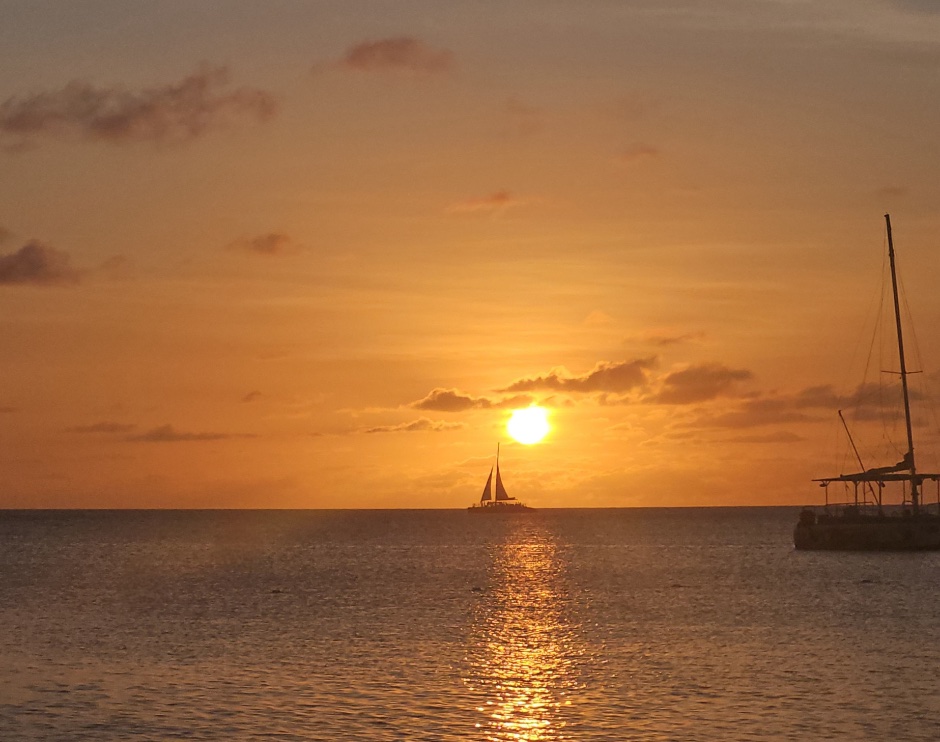
By chance and thanks to music, I find out that a pleasant destination on a Thursday is Ike’s Bistro at the Manchebo Beach resort, for paella night. I have no plans to leave the Palm Beach area, but the glorious sunset and a couple from Chicago change my mind. As the sky shifts colors, I hear guitar strumming behind me and turn around. A man and a woman are lying on beach chairs, he holding a guitar and she contemplating the sun’s descent. I can’t help myself and shout to the man: “That sounds good. I sing too!” After a few polite exchanges at high volume, I end up with my beach chair next to them, attempting to figure out chords for The Sound of Silence. He plays, I sing. A few sunset-admirers move closer to the water, this variation on Simon and Garfunkel’s hit not being quite what they signed up for under the “serene sunsets” clause in their vacation scenario. The Chicago couple tell me they’re going to Ike’s Bistro for “paella night” that includes a glass of Sangria, which could easily turn into an unidentified number, they joke. I join them and relish every bite of the rich seafood paella along with the sparkling atmosphere by the pool, the evening air shimmering with live Spanish guitar music.
And thus, my original plan to read and write evaporates in the Aruban wind. My copy of Dante’s Inferno scorches itself into oblivion on a beach chair in the unrelenting sun. Aruba gets to me. And to my credit card. But, most of all, Aruba, teaches me that I can visit her only when I can be generous. Generous with time and attention, generous with taking pleasure in her offerings and indulging the senses, in short, generous with—and to—myself. Aruba is one possessive lover who demands you in your entirety.
“Analyze translations of literary masterpieces on your own time at another geographical location,” the island whispers to me on one of its caressing breezes, “but when you venture into my territory, your time, your money, your senses, and your wavering willpower are mine.”
Photos by Maria-Cristina Necula