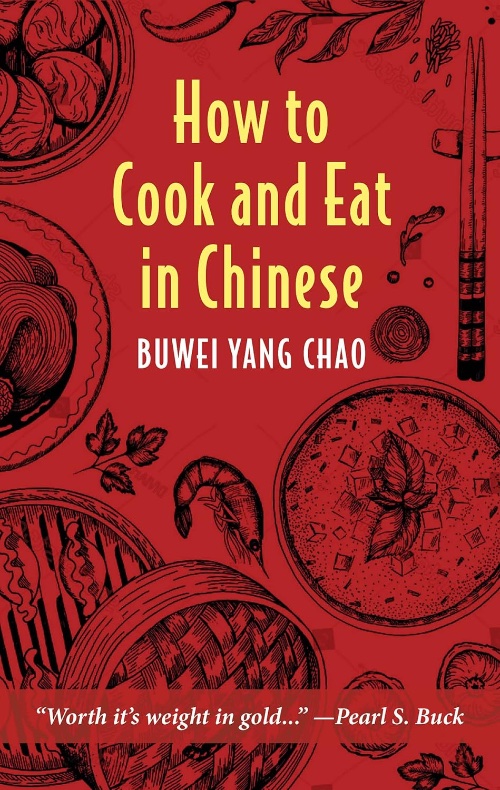
In her seminal 1945 cookbook How to Cook and Eat in Chinese, Nanjing-born physician and author Chao Yang Buwei introduced Americans to ch’ao, a cooking technique used for centuries in her native land. “Roughly speaking,” she wrote, “ch’ao may be defined as big-fire-shallow-fat-continual-stirring-quick-frying of cut-up material with wet seasoning.” With no precise English-language equivalent, Dr. Yang offered, “We shall call it ‘stir fry’ or ‘stir’ for short.”
“Stir-fry” stuck—becoming a catch-all term for both the technique and any stovetop dish that vaguely resembled the description. Today, they’re on regular rotation in many homes as tasty weeknight dinners that are healthy, economical, and accommodating. Along with aromatics (most commonly ginger and garlic), almost any low-moisture content protein or vegetable will do. And as for that half head of broccoli sitting in your fridge, stir fries can make even just-past-their prime veggies look good.
But if you’ve ever wondered why home stir fries don’t measure up to the take-out or enjoy at bustling eateries on Bayard, Mulberry, and Mott, here’s the number one reason: heat.
In Chinese restaurants woks are lowered into wells over commercial burners that output up to 100,00 BTUs that can bring the bottom of the wok up to 900° Fahrenheit. When you consider that cooking oil starts to smoke at 450°, you get the sizzle and smoke, and reason for that frenetic stirring, scraping, and tossing becomes clear.
In a proper stir fry, oil hovers just at the smoking point to cook food quickly. The goal is cooked, but still crisp. The interplay of elements—fats, sugars, blisteringly hot oil—produce the smoky aroma and pleasantly charred taste we associate with restaurant stir fries: wok-hei or “breath of the wok.”
The burners of even “professional” residential range burners output only about 22,000 BTUs at best. A wok well in one of these stoves might output 50,000 – tops. So it’s simply not possible to replicate restaurant-quality wok-hei at home. That said, if you’ve ever neglected a pan on a burner (as I have), you know you can bring oil to the smoking point. And a stir fry with any amount of wok-hei is lot better than one with none. Bottom line, there’s plenty you can do to up your stir-fry game.
Woks
First and foremost: use a wok if you have one and get one if you don’t. I’m always surprised when stir-fry recipes say, “either a wok or a frying pan” as if the two were interchangeable. They’re not. A skillet’s broad, even surface heats evenly, which is ideal for sautéing and grilling. But a successful stir fry demands the opposite, which is exactly what the wok provides in a small area at the bottom of concentrated heat that tapers off gradually along its tall sloping sides. As bite sized morsels are added in succession, cooks can push seared food up the sides of the wok to stay hot but never burn.
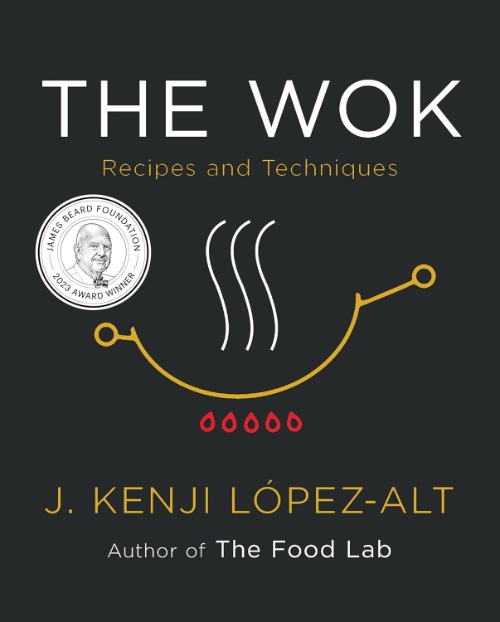
In his terrific 2023 cookbook The Wok, author, food columnist, and culinary consultant Kenji López-Alt allows that “most” of his recipes will work “reasonably well in a large skillet or saucier.” That said, he concludes, “get a wok. They are inexpensive, mostly indestructible, and will make a noticeable difference in the quality of your food.”
Wok Materials: Consider Conductivity
Woks, which have been around since the Ming dynasty (mid-14th to mid-17th c.) can be found in a variety of metals: clad stainless, aluminum, cast iron, non-stick, and carbon steel. The cheap wok I bought on Canal Street three decades ago is made of carbon steel, the material Kenji recommends.
Kenji points out that the other choices all have downsides. Aluminum heats evenly – the opposite of what’s needed for stir fries. Non-stick doesn’t caramelize (and the coating can degrade). At high temperatures, different metals that go into clad stainless contract at different rates, making them prone to splitting apart. And cast iron: what for?
Lightweight and durable, carbon steel heats quickly and is highly responsive to adjustments in heat source, as in the cook fiddling with size of flame and, once seasoned, a carbon steel wok is naturally non-stick and great at caramelizing foods.
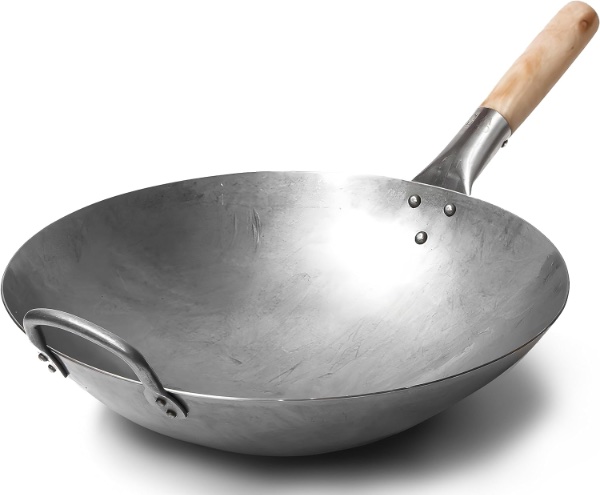
Craft Wok Traditional Hand Hammered Carbon Steel
Construction
With carbon steel woks you can choose between machine-spun and hand -hammered. According to Kenji, both are fine. Some chefs favor hand-hammered woks for surface irregularities better at “holding” food pushed up the sloping sides. But once seasoned, any carbon steel wok will do this. In buying a wok, it’s more important to select a size and weight that feels right for you.
Gauge and weight
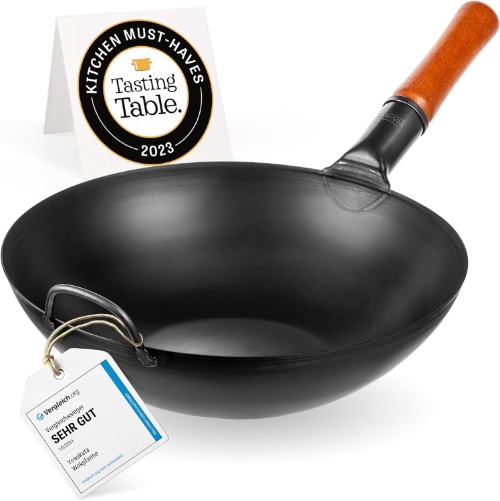
Kenji’s preferred 14″ wok is made of 14-gauge carbon steel wok that’s about 2 mm thick. My wok is 16-gauge (oddly, the higher the gauge the thinner the metal) and only about 1.6 mm thick. With its long handle (more about that in a minute) and heavier gauge, Kenji’s wok weighs 3.5 pounds. I like that I can swing my just-over-2-pound wok effortlessly from a hook on the wall to a burner on my range.
Since a heavier-gauge metal is better at retaining heat, Kenji’s preference is understandable. In addition to stir fries, he uses his wok for braising, deep frying and smoking, which I don’t do. In heating quickly, though, there’s probably very little difference between 16 and 14-gauge.
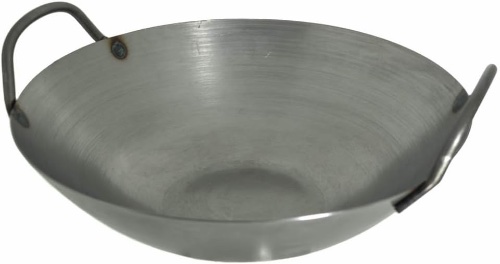
Bottom: Round or flat
Another choice in buying a wok is round or flat bottom. It’s possible that a round bottom gets a bit hotter than one that’s flat – but burner or cooking surface is also a factor in that. If your gas range has a wok well, a round is the logical choice. With an induction range, only a flat-bottom wok will make contact with heating elements. Cooking with gas? Round or flat: it’s up to you.
For gas ranges, Kenji still recommends a flat-bottom wok, which will sit squarely on a grate without wobbling. The flat area, he writes, should be only 4-5 inches in diameter.
While wok rings can be used to stabilize round-bottom woks, Kenji believes they raise the pan “too high above the heat source.” Here I disagree. This is surely true of plated metal wok rings that look like cheap Mardi Gras crowns. The low-profile cast iron ring I use stabilizes my wok without raising it at all.
Handles: Long or short
My Cantonese wok has two short metal loop handles attached with rivets. Mandarin woks have one long handle of wood or metal, and sometimes a shorter metal handle on the other side. For reasons of comfort and safety (woks get hot) Kenji recommends a long-handled wok.
I get it. I need a potholder in my left (non-stirring) hand, and over the years have found the need to quickly toss one that’s smoldering into the sink. With my relatively new cast iron ring, I do a lot less grasping. And when I do, smaller potholders do the trick. But if I were ever to replace my beloved wok, I’d go for one with a long handle. And after writing this piece, I may.
Finish: Pre-seasoned or unseasoned
When buying a wok, you get to choose between pre-seasoned and unseasoned metal. Unseasoned woks tend to be less expensive, because the seasoning process is DIY. Pre-seasoned woks are typically treated with vegetable or nut oils, such as shea, peanut or coconut.
I’m sure I bought my wok unseasoned, but have no recall of breaking it in. Kenji , who bought his more recently, assures that seasoning a wok is easy (if you don’t find the prospect intimidating). That is, all you have to do is heat it (to smoking point), oil it, heat it again, and start to use it—all easy to do on a gas range. For city dwellers with induction cooktops, a pre-seasoned wok may be a better option than Kenji’s alterative of a blowtorch which—even if you have outdoor space—your building management and neighbors might not appreciate.
Either way, every new wok needs to be well scrubbed before using or seasoning it to remove any coating applied by the manufacturer to prevent rust. Scrub it, rinse it, and dry it, then proceed.
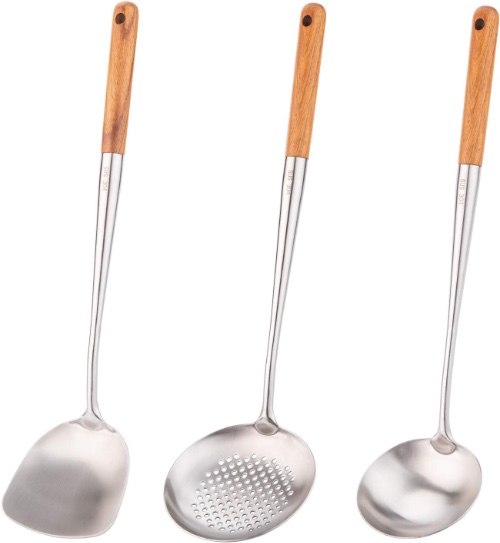
Wok Spatula and Ladle,Skimmer Ladle Tool Set
Long-handled utensils
Once you commit to a wok and high heat, your everyday utensils don’t cut it. With their relatively short handles, your stirring/tossing hand will get too hot. And the right-angled blades of Western spatulas are not ideal for scraping the curved bottom and sides of a wok. Chinese wok tools are generally inexpensive and sold as sets that include broad spoons, strainers, and food shovels. If you use your wok for deep frying, a stainless-steel skimmer (spider) is also a good tool to have.
Price point: High or low
Carbon steel woks can range from around $30 to $600 and up. I can’t speak from experience about high-end woks. But last Christmas, my sweet husband gave me a $150 wok from a “professional quality” online purveyor. I found it heavy and returned it. While I generally associate heavier cookware with quality and better results, woks, as I see it, are an exception.
Deconstructing the Stir Fry, Part 2—about ingredients, prep, order of events, and techniques that will maximize likelihood of achieving wok-hei.
Our editors have independently identified these products as something our readers may like. As an Amazon Associate Woman Around Town earns from qualifying purchases. Thank you for supporting Woman Around Town.