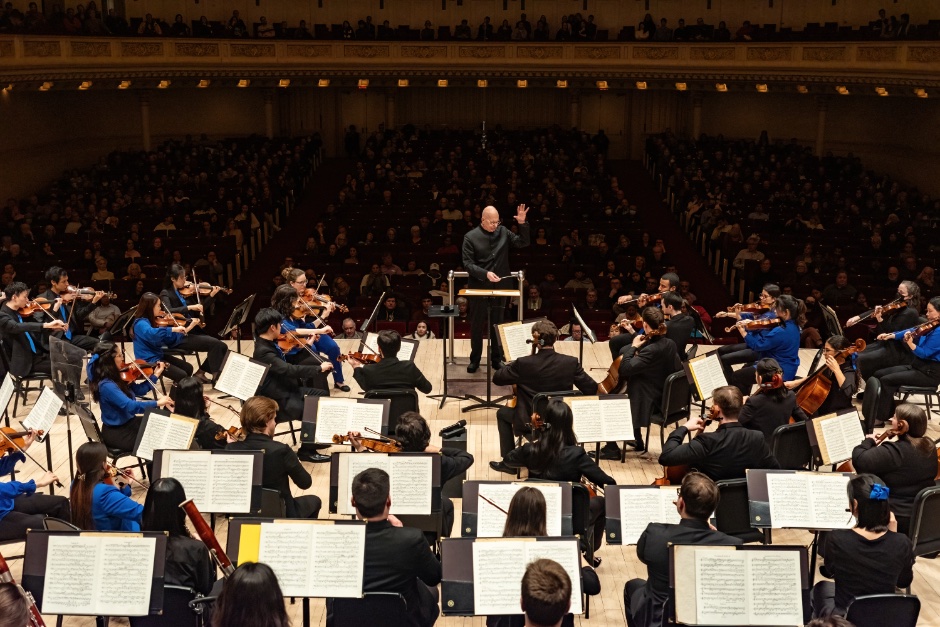
Translation is a multifaceted art capable not only of illuminating aspects of a work that might otherwise remain obscured, but also of generating unique creative possibilities. On February 11 at Carnegie Hall, The Orchestra Now’s program “Transcription as Translation” demonstrated how works composed for particular instruments can, when transcribed for an entire orchestra, open up portals of emotional and intellectual explorations that create thrilling musical dimensions beyond the original piece. These transcribed/translated works are artistic entities of their own that bear little to no comparison to the source, but can wholeheartedly be embraced as individual universes of musical expression. With Maestro Leon Botstein at the helm, the young forces of the orchestra brought forth new colors, depths, textures, melodious evocations, and resonances to three pieces by three master composers: Chopin, Smetana, and Beethoven.
The concert began with Mily Balakirev’s 1910 Suite on Pieces by Chopin. The Préambule wove a nostalgic atmosphere with the woodwinds resounding painterly and gently stirring, followed by the grandiosely dancing Mazurka. In the Intermezzo (Nocturne), a distinctively Russian mood set in through the warm, soulful strings and longing currents of phrases that, by an easy stretch of the imagination, could have been composed by a Slavic Puccini. The Finale (Scherzo) started somber and ominous, unexpectedly dark, and rolled towards its end with urgency and vigor.
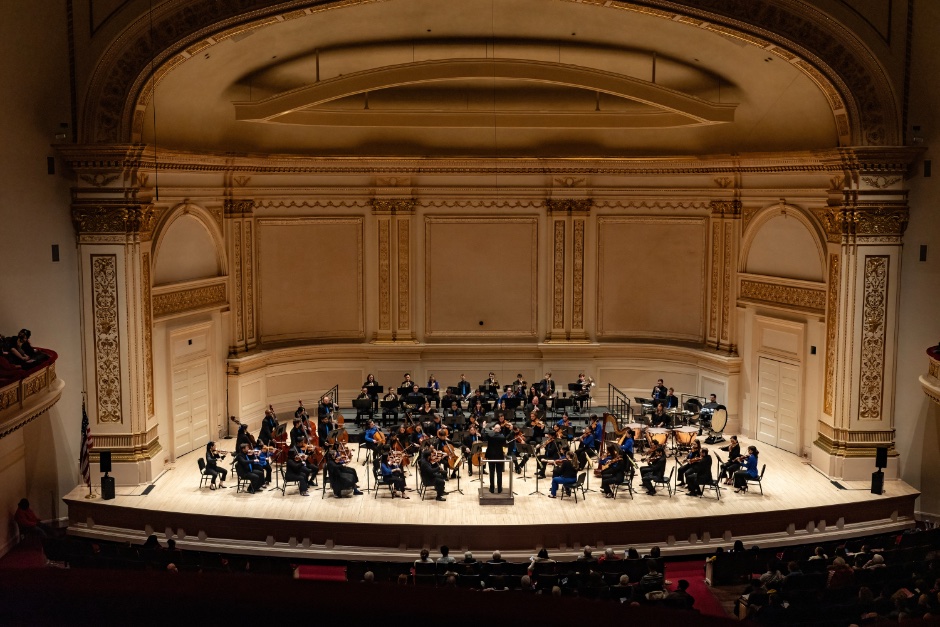
Leon Botstein conducts The Orchestra Now at Carnegie Hall (Photo by Matt Dine)
Smetana’s String Quartet No. 1 in E Minor, entitled From My Life, constitutes the composer’s moving personal journal inscribed in musical notes that depict his youth, his passion for dancing, his first love, the trauma of his deafness, his nostalgia for the past, and his final resignation to fate. In 1940, believing that this work deserved “wider musical horizons in orchestral form than are possible… for the string quartet”, George Szell transcribed Smetana’s autobiographical tone poem into a poignant orchestral work that infuses Smetana’s musical narration with novel, rich expressive elements. The first movement, Allegro vivo appassionato, opened innovatively and declaratively between horn and string sounds arising together and then leading to an overall swelling lyricism. In the second movement, Allegro moderato alla Polka, dance elements came to the forefront, brisk and flirty, depicted with bouncy youthfulness by the orchestra. In the third movement, Largo sostenuto, the touching cello solo, along with winds and strings, painted a yearning-filled, sweepingly romantic musical landscape with the syncopation acting as an obsessive dwelling on memories of first love. Finally, in the Vivace, Bohemian folk themes animated the movement, giving way to a fanfare-like sonorous profusion that brought back the epic opening and turned into rumbling and tremolos, in a sense of both confirmed premonition and resignation.
Before conducting Beethoven’s Hammerklavier, orchestrated by Felix Weingartner in 1926, Maestro Botstein asked a rhetorical question: Why orchestrate this devilishly difficult piano Sonata? He continued: “It’s one thing to orchestrate Bach because… who goes to church anymore to hear Bach…?” to which the audience laughed. But the Hammerklavier almost always draws audiences to marvel at—or criticize—the capabilities of the pianist who dares to tackle it. Maestro Botstein added: “Of Beethoven’s 32 Sonatas, the Hammerklavier is the Mount Everest of works… philosophers have analyzed this experimental sounding work that pushes sonorities and the capabilities of the pianoforte to its limits.” Still, while there is no definitive answer to the reason for translating this singular work, one intent is perhaps to demonstrate how, as the Maestro said, “music can be separated from the instrument that provides it while remaining tied to the medium.” And, to the audience’s merriment, he concluded with: “The other great thing about the next forty minutes is that they will never happen again!”
Joking aside, listening live to Weingartner’s transcription of this monumental Sonata is a rare experience, and at the end, it was hard not to wonder why it isn’t performed more often. In orchestral hands, this entire piece acquired a symphonic identity that could have certainly carved its place into the realm of Beethoven Symphonies. It stands on its own and confirms Weingartner’s belief in this Sonata’s symphonic nature. Not only that, but individual phrases seem to have more sonoral places to go to and colors to acquire. In the piano rendition, phrase suspensions, particularly in the third movement, can stall and break the arc of the entire work, while in the orchestral treatment, subtle instrumental interventions and resonances can keep the movement flowing.
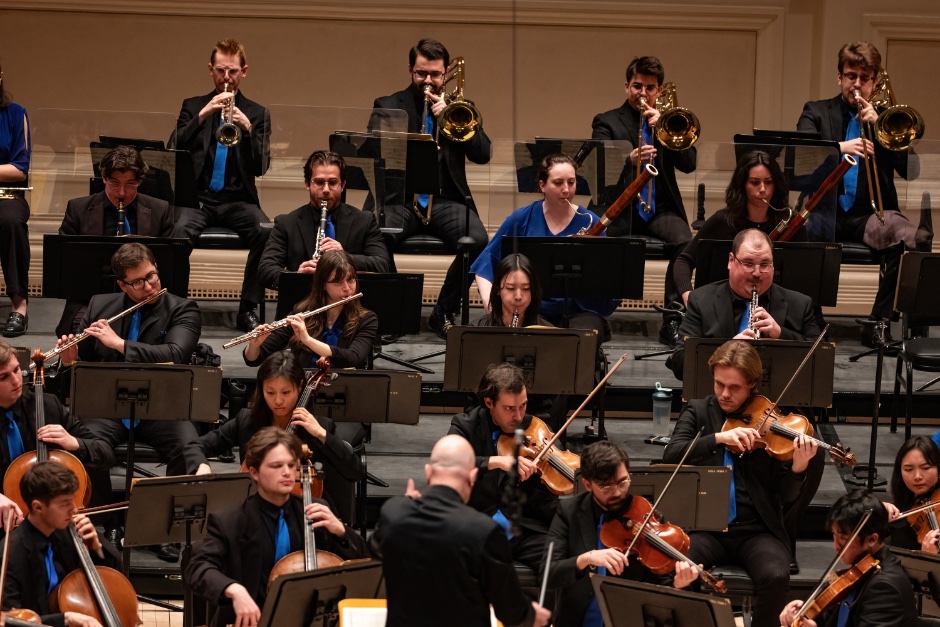
Leon Botstein conducts The Orchestra Now at Carnegie Hall (Photo by Matt Dine)
The first movement, Allegro, opened majestic and textured, with noticeably defined motifs, while the ensuing Scherzo gave a wider, slower paced meaning to the term Vivace, yet kept it animated and dance-like. The Adagio proved the most evocative of the movements, and it was here that the orchestra brought in its multicolored resonances and fluidity to support the floaty suspensions and still move the musical story forward. In the final movement, Largo, symphonic colors abounded with the strings underlining emotional depths, and building up into an almost Wagnerian dimension.
Throughout the concert, the orchestra displayed the extraordinary skills of its young instrumentalists, the future generation of professional musicians who, under Maestro Botstein’s baton, conveyed a harmonious sense of unity, refined sensitivity, and exhilarating robustness. It made for an evening infused with the promise that the future of classical music orchestral performance is in capable, magnificent hands. And overall, this program presented a profound gift of discovery, not just in terms of musical aesthetics and delights, but also philosophically. For this writer and translator, it brought to mind the never-ending debate about whether translators are creative artists in their own rights or not, and whether translated works can and should be appreciated as self-standing entities. In this program, and in the music medium in general, the answer is clearer than in literature. Each one of these three transcriptions/translations has a distinctive spirit of its own. While all three owe their creation to the existence of the original, their many merits prove to be independent of that source and don’t truly lend themselves to comparison, certainly not as a translated written sentence or paragraph or chapter would. Thanks to Maestro Leon Botstein, a musical program conceived by him is always more than a captivating musical evening in a concert hall; the experience also inevitably becomes an irresistible invitation to deep inquiry and reflection.
Top: Leon Botstein conducts The Orchestra Now at Carnegie Hall (Photo by Matt Dine)