This December marks the 100th anniversary of the premiere of Alban Berg’s Wozzeck at the Berlin State Opera – Staatsoper Unter den Linden. The Staatsoper launched its celebration of the centennial with a run of performances that opened on December 14th, the very date the opera premiered in 1925. I am far from being a die-hard of Alban Berg’s music and it took me a long time to approach Wozzeck, and only by, initially, burying myself in its ample theatricality and text. Based on Karl Georg Büchner’s play Woyzeck, the story revolves around its eponymous protagonist’s entrapment by the oppressive forces of absurd conventionality around him that clash with his originality and label it madness, and eventually lead to him murdering his common-law wife, Marie.
Wozzeck is an extremely challenging role for any actor but when you add singing to it as well as Berg’s expressionist innovative musical language, the psychological realism of it all reaches heights of almost unendurable intensity. It would probably be easier to slip into exaggeration and turn this character into a caricature of both submissiveness and rage. But that was not the case here.
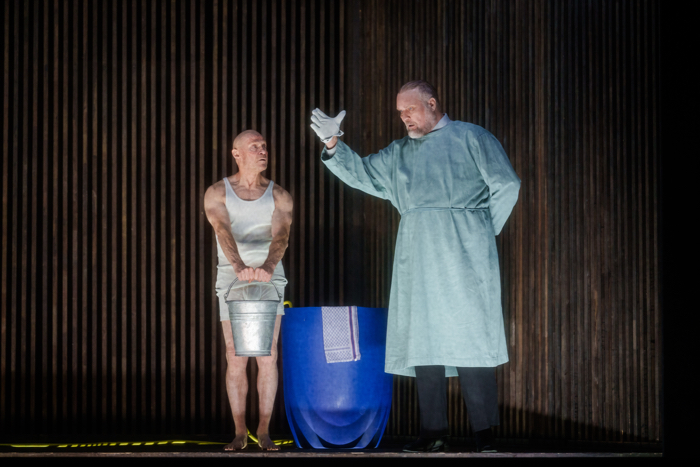
Simon Keenlyside as Wozzeck and Stephen Milling as the doctor in Wozzeck at the Berlin State Opera – Photo: Stephan Rabold
Simon Keenlyside created a truly memorable, complex, and haunting Wozzeck, in all aspects, from vocal colors to body language and gestures. His physical demeanor sometimes agitated, sometimes still and gathered together as though he were forcibly contained in an imaginary straitjacket, aptly reflected the societal imprisonment, abuse, and persecution befalling him.
His main abusers – the Captain portrayed by Wolfgang Ablinger-Speerhacke with snaky sounds drifting into unnerving falsetto and maniacal laughter, the doctor, sung with substance and imposing tones by Stephen Milling, and the Drum Major, a harsh, grainy-sounding Andreas Schager – created a strong, effectively jarring contrast to the beauty of tone within the vast emotional color palette in Keenlyside’s voice. In between hair-raising outbursts of despair and rage, lyrical musings and frightening observations of life, and the clear pronouncement of philosophical conclusions in low dark tones, and even in the most jagged phrases, Keenlyside’s core elegance of sound shone through. This made Wozzeck’s plight as a singular and misunderstood soul capable of detecting the unseen layers of life even more tragic. His excellent diction rendered the text understandable and his ability to color the meanings of words in the subtlest nuances added new and fascinating depths to this role.
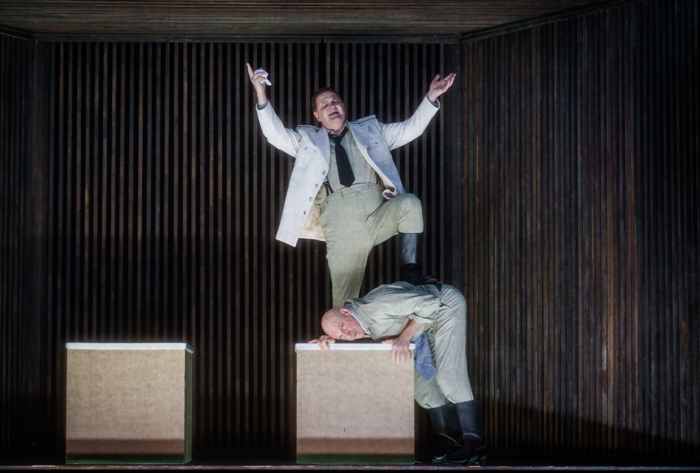
Wolfgang Ablinger-Sperrhacke as the captain and Simon Keenlyside as Wozzeck in Wozzeck at the Berlin State Opera – Photo: Stephan Rabold
Anja Kampe created a multifaceted Marie, from vulgar and lusty, conveyed by rich, sometimes brutal chest tones and electric edginess in the higher register to dreamy, almost mystical, captured in luminous vocal colors in her religious musings and offering a touching emotional lyricism in her short-lived remorse.
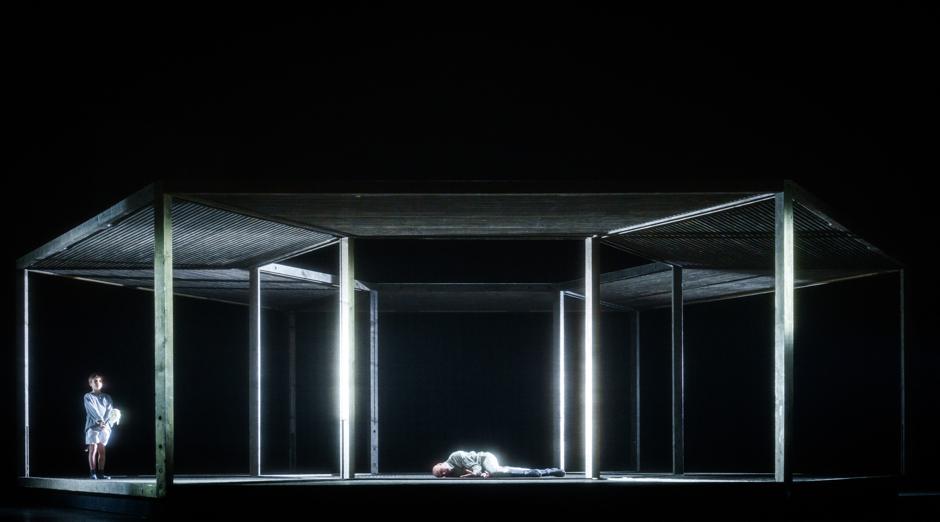
Andrea Breth’s production is set in a dystopian box, or rather a wooden structure that expands or contracts depending on the scene. The immediate impression was that of being in a cage, symbolic of everyone’s metaphorical imprisonment; even the oppressors were trapped by their own obsessions and foibles. Marie’s murder happens on a bare stage. Only at the end, after Wozzeck has killed Marie, did the entire structure appear open, bereft of its numerous bars, with Wozzeck lying on the ground at its center. I thought this clever as it indicated liberation from the daily cage at least for one character. That liberation belonged to Marie in death.
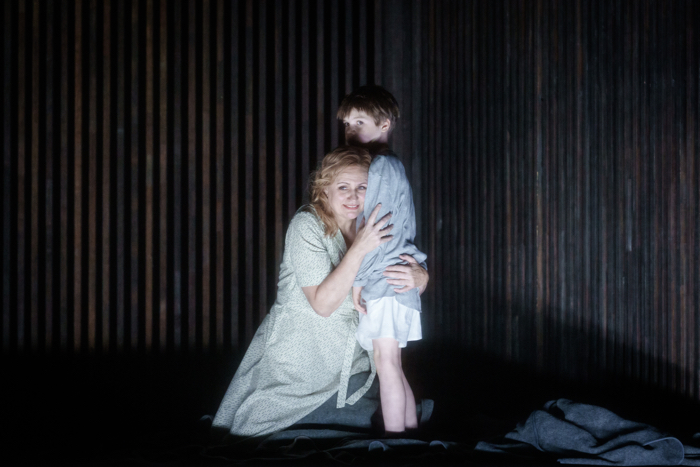
Anja Kampe as Marie and Jacob Tougas Gigling as the boy in Wozzeck at the Berlin State Opera – Photo: Stephan Rabold
Berth’s minimalist approach effectively captured the desolate, stark, cynical world of these personages. But why, oh why, was it necessary, in the tavern scene, to show a man having sex with a woman from behind while she was throwing up in a bucket? I would venture to bet that the audience totally understands that the misery and poverty of these oppressed, hopeless characters can lead to aberrant behaviors without having to witness such a disgusting moment.
Maestro Christian Thielemann conducted the outstanding orchestra with aplomb, more often than not he seemed to relish eliciting sheer volume and thick texture from them. Still, there were some appealing moments of restraint and floating instrumental coloring, like rare musical islands of softness in an overwhelmingly powerful universe.
Overall, this performance was a poignant, unsettling, stirring dramatic experience, and certainly a worthy centennial commemoration of Berg’s masterpiece.
Top: Simon Keenlyside as Wozzeck and Jacob Tougas Gigling as the boy in Wozzeck at the Berlin State Opera – Photo: Stephan Rabold
There is one more performance of Wozzeck on January 4, 2026. Click for info and tickets.